Sarah Mills: Ending door-to-door is the future for Canada Post
Rural Sask. has picked up mail from shared mailboxes for decades. Now, it will be the same in some parts of in Regina an...
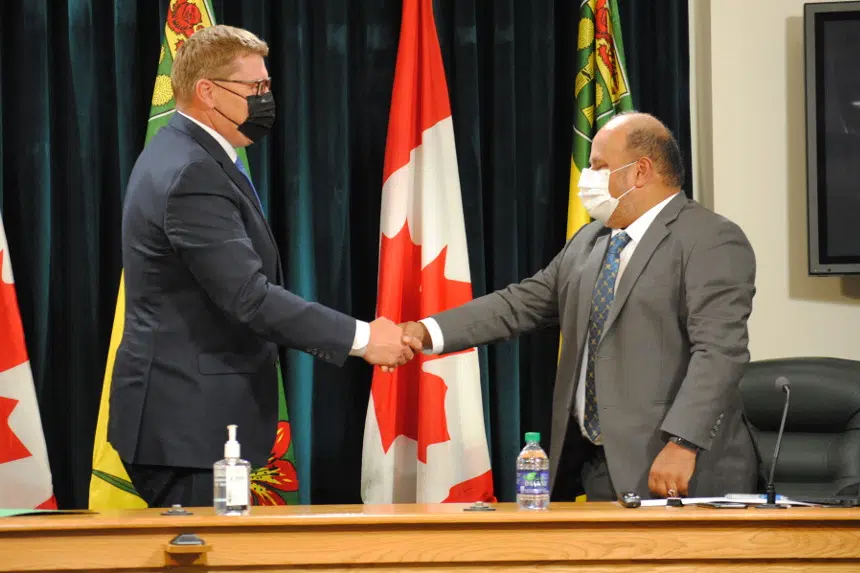
Early on in the COVID-19 pandemic, Premier Scott Moe said he looked forward to the day he could shake Chief Medical Health Officer Dr. Saqib Shahab’s hand, and on Wednesday he did just that – with the doctor reminding him to sanitize right after.
Just days ahead of all the public health orders and the state of emergency being lifted in Saskatchewan on Sunday, Moe addressed the province in the COVID-19 update as if at the end of a long journey.
“Out of wartime I don’t think a government has ever asked so much of its citizens. This was very difficult for all of us, but it was very necessary and it does get us to where we are today,” said Moe.
He pointed out that it will have been 485 days of public health orders and restrictions.
“There is no ‘mission accomplished’ banner that is hanging behind me,” said Moe. “And that’s because, although the restrictions are coming to an end, COVID is not … This fight against COVID does need to continue but it will shift into a new and somewhat different phase.”
Moe explained the province will move to using vaccines to deal with COVID instead of government restrictions. He used the opportunity to, once again, encourage everyone to get a vaccination if they haven’t already done so, calling COVID-19 an unvaccinated person’s disease.
Shahab presented the breakthrough case numbers for June, saying that 80 per cent of new cases were in people who weren’t vaccinated or hadn’t got through the three weeks since vaccination.
Seventeen per cent of new cases were in people who’d had their first dose, and 1.8 per cent were in people who’d had their second.
For the small number of people who’d been hospitalized with COVID in June, 64 per cent weren’t vaccinated while most of the other 36 per cent were either older or had comorbidities. And 81 per cent of those admitted to the ICU were unvaccinated and none had a second dose, while 40 per cent of deaths were unvaccinated people and none had their second dose.
Moe and Shahab held these numbers up as proof that vaccinations work and that they are the best bet for controlling the virus.
When first releasing the reopening roadmap in the spring, the premier pointed specifically to the United Kingdom and Israel to show that other places were moving at the same pace and in the same direction.
But both the U.K and Israel are now seeing a surge in cases from variants and Israel has started to implement rules like masking again.
Looking at those countries, and where Saskatchewan will be a few days, Shahab said at some point you have to move on from this.
“This is as safe as it’s going to get for the foreseeable future. That is why we now have to live with COVID; it’s not really practical to remain in lockdown forever,” said Shahab.
Shahab explained the province will watch closely what happens with cases and he admitted that cases could be lower right now, but he also pointed out that case positivity is under fiver per cent and cases per 100,000 people is under five, which he has always said is a safe zone.
There will be COVID cases after Sunday, said Shahab, and there will be outbreaks and pockets of virus. But he said they’ll mostly be in unvaccinated people.
Shahab also made another pass to encourage people to get vaccinated. He said he’s confident the health system will be able to deal with the hospitalizations, but that doesn’t mean that unvaccinated people should continue to avoid getting the shots. He said COVID will continue to find people who aren’t vaccinated.
If there were a surge in cases, it’s unclear at what point the provincial government would consider implementing new health orders. Shahab said he wouldn’t rule it out, but he also doesn’t think broad orders, similar to what were implemented last year, would work now.
“The 70 per cent who are vaccinated, the 70 per cent who are generally compliant, will not be the ones who are transmitting. So the approach if we were to see a resurgence may have to be more specific for people who are unvaccinated at that time — and we do that all the time with pertussis, measles, mumps outbreaks,” said Shahab.
He explained health officials will have to watch, monitor and advise accordingly — see what the transmission chains are and whether it’s something like a geographical community to worry about or networks.
The province also released guidelines on Wednesday for Step Three.