
Sarah Mills: Whatever form our pets come in, they are an extension of our family
Fifty guinea pigs ending up at the Calgary Humane Society in an overbreeding case has Sarah Mills feeling grateful for t...
OTTAWA — Prominent Russian democracy activists are urging Ottawa to resettle dozens of their peers who tried to claim asylum in the U.S. and now face deportation and imprisonment in Russia.
The activists told The Canadian Press 30 Russian nationals being held by U.S. Immigration and Customs Enforcement would face extremely grave consequences if they’re sent back. They said as many as one thousand pro-democracy Russians in the U.S. are facing the prospect of deportation.
“We wanted to build alliances here in Canada, because solidarity is our biggest weapon against dictators,” said Natalia Arno, founder of the Free Russia Foundation. “Canada, with its voice, is a very, very relevant country for us.”
Arno visited Ottawa, Toronto and Montreal this past week to meet with Canadian officials alongside Ilya Yashin, an opposition politician.
Arno and Yashin said they’ve advised federal officials on how Canada’s embassy in Moscow could be used to support the democracy movement. They said the most effective way to support democracy in Russia is to stand up for Ukraine.
Arno, who lives in Washington, was forced to leave Russia in 2012. Waves of Russian citizens have fled the country as Moscow has cracked down on civil society, particularly since Russia’s 2014 invasion of Crimea, the 2015 assassination of Boris Nemtsov — a prominent critic of Russian President Vladimir Putin — and the 2022 full-scale invasion of Ukraine.
Dozens of Russians who have made asylum claims through the legal process in the U.S. have been either detained or are trying to live with no clear status, said Yashin, a former opposition party leader and Moscow city councillor.
“We are trying to find a way to defend them, and how to save their lives,” he said.
Arno and Yashin noted that the U.S. sent at least two planeloads of deportees to Russia this year; Arno estimates those flights carried about 100 people.
They cited the case of Leonid Melekhin, an opposition supporter who was denied asylum in the U.S. and was arrested upon his return to Russia this year. There are contradicting reports about whether Melekhin was deported or returned voluntarily.
Melekhin now faces terrorism charges related to a poster that alluded to hanging Putin.
They also cited the case of Artyom Vovchenko, who was conscripted into the army and escaped Russia for the U.S., only to be deported by Washington in August. Yashin said Vovchenko has dropped out of sight and may have been deployed to fight in Ukraine.
Yashin argued the administration of U.S. President Donald Trump is bent on getting as many foreigners out of the United States as possible, and doesn’t much care where they end up.
He said Canada could ask the U.S. to send its Russian nationals here.
Immigration, Refugees and Citizenship Canada did not answer directly when asked whether the government would be open to creating a program to resettle Russian dissidents from the U.S.
“Canada maintains a rigorous process to assess asylum claims that balances our humanitarian objectives, legal obligations, and safety and security measures,” wrote department spokesperson Rémi Larivière.
Global Affairs Canada confirmed its officials met with Arno and Yashin on Wednesday.
“Discussions included a broad overview of the domestic situation in Russia and their support for Ukraine in the face of Russia’s war of aggression,” wrote department spokesperson Clémence Grevey.
Arno said those in Russia’s pro-democracy movement were “the first victims of the Kremlin regime” and also “the first to warn the world about the criminal, dangerous, corrupt and murderous nature of Putin’s regime.
“We are the ones who would like to take responsibility and change our country for the better, and we do need allies.”
Arno said Canada should consider resettling more Ukrainians if the U.S. ends the temporary status that allows thousands of them to live there.
She said Russia’s invasion is being fought by ethnic minorities pulled from Russia’s remote regions.
“It is a genocide in Ukraine, but it’s simultaneously genocide inside Russia,” she said.
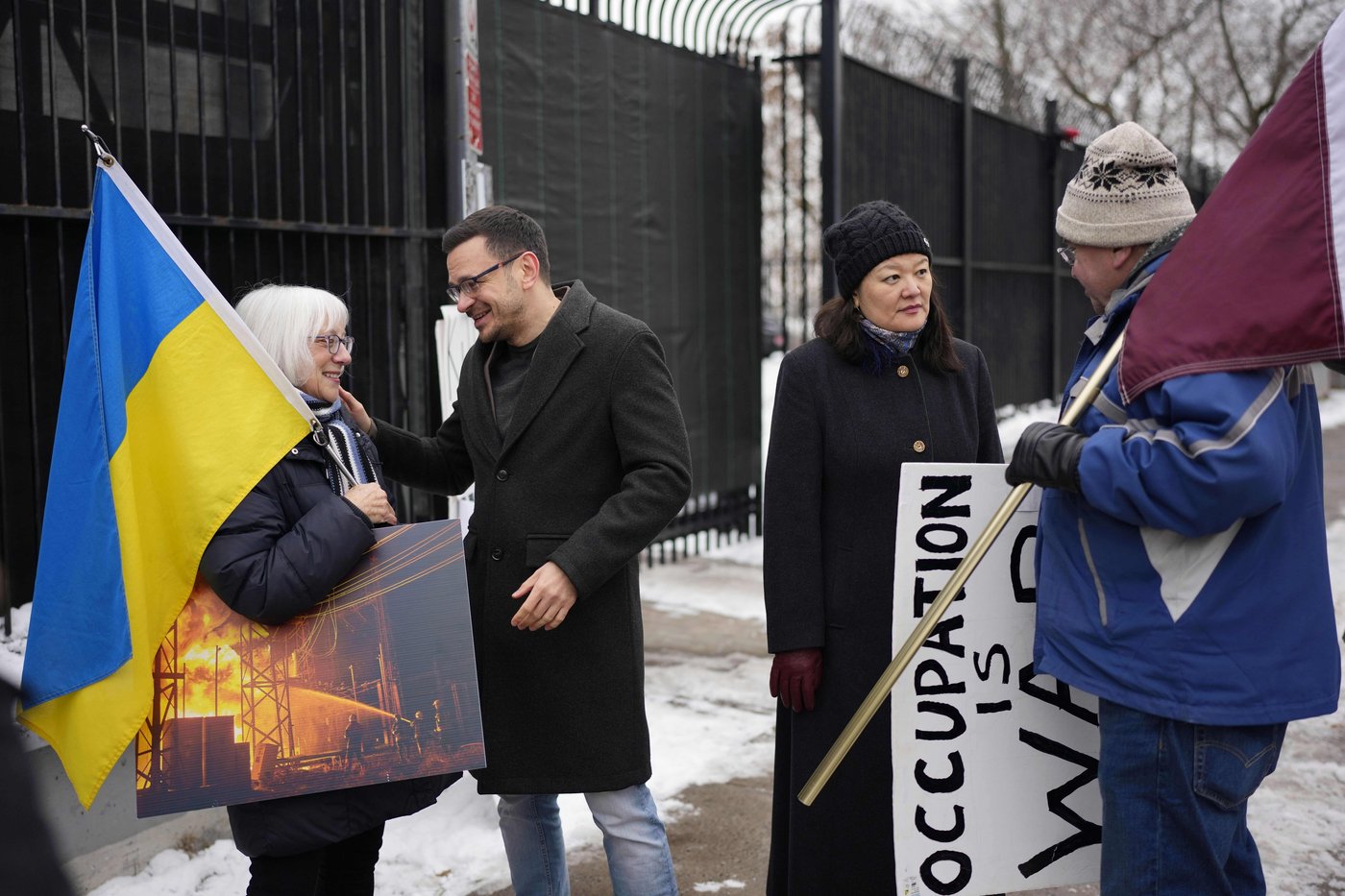
On Wednesday, Arno and Yashin took part in the recurring protest outside the Russian embassy in Ottawa staged by supporters of Ukraine.
Their visit came amid a public rift between Russian dissidents and Ukrainian activists. Many Ukrainians have questioned why Russian civilians haven’t staged mass protests and note that some pro-democracy Russians have played down the idea that Ukraine is a distinct nation.
Arno and Yashin said Ukraine’s struggle for peace and sovereignty is the key to the future of the entire continent, Russia included.
“Putin’s ambition is to change the world order, and he is going to ruin the European security system, he’s going to ruin all the world order,” Yashin said.
“If Putin wins in Ukraine, his regime will become stronger, there will be more repression against people like me, and Russia just loses its future.”
Yashin said nationalist bloggers reporting on Russia’s war on Ukraine often criticize their fellow Russians for trying to avoid conscription, adding “Russian people do not support this war.”
He and Arno said Western leaders — rattled by the risk of political chaos in a country with a massive nuclear arsenal — are far too timid about calling for an end to Putin’s regime.
In March 2023, when Mélanie Joly was foreign affairs minister, she caused a stir when she publicly mulled the prospect of “regime change in Russia” due to Moscow’s growing isolation. The Liberals haven’t repeated that message since.
“The Kremlin is in a very bad kind of position at the moment,” Arno said. “We need to continue putting pressure on all the vulnerabilities.”
Yashin also suggested Canada shift its language on sanctions to refer to them as targeting the Putin regime, instead of Russia as a country. He said Russian media outlets have spoken of “sanctions against Russia” to push a propaganda narrative claiming Western countries are motivated by hate against the Russian people themselves.
“It’s much more clever not to create this collective guilt situation, but try to find allies in Russian society,” he said.
Arno said Canada can highlight the work of Russian dissidents, including political prisoners, by speaking about their bravery in ways that resonate with Russians.
Yashin and Arno said Russian dissidents could help Canada tailor its sanctions and share information on how they’ve managed to evade increasing censorship online.
Arno said Russian dissidents look to Canada as an example of what their country could someday become — a pluralist, ethnically diverse country that defends democracy and human rights.
“We always say in discussions that Canada is the most relevant example,” she said.
This report by The Canadian Press was first published Dec. 6, 2025.
Dylan Robertson, The Canadian Press