
Sarah Mills: You never forget the memories of your first teacher
Teacher Appreciation Week has wrapped up in Saskatchewan, but Sarah Mills says the memories of the classroom, especially...
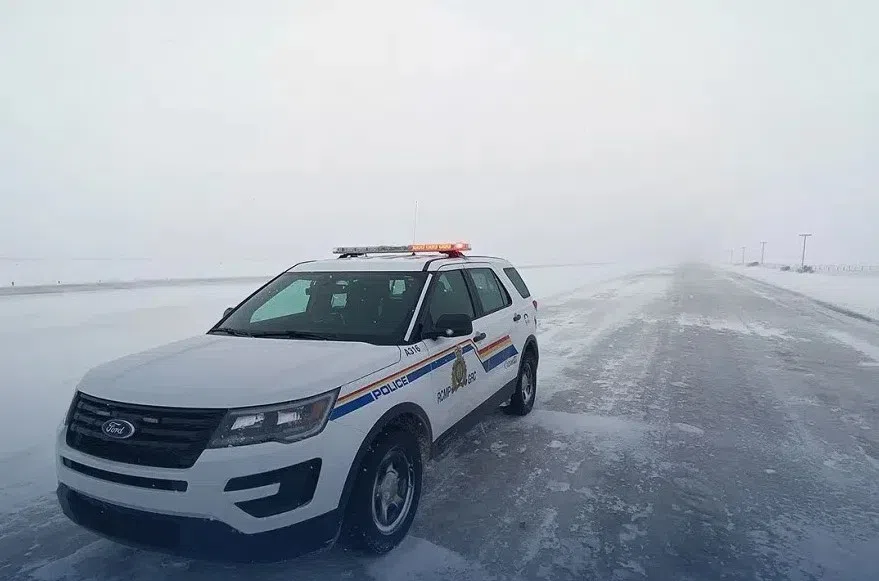
A winter storm is gearing up to hit the prairies, which is sure to test everyone’s driving abilities.
Ahead of the storm and welcome to the holiday season, Cst. Mike “Hawkeye” Seel, with the Regina Police Service (RPS) Traffic Team B and Sgt. Ray Robertson with the Saskatoon Police Service (SPS) joined The Evan Bray Show to discuss traffic safety and impaired driving.
This was part of the Round Table of Justice segment, which happens every Monday.
Read more:
Seel has been a police officer for 17 years, seven of those years directly working with traffic enforcement, with his main focus on distracted driving. He’s a level two crash reconstructionist and is trained in standard field sobriety testing.
Robertson has 14 years of experience with traffic law enforcement. He is also a Standardized Field Sobriety Testing (SFST) instructor and a drug recognition expert (DRE) instructor and has since taken over as the impaired coordinator for the SPS.
The following transcript has been edited for length and clarity.
Evan Bray: When would you do the standard field sobriety test, and when would you have drivers blow into a roadside screening device?
Ray Robertson: So when we do a traffic stop, or if we’re at a check stop, and we have suspicion to believe that they are impaired or have consumed alcohol, then we’ll do a roadside screen device in our roadside ASD (Approved Screening Device) to see if or how much alcohol they have in their system.
If they provide that sample and it comes to zero, and we still believe that they’re impaired by something, being a drug of some sort, then we can go into the standard field sobriety test. The standard field sobriety test and the ASD are suspicion-based tools to get reasonable, probable grounds in order to go further with our investigation.
What is the difference in the testing between the Drug Recognition Expert (DRE) testing and the Standard Field Sobriety Testing (SFST)?
Robertson: The standard field sobriety test has the Horizontal Gaze Nystagmus (moving eyes side to side), it has the walk and turn and the one-leg stand. That’s designed to determine if the individual is impaired, given that they performed poorly. That takes you to the next step.
Once you go to the next step, and you have reasonable, probable grounds to believe (they are impaired) with the DRE, then you’re going through the Drug Recognition Expert evaluation, which confirms impairments, both through psychophysicals and clinical indicators. It’s a totality of that investigation that will determine, yes, the person is impaired and what category of drug they’re impaired on.
That would then give us the grounds to continue with a charge for impaired.
When it comes to drugs, what are you doing in terms of that testing?
Robertson: Once we go through the evaluation, we determine that the individual is impaired and then we have a category drug, and then we demand the urine test, because it’s easy to collect the urine at detention to send that off for analysis. It’s a little bit more invasive to request blood and get blood drawn.
Many people are under the impression that you randomly pull people over and test them for drugs, but that’s not the case, right?
Mike Seel: At RPS, when we do our traffic stops, we do mandatory alcohol screening. But with the mouth swab, you have to have a suspicion of recent use of drugs. You can’t just mandatorily mouth-swab someone.
In the case of pulling someone over, and you see no signs of impairment, but the driver tells you that perhaps they smoked marijuana or took medication the night before. Do you automatically test for drugs? Or do you still need to see signs of impairment?
Seel: I still like to see some signs of impairment, whether it’s bloodshot eyes or slurred speech. Depending on what I pulled them over for, like blowing a red light or swerving their lane, that could also be evidence of that.
With traffic safety officers on the show, the text lines go ablaze! One listener asks: Are black and white lane designation signs mandatory? Can someone get a ticket for not following them?
Seel: Yes, you can. Those lanes are to help flow traffic and also to avoid accidents. I believe that ticket would be for disobeying a traffic control device.
Are front-tinted windows still illegal?
Robertson: Front and side tinted windows are still illegal for safety reasons, and it’s mandated by the Vehicle Safety Regulations Act. A lot of times, we do what we can in order to enforce it and have people remove it, but it’s very popular.
Is this an automatic ticket? Or can they be given a warning or an inspection ticket to remove the tint?
Seel: At RPS, we track the warnings that we give; it used to just be verbal warnings. Now we actually give people a printout warning. They can just throw the piece of paper away, but we keep track of whether they’ve been warned about it before. But a lot of times, they’ll get a warning and then inspection tickets to come down to the front desk and show that they’ve removed that tint.
Are mandatory roadside tests required with each vehicle stopped by police?
Robertson: We’re not mandated to do a mass sample every single traffic stop, but we do have our suspicion and can use the suspicion demand.
Is there a time limit to issue a driving violation ticket?
Seel: Yes, there is a timeframe. It’s six months from the date of the occurrence when you can get issued a ticket.
Another question goes, there are thousands of videos from the U.S. where people say they don’t have to give their license and registration unless a crime has been committed. Is this the case in Canada?
Seel: They do (have to give their license and registration). Here, we have to have a legal reason to pull you over. Once we do, you’re required to provide your license registration and provide your name.
What if someone doesn’t have their license with them?
Seel: We can get their name and their date of birth. We have access to SGI, just limited, but we can pull up their name and confirm their photo that’s on their driver’s license, confirm that that’s them. And that can sometimes result in getting a ticket or not providing your license. A lot of times, it will result in just a warning saying make sure you have it.
Is a photo of your license and registration on your phone good enough? Or does it have to be a physical copy?
Seel: The photograph isn’t enough. You have to have your physical license on you. It can be hard to tell whether it’s actually a real photo. You can doctor that photo. You can change the expiry date if you’re really good at Photoshop. So that’s why we need to have the actual license.
Can someone be given 48 hours to produce their license, or can you still be given a ticket?
Seel: There are actually two separate charges under there. There’s one for not providing it at the time, and one for not providing it within 48 hours.
What used to happen a lot, when I started 17 years ago, people would be given a warning and come down to the front desk to provide their license at the front desk. The issue with that is with all the inspection tickets, they’re very busy.
So right now, it usually would either result in just a ticket there for not providing at the scene, or just a warning saying, make sure you have it in the future.
Is there a law against using your high beams? How is it enforced?
Robertson: There is a law that if you’re operating within the city and you have traffic that’s coming towards you, you have to make sure you don’t have your high beams on. So you have a responsibility to turn your high beams off.
It is enforced just whether or not the officer observes it and is able to get around to pull the vehicle over. But it can be tough, because older vehicles and newer vehicles have different intensities of lights.
Why are drivers not charged for distracted driving with a dog in their lap?
Robertson: We have to have some kind of driving evidence, being that they’re not able to keep in the lane, or they’re almost causing a collision and whatnot. So, in regard to distracted driving on that aspect, we have to consider other things in order to lay that charge.
You could be charged with driver permitting an overcrowded driving compartment. That’s another section of the Traffic Safety Act.
It’s not illegal, though, technically, there’s no charge for having your pet not fastened in a vehicle for example?
Robertson: There’s no actual section that says you shall not have an animal on your lap when operating a motor vehicle. Other sections could be written if the officer so chooses to.
If you’re sitting at a red light, can you be on your phone?
Seel: You cannot be on your phone just because you’re stopped at a red light. A lot of people do it, but it’s not okay. I always say to people, you still have to wear your seat belt at a red light. You still have to follow all the traffic rules. You have to be off your phone while in traffic in a driving lane.
Let’s say I use Talk to Text to make a phone call. Can I be holding my phone while doing that?
Seel: No, that wouldn’t be considered hands-free. You can buy a mounted holder, whether it’s on your windshield or in your vents, or you can even put some in your cup holder. Just have it mounted somewhere so you’re not holding it in your hand.
Another question from Saskatoon: Is it legal to make a U-turn at a lighted intersection? I see it on 8th Street all the time.
Robertson: You can’t do a U-turn on any light-controlled intersection in the province under the Traffic Safety Act. It is a problem on 8th Street; it does cause collisions.
Do you issue tickets to drivers who are driving so slowly that maybe they’re a hazard to people on the roadway?
Seel: Yeah, absolutely. So it doesn’t matter whether in the left lane or the right lane. I see it a lot on the Ring Road and on Albert Street, and there’s a charge for driving at a speed that impedes the flow of traffic. So this time of year, obviously, the road conditions do account for people driving a little bit slower, which isn’t a bad idea, because the speed limits are for ideal road conditions. But some people drive in the summertime 30 to 50 km below the speed limit, and that is, I agree, as dangerous as people who are speeding.
I’ve actually pulled many people over and issued that ticket for them, saying, ‘If you’re not comfortable on the Ring Road, go through the city. There are a lot of different options for you.’
Can drivers be ticketed for not clearing off snow and ice from their windows?
Robertson: Yes, there is a ticket for that for failing to provide a clear view of both sides and the rear of the vehicle. It is your responsibility to clean off the snow and ice.
You both have been doing traffic enforcement and writing tickets for a very long time. I was a softy as a traffic cop. If someone gave me an excuse that sounded plausible, I was probably going to let them go with a warning. But I want to know, what’s the best story that you have of someone trying to get out of a ticket?
Seel: The common one that we always laugh at in the office, because we get it so often, is “I have to use the bathroom.” Well, when we pull people over, we usually can tell that they’re not being super truthful. And we always say, well, we’re stopped right in front of a Tim’s or McDonald’s, you can go in there, use the bathroom while we do up your ticket.
Another one we get quite often is, “I’m rushing to the hospital,” when they’re driving the exact opposite way from the hospital. But we always have to be aware, because we hear these excuses and kind of get desensitized. But, I had one gentleman once who’s like, “My friend in the back seat, he’s having a medical issue.” And I was like, “Okay, here we go.” And I looked in the back seat, they’re about four blocks away (from the hospital), and he was in the middle of an allergic reaction. I’m like, “Okay, we’ll get him to the hospital.” I told him to drive there safely; they didn’t need to end up in the hospital for another reason.
Sgt. Ray Robertson, what’s your best story?
Robertson: I pulled an individual over because he was driving in excess of the speed limit. I talked to him and he was pretty stressed out, and I looked over in his front seat. He had some pickles and ice cream. He had to get home as fast as possible because his wife was pregnant. She was having cravings, so she wanted pickles and ice cream, and he was trying to get home in order to get what she wanted.
He was pretty stressed out, bags under his eyes and I felt sorry for him. I advised him to slow down, and I didn’t give them a ticket.