

Murray Wood: Conservative floor crossers could hand Mark Carney a majority government
Murray Wood says Prime Minister Mark Carney is happily accepting floor crossers from the Conservatives, but maybe it's t...
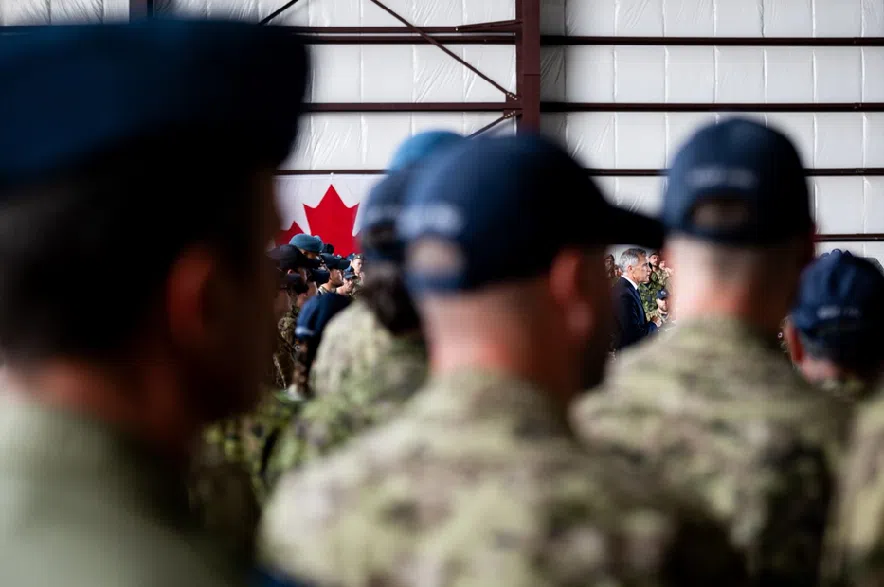
OTTAWA — Canada is injecting tens of billions of dollars into defence as it looks to ramp up spending to levels not seen since the Cold War — both to meet its NATO commitments and to juice the domestic economy.
But it remains to be seen whether National Defence — a department which the opposition Conservatives point out has tended to struggle to spend its full budget — can actually push money out the door quickly enough to convince Canada’s allies it’s getting serious about its military.
Read more:
Defence Minister David McGuinty tells The Canadian Press he’s “confident” the federal government will hit its marks and that Ottawa is “moving quickly” on the accounting.
“We have a very disciplined approach here to acquiring what we need … We’ve broken it down into bite-sized pieces and we’re making progress,” he said.
“The truth of the matter is for the first time in a long time, the Canadian Armed Forces and National Defence are being properly funded, and this is long overdue.” He pointed to a number of large expenditures already in play, such as $2 billion for the military pay increase this year, renewed aid for Ukraine worth $900 million and a string of new procurements and infrastructure upgrades.
Canada was something of a pariah within the NATO alliance just a little over a year ago, when it was being called out by American politicians for consistently failing to meet its spending commitments.
A Pentagon document leaked to The Washington Post revealed former prime minister Justin Trudeau told American officials Canada would “never” meet its NATO commitment of spending the equivalent of 2 per cent of GDP on national defence.
Documents prepared for Trudeau just ahead of the 2024 NATO summit, obtained by The Canadian Press through Access to Information, provided him with canned responses arguing that the path to 2 per cent is “a journey” and that it “cannot happen overnight.”
Just one year and one prime minister later, the message from Ottawa is now very different. Prime Minister Mark Carney announced in June his government would meet the target this year, then later that month committed Canada to reaching 5 per cent by 2035.
The risks involved in not meeting the target are clear. U.S. President Donald Trump has repeatedly warned NATO nations not to expect the U.S. to come to their aid if they don’t pay their share on defence, and recently gloated about forcing the alliance to hike its collective spending floor.
“NATO calls me daddy,” Trump said in a Dec. 9 interview with Politico.
Carney’s first federal budget laid out nearly $82 billion in defence spending over the coming years, with $9 billion booked for this year alone. Many details on where all the money is going remain obscure to outside observers.
NATO projections suggest Canada is on track to spend some $63 billion on defence this fiscal year.
David Perry, president of the Canadian Global Affairs Institute think tank, said Canadians won’t know for months if all of the earmarked money actually gets Canada to the 2 per cent mark.
“I wouldn’t bet my own money that every dollar of it gets spent, but I do think we will pass the bar that we need to politically within the alliance (showing that) at least we’ve tried,” he said, adding that the department lapsed significantly less funding than usual this year.
Anessa Kimball, director of the Center for International Security at Laval University, said the 2025 budget provides an “incomplete picture.”
Kimball said it’s missing key items such as the planned fleet of expensive new submarines and a full fiscal plan through to 2035 — and may even run about half a billion dollars short of the 2 per cent target.
But even though the share of spending by GDP can fluctuate depending on how the economy performs, Kimball said she thinks Canada will be “close enough” to the mark to avoid further diplomatic turbulence.
“I’ll be watching to see in the end in March if they actually do it,” Kimball said, “but it looks like they’ve aligned themselves.”
U.S. Ambassador to Canada Pete Hoekstra told The Canadian Press the U.S. takes Carney “at his word” when he says Canada will reach the 5 per cent target and the “indications” are that Ottawa is getting serious on increasing military funding. That should quell any bilateral tension with Washington over defence — at least for the time being.
The 5 per cent figure also includes a carve-out allowing “defence-adjacent” spending — such as infrastructure upgrades — to count toward the NATO commitment, making it easier to hit that bigger number.
Kerry Buck, Canada’s former ambassador to NATO, said that carve-out makes sense because the alliance still needs to spend money on infrastructure to support its militaries — by, for example, upgrading the many older bridges in Europe that still can’t bear the weight of tanks.
The 2025 budget claims the 1.5 per cent target will be easily met through anticipated provincial and municipal spending, meaning Ottawa only really needs to worry about the remaining 3.5 per cent.
“The 1.5 per cent spending can include spending on a regional level,” NATO spokesperson Noellke Paul confirmed.
Kimball said the opaque nature of NATO’s definitions permit “creative accounting” to help member states reach the difficult 5 per cent figure. Many questions remain about what qualifies, however — such as whether the planned Alto high-speed rail project could qualify as “defence-adjacent.”
But then there’s the problem of maintaining momentum with even steeper commitments barrelling down on the government.
“It’s going to be a big stretch for us just to get to 2 per cent, and we’ll see whether or not we get here in one year. Moving to to 3.5 per cent is a considerable lift beyond that,” Perry said.
“The higher the intended spending rate goes, the more defence’s relationship with the rest of the government of Canada … is going to influence this. If we are legitimately on a path to 3.5 per cent of GDP being spent on defence, that’s going to see a big reallocation of dollars spent on other activities of government.”
Kimball notes Carney will still have to convince both Parliament and voters the high spending is needed, since all of the funding for future years still needs to be approved.
This report by The Canadian Press was first published Dec. 16, 2025.
Kyle Duggan, The Canadian Press