
Wood file: Sometimes the better team doesn't win
Canada was snakebit in the gold medal hockey game, and sometimes, even when you dominate the other team, you come up sho...
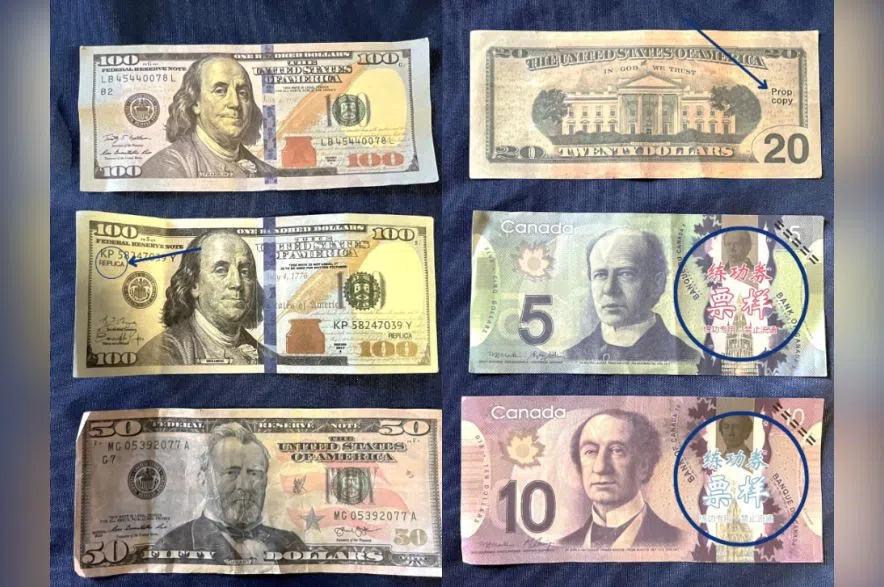
Moose Jaw Police Service is reminding businesses and residents to carefully inspect larger banknotes during the holiday season, particularly after counterfeit $100 bills surfaced in Saskatchewan and Alberta communities this month.
JD Haughton, strategic communications and public information manager with the Moose Jaw Police Service (MJPS), said while the city has seen only one incident recently, similar cases in other jurisdictions warrant continued vigilance.
Read more:
“There was that incident that happened a couple weeks ago where there were some counterfeit $100 bills that were discovered at a local business here in Moose Jaw,” he explained, adding that it isn’t something the MJPS sees often.
The fake bills discovered in early December were relatively easy to identify because they contained obvious markings.
“They were pretty noticeable that they were counterfeit just because they said ‘prop money’ on them,” Haughton said. “That’s a big one.”
The RCMP reported an incident in Yorkton involving fake $100 bills, and Edmonton police also dealt with fraudulent $100 bills, according to Haughton.
“It seems like right now it’s the $100 bills,” he said. “If people are creating fraudulent $100 bills, obviously the Bank of Canada has very detailed information on all the series of currency within Canada and how they’re built and how you can tell if they’re fraudulent or not.”
Genuine Canadian banknotes contain multiple security features that help identify counterfeits, Haughton explained.
For $100 bills specifically, Haughton identified several key features: “The metallic portrait on the right side of the bill that has the individual that’s on the bill. And there’s text within that portrait as well. There’s different types of kind of holograms within the bill. There’s raised ink, hidden numbers. There’s a frosted maple leaf kind of window as well. And that’s the same for the $50 bill.”
The paper quality itself provides another indicator.
“The real currency has a certain texture,” Haughton said. “And then some of them that you can tell that are really noticeably fraudulent, the paper feels a little bit thicker and the texture is not the same as it would be on an actual $100 bill or any type of currency — 10, 20, 50, 100.”
When businesses or individuals encounter suspected counterfeit currency, Haughton outlined a courteous but cautious approach.
“Businesses do have the authority to refuse the note and explain to the individual that it might be counterfeit,” he said. “You can ask for another bill. You can advise the individual to go to your local police service or agency and try to get them to inspect the bill to see if it is fraudulent or not.”
He emphasized maintaining respect for people who may unknowingly possess counterfeit bills.
“For business owners, be courteous, because the person could be an innocent victim and they might not realize that the note is fraudulent. So just be courteous, be patient with them, explain to them why it is suspicious or potentially fraudulent.
“If you do come to the police service and you get your note inspected and it is real, obviously they’re not going to take that money. You’ll be able to keep it.”
Reporting suspected counterfeit activity helps police track circulation patterns and supports prosecution efforts.
The Bank of Canada website provides detailed information about current and previous banknote series and counterfeit prevention.
Anyone with information about counterfeit currency can contact Saskatchewan Crime Stoppers.