
Wood file: Canada can lose occasionally and still be No. 1
Canada was snakebit in the gold medal hockey game, and sometimes, even when you dominate the other team, you come up sho...
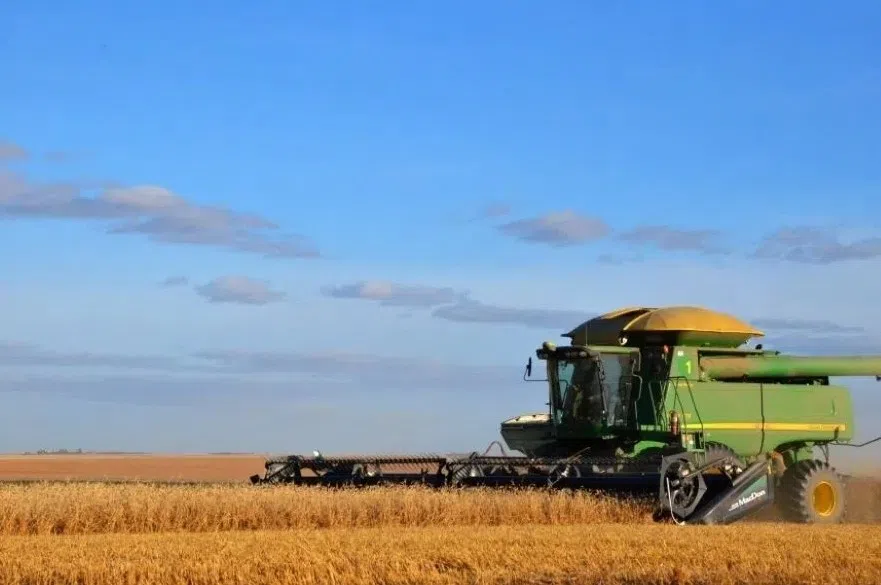
From big yields, the rising cost of beef, canola tariffs and drought, there was no shortage of major headline stories for agriculture in Saskatchewan for 2025.
To recap the year and look ahead to what 2026 might bring, guest host Justin Blackwell welcomes Shaun Haney, founder and CEO of RealAgriculture, to the Evan Bray Show.
Hear the RealAg Minute with Shaun Haney on CJME and CKOM every weekday and tune in Saturdays at 4 p.m. and Sundays at 1 p.m. for RealAg on the Weekend.
Read more:
The following transcript has been edited for length and clarity.
Justin Blackwell: You started a new show on this radio station, RealAg on the Weekend. How has that been treating you so far?
Shaun Haney: It’s been really good. There’s a lot happening in the world of agriculture right now, obviously in the province of Saskatchewan, but across Canada and really around the world. Whether it’s trade issues, or it’s trying to deal with some of the geopolitics and how that’s impacting supply and demand and the movement of goods. Canada is mixed up in a bunch of different issues right now, and so trying to shed light and clarity on all that is a great challenge every week, but we love doing it at Real Agriculture.
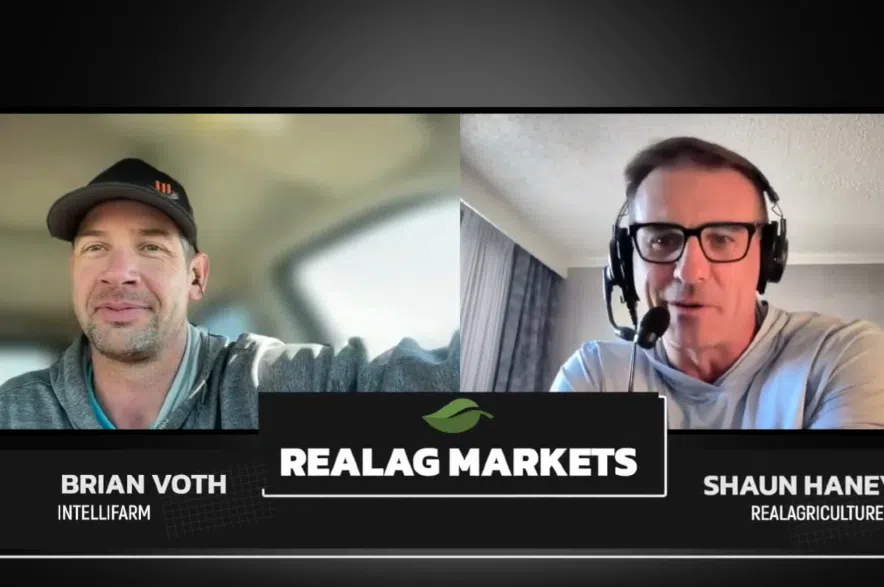
IntelliFarm’s Brian Voth spoke with Shaun Haney of RealAgriculture.com this week about the future of oilseeds this week. (RealAgriculture.com video/Screenshot)
As 2025 wraps up, how would you best describe the overall year for agriculture in Saskatchewan and Western Canada?
Haney: Probably the best story is kind of the record crop output that we had. If you compare 2025 to 2024, 2024 in the western Canadian prairie was really disappointing. We started out so well, and then Mother Nature turned up the heat, forgot to drop some rain, and the yields disappointed.
2025 was the opposite. We started out kind of shaky, and then we never got the heat in July, and we got some July rains that really pushed some of those yields higher. Talking to a lot of farmers across Saskatchewan, they’ll tell you that their yields were way better than probably what they thought for the most part.
What we need is the prices to be better, and profitability is really a concern for a lot of farmers. But by far, I think the best story for 2025 is what has happened from a ranching and cattle feeding perspective. We have had tremendous prices in the beef markets, and we appreciate the consumers who are listening and continue to spend the money on beef, even with some of these record-high prices. Ranchers are finally making money, and it’s been a really good news story for 2025 in that regard.
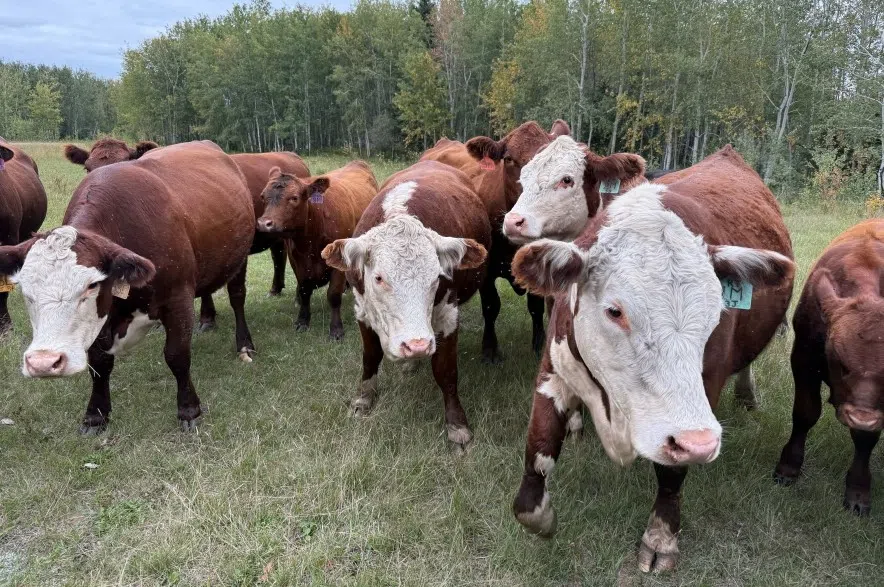
Cattle on a farm near Kinistino. (Nicole Garn/980 CJME)
While discussing prices, let’s look ahead to 2026. What are we expecting in terms of prices and tariffs when it comes to China?
Haney: I don’t think anybody really knows what’s going to happen. We had done some market research earlier in the year, and I think it was like 72 per cent of western Canadian farmers believe that the Carney government should lift those EV tariffs, with the hope of China lifting the tariffs on some of our Canadian agricultural goods, like canola.
But there’s no assurity of that. That’s not a given 100 per cent bet. So I think we just kind of sit and wait. There is going to be a visit by Prime Minister Carney here in Q1, I believe, to China, hopefully to try to lessen the trade tension between Canada and China. But for the time being, those tariffs are on, and our hope is that canola is going to be able to make it to China. It might just have to take a bit of a securities route through some other countries.
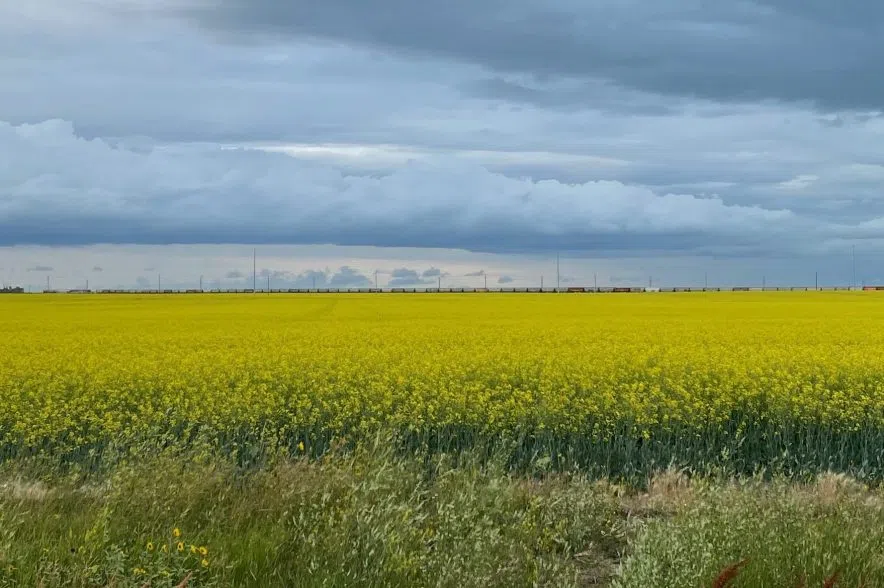
A Saskatchewan canola field. (980 CJME file photo)
Do you think Prime Minister Mark Carney is doing enough to help farmers win when it comes to those tariffs?
Haney: What’s the expectation? Are they working front and back channels in terms of having a better relationship with China? I think so. They also have issues with the United States at the same time, where those two countries are not on the best of terms when it comes to trade. Canada is very much caught in the middle. So that’s a sensitive topic.
The number one market for Canadian canola is actually the U.S., and having access to the U.S. biofuel markets, we can’t jeopardize that at the same time. Some people don’t believe that there should be some sort of compensation for western Canadian farmers because of some of these tariffs that really stem from Canada applying those EV tariffs in the first place.
So if your expectation is that there should be compensation, you’re probably not thinking the Carney government has done enough. We have seen big payments in the U.S.; they’re going to be rolled out here in January and February, regarding farmer profitability and trade tension, about $12 billion. We haven’t heard that kind of talk out of the Canadian government, but there also hasn’t been a lot of loud noise, like there’s been in the U.S. for that kind of package. We’ll have to see if the Carney government changes their mind, or if farm groups start to speak louder on that front.
Do you think the issue of drought has been properly addressed?
Haney: We need to talk to a higher power, maybe, or something. Last year, we had moisture in parts (of the province), and like I said, the crop yields showed it. The trouble is, we don’t have a lot like that deep reserve, right?
So, if Mother Nature wasn’t so timely in 2026, we’re kind of back behind the eight ball again. So I’m not exactly sure how we would want the government to address it. I know farmers themselves are looking for the most minimal till practices and trying to disturb the land as little as possible to conserve that moisture, also getting into trying some other practices as well, like leaving more stubble on the ground to try to trap more of that snow and those kinds of things. I think farmers are doing their part. We just need Mother Nature to really come through here.
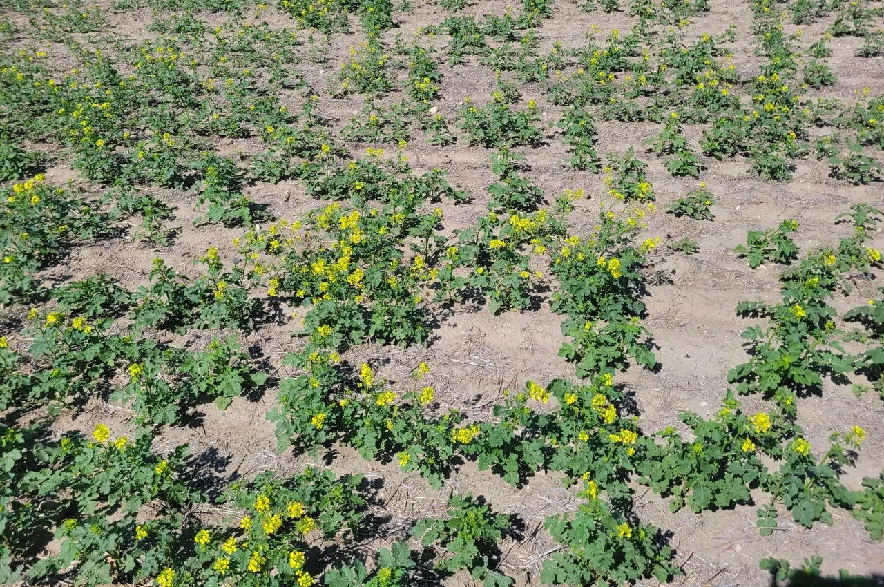
Dry conditions in the RM of Enterprise in June, 2025. (Virginia Maier/Submitted)
Is it a learning process for everyone involved? Because you look back maybe 10 to 20 years ago and drought wasn’t so much of an issue.
Haney: I think so, and farmers are a creative lot, and they’re innovative, right? The key is to figure out what works on your own ground. If you’re in eastern Saskatchewan, maybe you are dabbling in some things like cover crops and things like that, to try to see if that provides you with any sort of advantage. But if you’re in the southwestern corner, you’re probably thinking, that’s not a good fit, right? It’s about accessing some of the extension work with the Saskatchewan government or the University of Saskatchewan. There’s a lot of great research being done there, and trying to do the best you can to get the other side of this weather cycle.
Many producers have relied on programs like AgriStability and crop insurance. Are those enough to help farmers?
Haney: Well, that’s a big play the farmers have. We did research with our audience at RealAgriculture and 53 per cent of our audience says they’re using AgriStability. That number goes higher as the farm gets larger; it gets like 72 per cent of farms are using AgriStability if they’re over $5 million in revenue.
We’re going to be looking, as we get into next summer, at a lot more talk about a new Canadian ag framework. I think there’s going to be a lot of attention on something like AgriStability and then questioning the provincial leaders, as well as territorial and the federal ag minister, Heath MacDonald, on whether there needs to be significant improvements to this? Is it actually delivering on what farmers need? One of the big focuses that smaller farms have here is: It’s not simple. I have to pay an accountant to fill out the paperwork and do all that kind of stuff. I hear this from the audience all the time, but at the same time, does it actually deliver and provide a risk management tool so that farmers have confidence in the fact that if they’re not having a good year, there is going to be some sort of assurity of a payout. That’s a lot of criticism that a lot of farmers have. Now, a lot of farmers are using their accountants to help them with that filing, because the payment and it’s a critical part of the process for the risk management program.
What trends or changes in ag policy, global markets or climate should Saskatchewan farmers be watching out for next year?
Haney: It’s all on the policy front, and I think all attention right now is on what happens between Canada and the U.S. As we get closer to this July 1, 2026, date, where all three countries (The Canada-United States-Mexico Agreement [CUSMA]) have to state their position on what they want to do going forward.
Some people say that President Trump’s going to withdraw. I don’t necessarily believe that. I think we’re going to see a pretty rough road here for six to nine months as these three countries negotiate, maybe a trilateral deal. There’s talk of whether they’re moving to bilaterals? It’s going to be bumpy, and I think it’s going to be a real test of Canadians’ ability not to be too offended by some of the things that are going to be said, especially coming out of the White House.
At the end of the day, though, I think for all three countries, the best economic solution here is to have a trade agreement. And I think even the Americans know that. But it is going to be a bumpy road for a lot of Canadian industries as we try to get to the other side of these negotiations.