

Wood file: Sometimes the better team doesn't win
Canada was snakebit in the gold medal hockey game, and sometimes, even when you dominate the other team, you come up sho...

Police chiefs in Regina and Saskatoon are looking forward to 2026.
As the new year begins, reporters from 980 CJME and 650 CKOM sat down with Regina police chief Lorilee Davies and Saskatoon police chief Cam McBride to look ahead to 2026 and discuss their plans.
Read more:
Davies is beginning her first full year as chief of the Regina Police Service. She was appointed to the role on a full-time basis in December after the firing of former chief Farooq Sheikh.
980 CJME’s Geoff Smith sat down with Davies to look ahead to 2026.
The following transcripts have been edited for length and clarity.
980 CJME: What was the first thing that came to your mind when you said “OK, now that I have this job, I want to get the ball rolling on this”?
LORILEE DAVIES: Obviously budget, for us, is a big piece of it… Investing in our mental wellness for our front-line patrol officers is a number one priority for me, to be able to move that forward. Our front-line officers see so much on a day-to-day basis that really impacts their mental health that we need to be intentional in making investments to keep them healthy. So that, for me, is the biggest thing.
The other piece is, 2026 is the final year of our four-year strategic plan, so we’re starting in January, thinking about what the next strategic plan looks like.
For member wellness, what are you envisioning?
DAVIES: It’s called ERST. It’s emotional resiliency skills training. It’s in partnership with Dr. Nick Carleton and (the Canadian Institute for Public Safety Research and Treatment) at the University of Regina. But it’s kind of a two-part program. Number one, we give people the training and the skills we need to be able to think mindfully about their mental health, where they’re at, and different strategies they can use to reframe things. And the second part of it is a technology piece with an app, where every day you do a little check-in. You take two minutes. You really think about where you’re at.
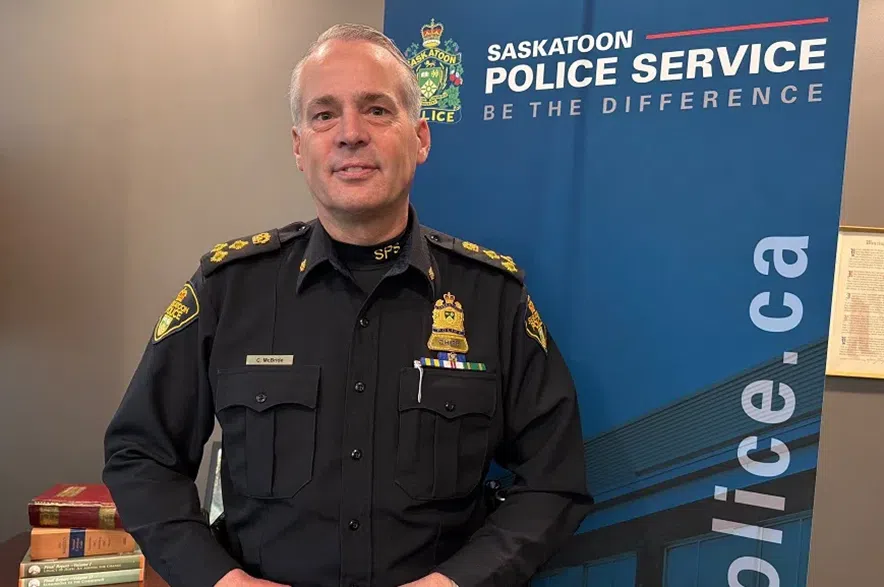
Saskatoon police chief Cam McBride says he’s excited to see some of the initiatives included in the 2026 police budget come to fruition this year. (Mia Holowaychuk/650 CKOM)
In Saskatoon, 650 CKOM’s Mia Holowaychuk sat down with McBride.
650 CKOM: What are you more excited for in 2026 for the Saskatoon Police Service?
CAM MCBRIDE: I’m most excited for seeing some of the commitments that we’ve made within our budget come to pass. We’ve made a commitment to bolster our communication center to provide better service and to ensure that our staff are called upon to do an equitable or an appropriate amount of work. I look forward to seeing our cyber security response bolstered and setting us in a place where I can feel better and more confident that we’re resistant to that type of activity.
I look forward to seeing some of our major challenges being addressed. One of our major challenges is the amount of digital video evidence that we have. We have to receive it, we have to store it, we have to manage it, and we have to provide it to the court. Ensuring that we have a seamless process to manage all of that digital video evidence is going to really make a difference in 2026 and 2027.
I was asked after the budget, “How do you feel?” It’s always stressful presenting a budget and making sure that you present it in a way that it’s understandable. I said I feel great now that the budget has been presented, but now I feel the weight of responsibility ensuring that the commitments made within that budget are managed and are realized. 2026 is just kick-starting that process to make sure that everything that our budget has promised we’re gonna do.
What do you think the Saskatoon Police Service can improve on going into 2026?
MCBRIDE: We have been running lean with regard to our front-line policing response for several years now. I think we can improve on that response. When you have very dedicated, professional people doing too much work, it weighs them down. It wears on them, and I’m alive to that. I take that very, very seriously. As we’re able to increase our numbers in order to alleviate some of the pressure from our front-line response, I think the city of Saskatoon and the citizens will notice that. They’ll see a group of staff who are really dedicated, but also who have the time.
Sometimes all people need in a moment of crisis is time for somebody to hear their story. Time for somebody to investigate thoroughly. When we’re thrust into a circumstance where we don’t have the time, it’s felt throughout.
–with files from 650 CKOM’s Mia Holowaychuk and 980 CJME’s Geoff Smith