

Sarah Mills: Justin Timberlake's arrest video should be made public
Justin Timberlake is fighting in court to keep his impaired driving arrest video hidden. Sarah Mills says the multi-mill...
This week, Prime Minister Mark Carney is in China engaging in a number of meetings with local businesses and groups, and on Friday he’s expected to meet with Chinese President Xi Jinping.
Premier Scott Moe was invited to join Carney on the trip. Moe had gone on a trade mission to China last year in an effort to smooth the way for talks about tariffs between the two federal governments.
Thursday morning, news broke about a number of MOUs signed between Canada and China, including to strengthen talks and collaboration between the two countries on several energy fronts.
Pressure is high for some movement on canola tariffs from farmers in the Canadian prairies. However, members of the federal government have cautioned that working things out with China can take time.
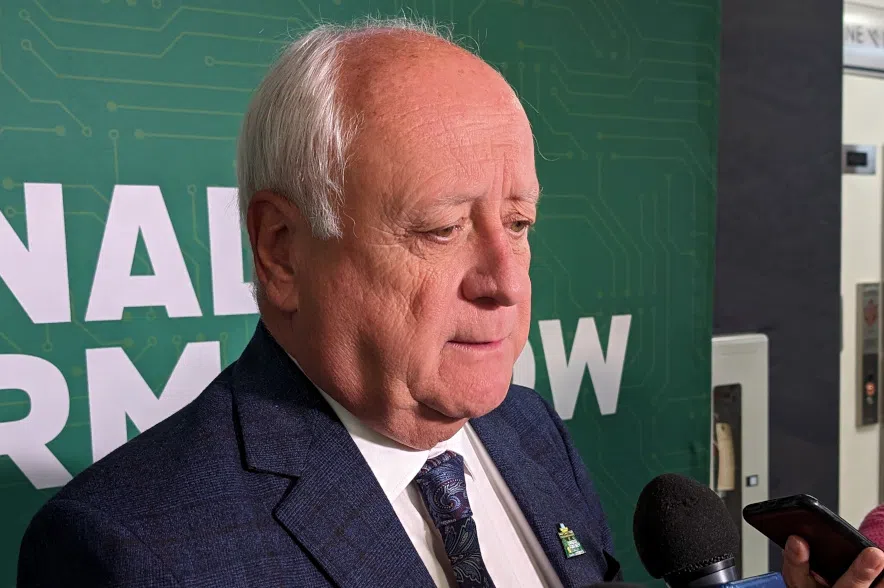
On Thursday, Sask. Agriculture Minister David Marit joined the Evan Bray Show to talk about the Canadian mission to China and the ongoing Western Canadian Farm Progress Show in Saskatoon.
This interview has been edited for length and clarity.
Evan Bray: David Marit, so what was the buzz around cabinet when Scott Moe, the premier, got the call to go with Mark Carney to China?
David Marit: Well, obviously, we’re all pretty honoured to hear that he got asked to go and, obviously, our premier has done a great job in advocating for Saskatchewan on the world scale and a lot of aspects – whether it’s potash, uranium, agriculture, of course, and forestry – he’s been a strong advocate for this province and a great, great diplomat on the world stage.
And for him to be asked by the Prime Minister to go to China again – this is the second time our premier has been in China in less than six months – so it’s quite an honour for us as government, but that just shows the leadership we have in our premier Scott Moe.
Minister Marit, correct me if I’m wrong, but I believe you were the ag ministry chair in 2019 when China halted imports of Canadian canola. That was after Canada detained their Huawei CFO. How does this compare? And did we learn any lessons from that that we’re applying to this situation?
Marit: Whether we learned anything or not, I think we have to have respect for China, it’s a big trading partner for us. It’s our second-largest trading partner, and unfortunately, politics gets in the way of delivering on food products to feed the world.
And it’s unfortunate in that aspect of it, and unfortunately, we can’t control the dynamic around that. In both cases, when China reacted to actions taken by Canada, it impacted the ag sector here in the province of Saskatchewan.
The Canadian Cattle Association has been pushing for Prime Minister Mark Carney to have beef discussions while he’s in China because, since 2021, Canadian beef has been marginalized in terms of the exports we’ve been able to send to China. Is that something that’s on the radar for this delegation as well?
Marit: I’m sure it is. And I know our premier will be bringing up just about all aspects of tariffs in the ag sector for the province. I did have a call with the federal ag minister (Heath MacDonald) on Monday, and for him to mention that he was glad to hear that the premier was going along on that trip says a lot about our premier and the respect that he has earned on the international stage, and it’s well deserved.
It appears Ottawa has been trying to temper our expectations a bit, saying, ‘Don’t expect the tariffs to be completely gone after this visit, maybe there will be some sort of an agreement to adjust the tariff levels.’ Do you have any thoughts on what expectations might be?
Marit: I was asked that question earlier and it’s a difficult one. Evan, I think, every farmer and rancher is always hopeful that there be some good outcomes out of this.
I think it’s just a whole discussion, and there’ll be a re-calibration of everything that they are doing over there. And obviously, when you’re dealing with a country like China, things take time.
I had good discussions with some of the folks at the crop show the other day in the industry sector and obviously, everybody’s optimistic, but I guess we’ll just wait and see how it all rolls out. And I’m hopeful that the premier and the federal government can come out of China with something.
You made a fairly exciting and important announcement when it comes to crop research, talk a bit about what this funding is and why this is needed.
Marit: Well, it’s obviously very important for us as a province on the investment in research. I mean, it’s just under $10 million again this year that we’ve announced in research projects. And at this time, Evan, I really do want to commend the board of the Ag Development Fund. It always gets over-subscribed with research projects, and I think what I like about it, it just removes the politics of it.
And these are folks that are farmers and ranchers who really do look at these projects and how they’re going to help the farmers and ranchers here in this province. So it’s something that I’m very proud of, and to see the investment that we’ve made – I think we’re well over $100 million in the last five years that we’ve invested in research – and we will continue to do that.
I looked at all the projects, there are quite a few as everybody knows, but to see that investment in us, and also from the private sector too, and they should be commended as well. A lot of the commissions and the private sector have invested in these research projects as well.
When I saw that one of the studies was the long-term management of herbicide-resistant kochen and wild oats – kochen, in my family farm’s neck of the woods, is a thing. It’s a thing all over the province. So these types of pieces of research are so important.
Marit: Yes, they are, and one of the big projects is just that evidence looking at chemical-resistant kochen and wild oats. And the project is a big one, and it takes time.
I know even when I sat in this chair a few years ago, one of the projects was a three-year project, and it was really to increase the protein in yellow peas, and they achieved that. So, I just think that the dollars we invest in this research are always good dollars, and there’s always a payback on that. I think the number I saw yesterday is for every $1 we invest, $33 comes back to the ag sector.
I’ve had the privilege of being at the university, at the crop development centre, and seeing the research that’s going on. When you invest this kind of dollars into the research, you attract some of the world’s best researchers as well. I was really in awe of the bright young minds that are doing the research and all this crop development, and it’s really incredible that we can attract those kind of folks.
The announcement that you made on Tuesday was a joint announcement with the Government of Canada and Saskatchewan. I also know at the same time, the Western Canadian Wheat Growers Association has been frustrated with the federal government because of this 15 per cent budget reduction initiative that they’re doing. Have you noticed any implications on some of these budget curbing things that are happening federally?
Marit: I haven’t yet. Obviously, I’m new to the ag minister role, but I’m sure it’s going to be one of the main topics of discussion at the (federal, provincial and territorial ministers) meeting that we’re going to be going to later on this year.
That is a very big concern for us, where they are going to make those cuts on that 15 per cent, is it going to be their investment into research? Is it going to be their investment into business risk management? Where are they going to find that 15 per cent, because that’s a big number.
We’re just going to start the discussions going into our next federal program, and because we usually start those discussions about two years before the current one expires, and the current one will expire in 2028, so we start putting into our discussions. And we will be reaching out to our ag sector here in the province of Saskatchewan on some of the programs that we have – are there changes we should be making? What are some of the recommendations on new ones and things like that? So those discussions will start later this year, as well.
I know you’ve got your clean desk in front of you, ready to start 2026, if I take all of the trade issues off the table, what would you say priorities look like for Sask ag?
Marit: If we take the tariffs off the table, probably the biggest priority is increasing trade. That’s going to be one of our key ones – where can we increase trade? What can we do for the value-added side as well? Is there some opportunity for us to increase the processing here in the province of Saskatchewan?
We have some good programs in place that allow the investors to come and invest in the province, and we’ve seen that when you look at our canola crush, you look at our oat processing, you look at other pulse processing – how that has grown over the past few years here in the province of Saskatchewan.
We want to continue on that side as well, and we also want to ensure and make sure that our livestock sector continues to grow and thrive here in the province of Saskatchewan as well.