


Evan Bray: Diversifying trade doesn't mean abandoning U.S. relationship
Evan Bray says there's nothing wrong with Canada looking for new trade partnerships, but the idea of joining the Europea...
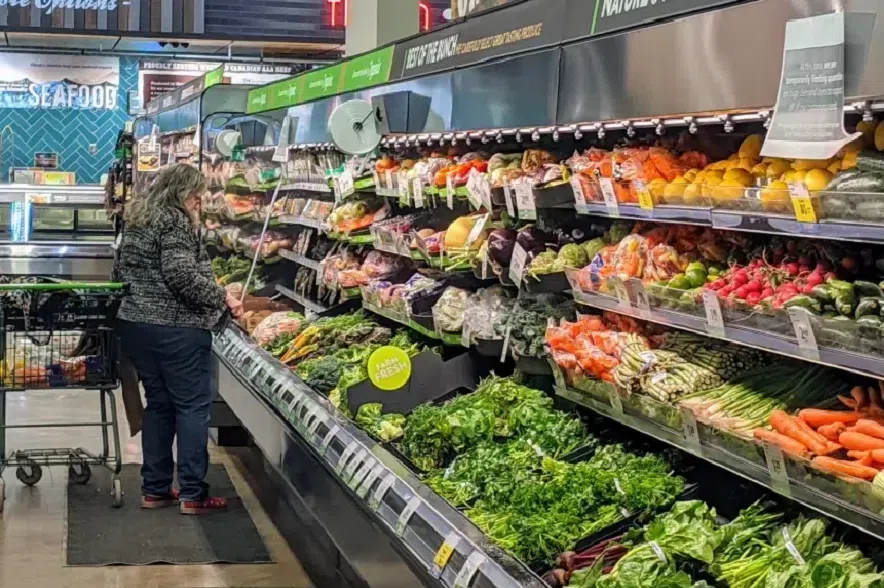
An expert studying food distribution and policy says the GST credit announced by Prime Minister Mark Carney on Monday will help many struggling Canadians afford food, but more needs to be done in order to reduce high prices at grocery stores over the long term.
The announcement on Monday will see Canada’s GST credit rise by 25 per cent over the next five years in order to help residents foot the cost of groceries and other essentials. Additionally, a one-time payment worth half of the credit is expected to come to qualifying Canadians this year.
Read more:
Carney said grocery prices have remained “too high for too long,” leaving many Canadians facing daily financial worries.
Dr. Sylvain Charlebois, director of the Agri-Food Analytics Lab at Dalhousie University, joined the Evan Bray Show on Monday to share his thoughts on the GST credit and explain what he thinks Ottawa should do to help bring down skyrocketing grocery prices.
The following transcript has been edited for length and clarity.
EVAN BRAY: How significant do you see this increase in the GST credit being for Canadian families in practical terms?
CHARLEBOIS: With the announcement yesterday, I was thrown off by all the props. And I don’t know if you saw the presser, but you had Prime Minister Carney looking a little bit like former Prime Minister Trudeau, really, in a grocery store. In the back, you saw produce with no prices. That was interesting, and of course they used a slogan, using “grocery rebate,” “grocery benefits.” I can’t remember the exact name of the program, but they’re basically switching the name of the program from GST credit to grocery benefit and something like that, which I thought was a bit cheesy, to be honest, because that’s exactly what we got for nine years under the Trudeau regime.
But the amounts were significant, as far as I’m concerned. You’re looking at a program that that is supporting 12 million Canadians, and if you actually do qualify for the GST rebate, it means that you’re not making a whole lot of money. I’ve always been incredibly skeptical and disappointed in governments that always throw money at everyone for anything, but in this case it’s targeted and it is a decent amount. Not too much money, but a decent amount money to cover the spread. As you know, we are expecting food inflation to affect many food categories at the grocery store this year. It will cost almost $1,000 more than last year for a family four to feed itself. And that covers the spread. So overall, the amounts were great, but of course in the announcement – this is where I thought things got interesting – Prime Minister Carney knows that just by sending out checks, it was going to be very electoral. I guess it’s about, perhaps, the next election, but he decided to get a little bit more strategic about talking about supply chains and and small- and medium-sized businesses, greenhouses, food banks and things like that.
BRAY: Can you give us an idea of the tangible benefit this will mean for those families that will get this GST rebate? And can we talk also about the large number, the thousands of Canadians, hundreds of thousands, perhaps millions, that are struggling day to day but will actually qualify for this benefit?
CHARLEBOIS: So for the first year, there’s going to be a one-time payment. Fifty per cent of the money you would get, basically, you will get as a one-time payment this year. And so, again, for family of four, that equates to about $1,800 for year one, and for other years they’re increasing the amount by 25 per cent of the amount you typically would get as a household. So the average in Canada would be around $1,400 for a family of four.
Let’s face it: that’s money that a lot of people need, and so it’s hard to dispute. And I would be shocked if Conservatives actually vote against that, to be honest, because, like I said, it’s targeted. You can say “Listen, this is public funding. You could actually make inflation a worse problem,” which is actually true. As soon as you see a government spend too much money, you can actually make inflation a worse problem. But in this case we’re talking about $5 billion this year, which is not a whole lot. The argument I’ve always made, Evan, is why not eliminate the GST on food altogether? Canadians pay anywhere between $7-10 billion of GST on food alone every single year. That’s a lot of money, and that’s money a lot of people would actually use to do other things. It’s about $200 per Canadian, essentially, per year, and that would make a difference.
BRAY: Yeah, there’s been a number of people talking about the removal of GST on an essential items, or the removal of it all together on items.
CHARLEBOIS: I’ve always believed that taxing food is immoral. It shouldn’t happen, but it is happening, and a lot of people think that we’re only taxing bad food. That’s actually not true, because for inflation, there are more and more products being impacted. We have some goofy fiscal rules in Canada. For example, if you buy two muffins and it’s over $4, it’s not taxable. Under $4, it is taxable. If you buy four muffins, then that’s not taxable. If you buy five granola bars, that’s taxable. Six is not taxable. I mean, it’s all over the place and it’s very confusing. And I’ve always believed that when you get to the till, a lot of people don’t even look at their receipts, but you’d be surprised how much taxes you actually pay.
BRAY: Yeah, it adds up. But also in there, aside from this GST rebate, there’s the government’s plan to strengthen domestic food production and supply chains. Can you talk about the impact you think they’re going to make? Is there room for positive impact there?
CHARLEBOS: We need to underscore that it is an issue. I think we need to focus on supply chain efficiencies and, of course, resilience. What’s unclear to me is what exactly is going to happen with that money. I mean, what is the intent here? There were no details yesterday. What you want is to see a government, a federal government, do some of the work, but the heavy lifting has to be done by the private sector. For example, we just saw Nutrien, which is, well, in your backyard, investing more than a billion dollars in Washington State to build their next terminal there, instead of Vancouver. That’s a sign. And it’s hard to blame Nutrien, because they’re not they can’t rely on on the infrastructure in Vancouver, and with the Vancouver port being not very efficient and because of our infrastructure, well, a lot of companies do look south. And so those are things that, as a government, you need to address. So you need enough stimulus to get things going, but at the end of the day you need the Nutriens of this world to reinvest in Canada, right?
BRAY: Can you lift the curtain a bit, Dr. Charlebois, on how supply chain equates to the money I spend when I’ve got items on the grocery belt? How can an investment that the government makes into supply chains help everyday Canadians?
CHARLEBOIS: Well, you need to look at a couple of things, like the potential for disruptions. For example, labor disputes. We’ve seen a few, and you’ve covered them quite extensively on your show with CN, CP, and I’ve always believed that it’s important to recognize these chains as an essential service to reassure farmers, to reassure processors. It’s never been done. It should be done. You don’t have to throw around $500 million to do that. You just make it into law. That’s it. Do your job as a government. The other issue, of course, is resiliency. In terms of infrastructure, I do believe that our railroads are under-capitalized in Canada. Ports are disastrous. The three big ones in Canada – Montreal, Halifax where I am, and of course Vancouver – all three ports are third-tier ports if you compare their efficiencies with other ports around the world. There’s been some investments out west, where you are. We need more. We need to make sure we can develop the Asian market. Prime Minister Carney was just in China to to make sure that we have some transactional deal to continue to make sure that canola flows through Asia, but you need infrastructure to keep the cost down and make our products as competitive as possible. And, of course, we need to talk about the industrial carbon tax. It’s going up again in April. We’ve done some work in that area. And we do believe that the industrial carbon tax – not the consumer carbon tax, the industrial carbon tax – is actually impacting our food chain’s competitiveness.
BRAY: And, ultimately, food prices.
CHARLEBOIS: Oh, absolutely. Of course it’s always hard to correlate both, but if you’re making your food industry less competitive from farmgate to store, obviously it’s going to have an impact on food prices as well. Right now we’re starting to see more and more companies investing in the U.S., and I note a lot of people don’t like to say that Trump is right and Trump’s strategy is working, but look at Crown Royal in Ontario. Minute Maid, owned by Coca Cola, is closing as well. In Ontario all these jobs are going south. Why? Because it costs less to produce food, and that’s what needs to be addressed here.
–with files from The Canadian Press