Murray Wood: Is it fake, or just stolen?
People looking for news on Facebook need to watch out for fake content. And even if it's true, it may have been stolen. ...
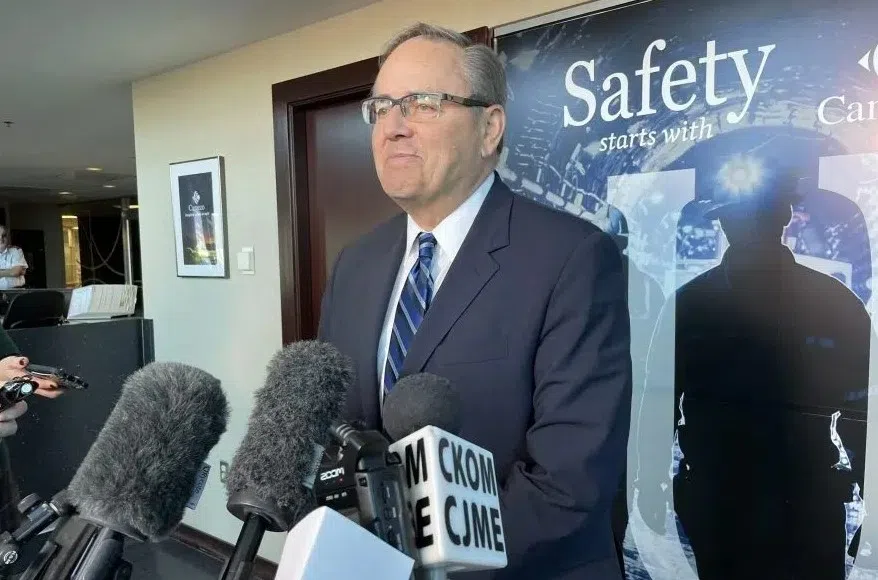
Provincial stakeholders are offering mixed reactions to the large nuclear reactors announcement made by the province and SaskPower on Wednesday.
Cameco Corporation president, Tim Gitzel, said this addition to the energy plan for the province is “prudent” and “rational.”
“The whole world now is moving to nuclear, and Saskatchewan is in the game now,” Gitzel said, calling nuclear the safest electricity on the planet. “We’re super excited.”
Read more:
There are concerns about nuclear power, generally, coming to the province, as well as some of the particulars of large nuclear reactors being voiced by the Saskatchewan Environmental Society. Vice President Bob Halliday said the chance of bringing in large-scale nuclear reactors on time and on budget is “slim to none.”
“There’s scarcely a nuclear project in the world that’s coming on time and on budget,” Halliday said, mentioning he was not surprised at this week’s nuclear announcement.
Halliday believes the province’s nuclear timeline is also behind, hence the announcement to start seriously considering large reactors. He anticipates the two small modular reactors the province has been exploring and planning for—about 300 megawatts each—will be producing power sometime in the 2030s. To get to zero carbon emissions by 2050, however, Halliday estimated the province would need about 10 SMRs to meet its target.
“It doesn’t surprise me that they would then start considering these large-scale nuclear reactors,” Halliday said.
He referenced two reactors the province is likely considering: the CANDU MONARK reactor (1000 mw) and the Westinghouse AP1000.
As an owner in Westinghouse reactors, Cameco said its AP1000 reactor is 1200 megawatts and is presently being built around the world.
“I think it’s one of the potential choices that the Saskatchewan government can make,” Gitzel said, “so we’ll be putting our best foot forward in that regard.”
Gitzel said Cameco was aware of the Saskatchewan First Energy Strategy back in October when Jeremy Harrison, Minister responsible for SaskPower and SaskPower president, Rupen Pandya, brought the plans to the Cameco office.
Cameco has been working with the province on the fuel side of nuclear discussions “all along the way,” according to Gitzel.
The 10-to-15 year process predicted to see large reactors to production in the province makes sense for Saskatchewan’s greenfield operation in nuclear, Gitzel commented, though he said once the infrastructure is built, future projects will take less time to actualize. A lot of work goes into public consultation, siting and environmental considerations before a project like this can move into construction.
“Major projects take a long time and you want to do them right. The best time to start was yesterday. The second best time was today,” Gitzel quipped. “We’re going to need electricity for the next 100 years in this province, and a lot more of it. So we need to get going now, and nuclear has got to be part of that solution.”
Gitzel saw no reason why the province shouldn’t just meet, but beat its goal to move into nuclear power by 2050.
“I think we can do it before then. That’s Tim speaking,” Gitzel said. “I think that the government’s moving ahead with their SMR plans, and those seem to be on track and now large reactors, as well.”
The Saskatchewan Environmental Society has maintained its opposition to nuclear power coming to the province.
“Nuclear is not the way to go for Saskatchewan’s power future. In fact, I’d go so far as to say for Canada’s power future and maybe even broader than that,” Halliday stated.
Halliday voiced concerns beyond time and cost for the province, including long-term disposal of radioactive waste and making sure the province has enough cooling water for the reactors, which operate at a very high temperature.
“They cannot be air-cooled, to my knowledge,” Halliday mused, “so we’re talking about water-cooled large-scale reactors, and where’s the water going to come from?”
“It’s peculiar to Saskatchewan, because there’s not that much water availability here,” Halliday added.
Large reactors will help better address the “tremendous need for electricity,” in Gitzel’s words.
“I think we saw even just over the last few weeks, those of us that live here in Saskatchewan, the electricity needs when the temperatures go down to minus 40 in this province. Thankfully, we had good running electricity, and I think we even lent a bit to the neighbours,” Gitzel said. “If you don’t, you’re in trouble.”
He said electricity demands are skyrocketing around the world and many countries are choosing to turn down the path to nuclear power.
Gitzel cited no concerns with this announcement from the province, referencing Ontario’s 17 nuclear plants and that province’s reliance on nuclear power for the last half a century. He commended the Saskatchewan Government and SaskPower for working with Ontario on this project.
“Saskatchewan is on a good track,” he said. “We’re working closely with the province, and I know they’re taking counsel from other provinces and countries that are already employing nuclear (power) and I think Saskatchewan is doing a great job.”
Halliday sees a different course, however, and thinks the province has better opportunities for increasing power generation than “horsing around with nuclear reactors.”
Interconnections to other provinces—which he said was mentioned as an achievement for Canada in the Premier’s meeting held Thursday—and a “southwest power pool,” entering action with the U.S., are other options for power that Halliday and the SAS see as feasible.
“That’s probably a leg up for Saskatchewan to be importing that power from the States and beyond,” he said.
Halliday mentioned the success the province has had with gas-fired power stations, adding that he couldn’t imagine that, with carbon capture and storage, it wouldn’t be a substantially cheaper option than a nuclear facility.
Also mentioning air and solar power, as well as energy conservation methods, Halliday said he would like to see a thorough examination of Saskatchewan’s power future to get a fulsome picture of the variety of options Saskatchewan has at its disposal.