


Murray Wood: Who's hot... and who's not
Every Friday, Murray Wood takes a look back at the week's news and decides who's hot... and who's not. This week's list ...
Contrary to popular belief, treasure isn’t always buried in a jungle or locked behind stone traps.
Sometimes it’s rolled into a tube, folded into a letter or quietly waiting in a drawer.
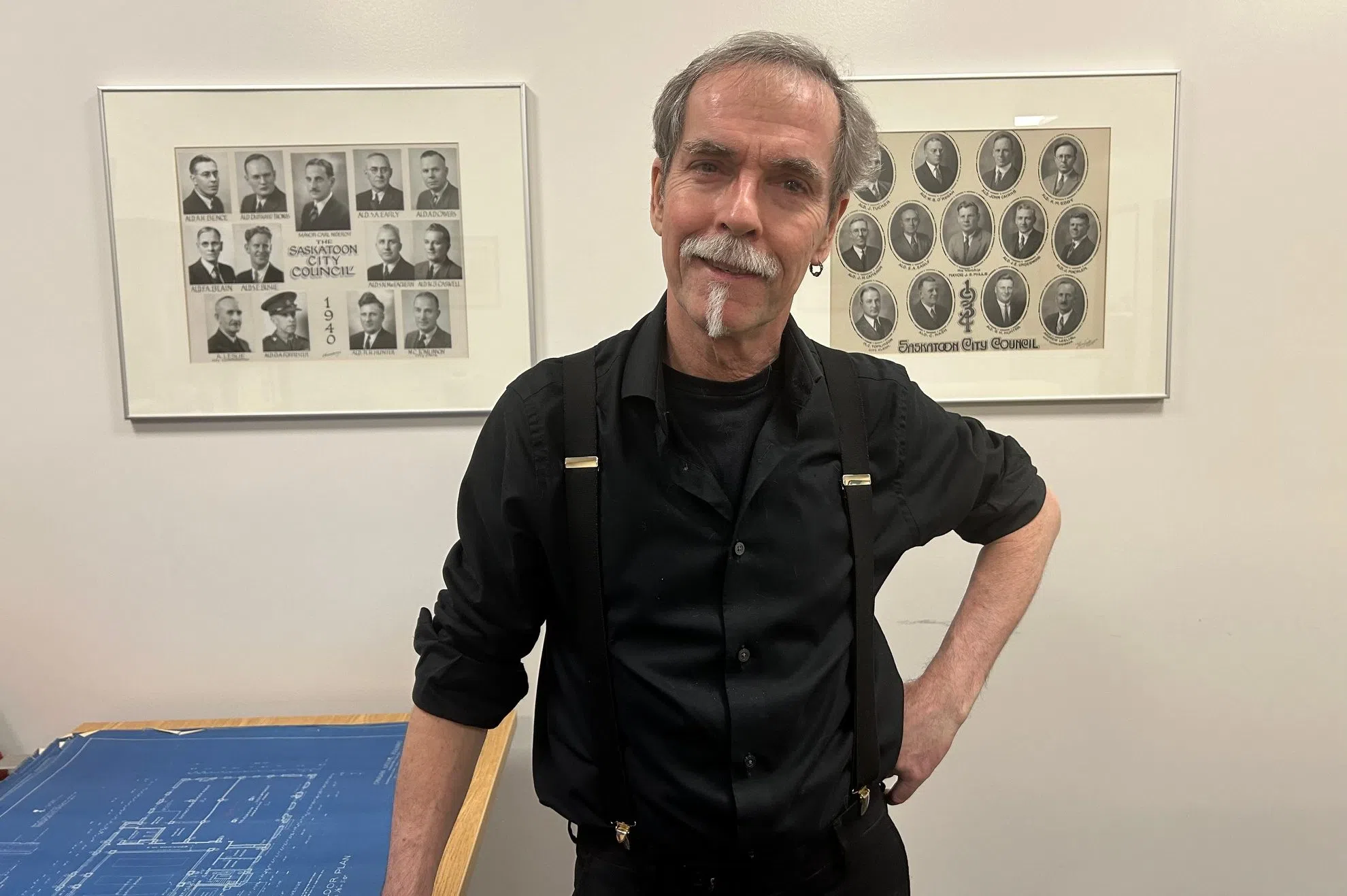
Jeff O’Brien knows this better than anyone.
“What archives do is allow us to revisit the past,” Saskatoon’s city archivist explained. “Time stops. An angry letter written in 1933 is still angry in 2026.”
To commemorate Archives Week (Feb. 2 to Feb. 8), O’Brien did what any good explorer would do: he opened the vault.
The first treasure is fragile. Handle with care.
These hand-drawn fire insurance plans reveal Saskatoon block by block, year by year. They were made to set insurance rates, but they accidentally documented the city’s bones.
“The yellow ones are wood frame buildings. Ones like this in red are brick … these ones here are metal,” O’Brien said, reading the map like a secret code.
One sheet shows the Senator Hotel at Third Avenue and 21st Street, labelled ‘under construction’ in September of 1907. That small note marks a turning point.
“In 1903, Saskatoon’s downtown looked like a set from an old western,” O’Brien said. “By 1907, suddenly we’re building the permanent city.”

These two fire plans, the first from 1907 and second from 1923, show the rapid development taking place in downtown Saskatoon. (Submitted)
They were digitized decades ago, their originals protected like relics. “You can see how fragile they are. We never bring these out,” he said.
These original 1907 plans were once believed to be lost. Then one day, the phone rang.
O’Brien was sitting in his office. Someone from the John Deere Building was on the line. They were cleaning out cabinets. “I found these old maps,” the caller said.
O’Brien asked the only question that mattered: What kind of maps?
“They said, ‘Well, I don’t know. It looks like maps of the city of Saskatoon,’” he recalled. In that moment, he knew exactly what they had found.
O’Brien hung up the phone. Then he ran.

The original hand-drawn plans very rarely see the light of day and it’s plain to see why. The paper is incredibly delicate and must be handled with care. (Brittany Caffet/650 CKOM)
What waited in that cabinet was the original 1907 fire insurance plan set — a collection the archives believed had vanished. The city had even fundraised to buy a digital copy from a library in England, assuming the originals were gone for good.
Instead, Saskatoon’s own paper set had been hiding downtown the entire time. Rolled up. Overlooked. Intact.
Treasure recovered.
Every good expedition uncovers an alternate ending.
In 1913, city commissioner and planner Chris Yorath drew an enormous, hand-coloured map. Not just of Saskatoon as it existed, but of Saskatoon as it could be. Subdivisions stretch outward. Roads loop wide.

Yorath’s plan of Greater Saskatoon may never have become a reality. But it’s proof of the big dreams that Saskatonians have held for more than a century. (Brittany Caffet/650 CKOM)
“He draws this damn map showing Saskatoon within city limits, but also all these subdivisions,” O’Brien said as his hand swept over the massive drawing, spanning roughly ten feet by ten feet.

In 1913 the city hired Chris Yorath as city commissioner. He drew this map, just a section of the massive creation shown here, putting his vision for what Saskatoon could be down on paper. (Submitted)
Yorath was designing bypasses for a city that, at the time, had only a few hundred cars. He was planning decades ahead. The map has since been scanned, preserved and secured.

Yorath’s plan of Greater Saskatoon was drawn and coloured by hand. The detail is incredible, especially considering the massive size of the piece. (Brittany Caffet/650 CKOM)
“It’s priceless,” O’Brien said. “It’s a bona fide treasure. It’s absolutely unique.”
It’s not a map of where Saskatoon went, but of where it once dreamed of going.
Not all treasure gleams.
Some consist of faded ink, cramped handwriting and pages written twice over because paper was precious. These are the letters of Bessie Trounce.

Bessie Trounce’s letters helped uncover much of what we know about Saskatoon in the 1880s. (Brittany Caffet/650 CKOM)
Bessie arrived in Saskatoon from England in 1884 as part of the Temperance Colony. She ran a store, hosted dances and wrote home constantly.
“She was terribly lonely,” O’Brien said. “And she wrote these vivid homesick letters.”
The letters survived by luck. A granddaughter donated them decades later. Volunteers spent years transcribing them, because the originals are difficult to read — cross-written, faint, fragile.

It took two volunteers years to transcribe Bessie Trounce’s cross-written letters. (Submitted)
Bessie died in childbirth in 1887. “And now we have no clue where Bessie Trounce is,” O’Brien said. She lies in an unmarked grave in Saskatoon’s oldest cemetery, her wooden marker disappearing decades ago.
Time may have claimed Bessie’s grave, but the archive kept her story alive.
Next, we find something that no longer exists — except on paper.
The downtown railway station built in 1938 was demolished to make way for Midtown.
“Anybody who remembers a railway station in Saskatoon, this is the one they remember,” O’Brien said, tracing the lines of the blueprints.

The building may no longer exist, but the blueprints are here. Proof that for a time, it existed. (Brittany Caffet/650 CKOM)
The drawings show a grand building: a sweeping main hall with a mezzanine overlooking the floor below, tunnels leading under the tracks, staircases rising to the platforms. There was a lunch counter, telegraph offices, open spaces bustling with people — all captured in meticulous detail on paper.
The station, once alive with the clatter of trains and the murmur of travelers, now exists only in these plans.

These blueprints are just one set of many housed within the City of Saskatoon Archives. (Brittany Caffet/650 CKOM)
The archives hold plans for some structures still standing, and many that aren’t. They also hold gaps. In the 1990s, hundreds of thousands of permit plans were destroyed due to deterioration.
“I like to tell people we have some house plans, but we don’t have your house plan,” O’Brien said with a wry smile.
Even the best expeditions lose a few artifacts along the way.
This one looks run-of-the-mill at first. “It’s simply a photo album,” O’Brien said.

An archive in itself, this scrapbook was assembled and labelled with great care. (Brittany Caffet/650 CKOM)
But inside are decades of nostalgic summer memories: paddling pools, diving competitions, sand box contests, kids growing up frame by frame.
“Sometimes you see the same people over a period of years. And I wonder where they went,” O’Brien reflected as he flipped through the pages. “They’re all grown up. Probably most of them are gone.”

This photo captures the 1949 Westfield Sand Box Competition. (Submitted)
One image stops him every time: a hand-pumped merry-go-round. “You’d run like mad and get them going faster and faster,” he laughed. “Occasionally children were flung off!”

Some called them a death trap. Others, a rite of passage. The Albert paddling pool merry-go-round was a favourite for many kids in 1948. (Submitted)
A perfect snapshot of childhood long ago.
Deep inside the archive sit reels of 16mm film, each one a doorway to a Saskatoon that no longer exists.
They were shot by John Sproule Mills, mayor for seven one-year terms, a man whose camera captured the city as keenly as he ran it. The reels were donated by his grandson.

J.S. Mills was Mayor of Saskatoon for seven terms, a record that is unlikely to be beaten. In his day, mayoral terms were only one year in length. (Brittany Caffet/650 CKOM)
One reel bursts into rare colour footage of the 1939 royal visit: the King and Queen winding through sunlit streets, flags fluttering, faces turned to the monarchs.
“I don’t know of any other color footage of the 1939 royal visit,” O’Brien said, marveling at the living history before him.
Another film, This Is Your City (1953), focuses not on citizens, but on the workings of city government itself.
The film is silent, but O’Brien can almost hear Mills’ voice narrating live, as he was known to do, guiding crowds through Saskatoon.
“You have cars, you have buildings the way they used to be, and you have people,” O’Brien said.
Watching, the hum of everyday life from 1953 flickers back into existence. For just a moment, Saskatoon’s bygone era awakens, captured forever on film.
Archives don’t hand you finished stories. They give you clues. Fragments. Pieces of a tale that still wants to be told.
“In the end, history is where we come from,” O’Brien said. “And archives allow us to touch history in a very direct, very intimate, very personal way.”
That’s the real treasure hidden in the City of Saskatoon Archives. Not gold or glory — but proof.
Proof of who we were, how we built and what we dreamed of. Proof that, without an archive, might have simply disappeared without a trace.
Thankfully, this vault isn’t sealed. The clues are still there.
All you have to do is go looking.
Guided by city archivist Jeff O’Brien, explore fragile maps, vanished places, handwritten letters and flickering film hiding in Saskatoon’s city archives. (Brittany Caffet/650 CKOM)