

Sarah Mills: There is still some skepticism about ice skating judging
Canada's ice dancing bronze medal should be celebrated, but Sarah Mills says the stink of Salt Lake City and the judge v...
Regina’s future growth plan is one step closer to passing.
The city’s Official Community Plan proposes how new neigbourhoods will be phased in over the coming decades, where they will be located and, most importantly, how Regina’s wastewater infrastructure can meet those future demands.
Read more:
At a meeting of the city’s executive committee on Wednesday, councillors voted 9-1 to advance the changes to be voted on by city council. The amendments create different tiers of short-, medium- and long-term developments.
The tiers are divided into three groups. The first includes neighbourhoods that can built on existing infrastructure and wastewater capacity. The second tier includes new neighbourhoods that will eventually be served by the northwest lift station, and the third tier includes the communities that would need new water lines and/or larger-scale infrastructure upgrades before being built.
The tiered approach came as a disappointment to Evan Hunchak, president of Bright Communities and his partner, landowner Mark Geiger.
Their Skywood development, east of McCarthy Boulevard and north of Diefenbaker Drive, has been in the works for around a decade, and the developers said the planned community being bumped down to the third tier pushes the project back by 30 years.
Under the phased approach, Skywood wouldn’t be built until after neighbourhoods categorized as tier one, including Westerra, the area north of Westerra, Hawkstone, Somerset, Kensington Greens and the remaining unsubdivided area of Harbour Landing, along with the tier-two communities of Rosewood, Coopertown and Westbrook.
Geiger told the committee that the change will cause a drastic decrease in the value of the land.
“Skywood contains 206 acres of developable land,” he said. “At a phase-one classification, that land is worth $31 million. Under the proposed tier-three classification before you today, that value would drop to $3 million.”
Geiger and Hunchak said they think a large wastewater pipe that already exists can support development of the community, but city administration said the existing network is at its capacity, and while an addition may not impact its specific area, the entire city needs to be considered.
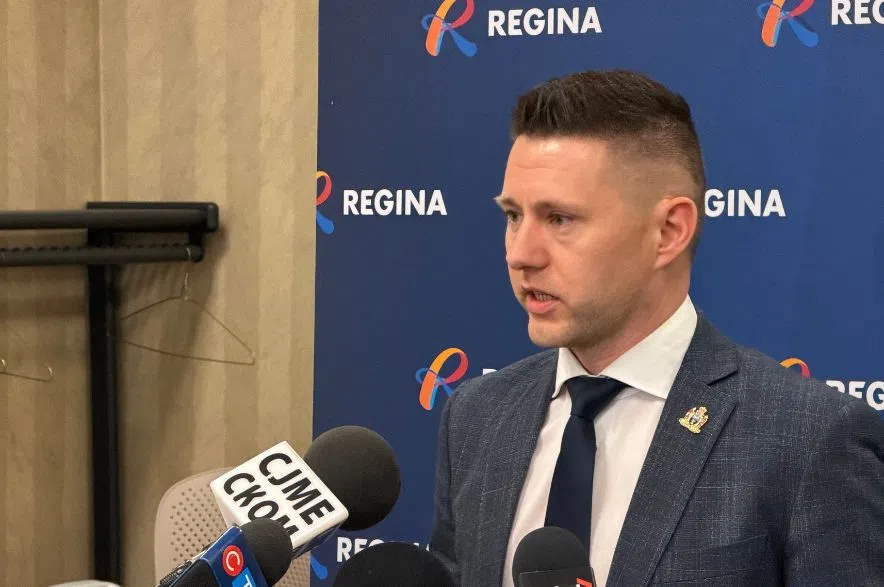
Mayor Chad Bachynski says that’s why the proposed changes to the community plan are so important.
“The growth plan, the revisions that were made, ultimately, is just a much more data-driven, calculated approach in how we grow our city,” he told reporters.
“It accounts for green-field development, it accounts for intensification and it accounts for addressing some service-level issues that we see in the city, like basement flooding.
“So it was almost two years of work that the city’s done, getting a serviceability study done that tells us exactly what our capacities are, and lets us plan accordingly and get the best value from the dollars that we spend on infrastructure in the city.”
Bachynski said the approach removes politics from decisions around which new communities to advance.
“I think what I heard today is not everybody is fully happy with it, but I didn’t hear anybody that was opposed to what we were doing. They were all just really making their case for pieces that they’d like to see,” the mayor added.
“I think that probably indicates that we’ve found a balanced approach.”
Council will make a final decision on the changes on Feb. 25.