

Sarah Mills: More money for Canada Post is not the way to go
Sarah Mills says another $1 billion for the public mail carrier is repeating madness and not conducive to the long-term ...
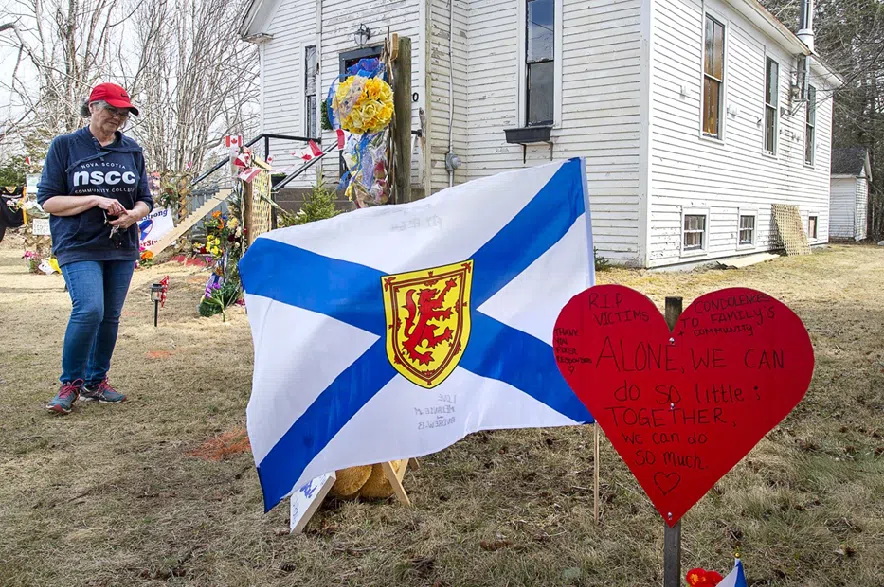
HALIFAX — It was almost six years ago that Tammy Oliver-McCurdie lost her younger sister, brother-in-law and 17-year-old niece in Nova Scotia, all of them victims of the deadliest mass shooting in modern Canadian history.
Oliver-McCurdie says that when she heard about the school shooting Tuesday in northeastern British Columbia, she recalled the agony she felt when she learned a man disguised as a Mountie had fatally shot the entire family and 19 other people on April 18-19, 2020.
Read more:
“This is very difficult for our family as this brings back many emotions,” Oliver-McCurdie said in a statement that focused on offering support to the people of Tumbler Ridge, B.C., where eight people — mostly children — were killed by an armed 18-year-old who police say took her own life.
“I cannot describe the amount of pain we are all feeling for you,” Oliver-McCurdie, a resident of Red Deer, Alta., said in the statement. “What I would say to you is, hold your loved ones tight and allow yourself to lean on those healing people who surround you — family, friends, community, church.”
Oliver-McCurdie also offered some advice on how to cope with a devastating loss that is also the subject of international scrutiny.
Her sister, Jolene Oliver, her brother-in-law, Aaron Tuck, and her niece, Emily Tuck, were among the first victims killed by the Nova Scotia shooter on April 18, 2020.
“Give yourself a quiet space to process, as the noise can be daunting,” she said. “And seek help early from victim services, counselling and those close to you.”
Oliver-McCurdie also said B.C. authorities should remember that the psychological fallout from this type of tragedy will extend far beyond the province’s borders. She recalled that after the murders in Nova Scotia, she and other relatives in Alberta struggled to cope.
“The distance was tough,” Oliver-McCurdie said in an interview Wednesday. “It took a long time for us to get supports in place.”
Still, she said many of the victims’ families in Nova Scotia have kept in touch over the years, which she said has provided her with an important source of strength.
“Our Nova Scotian family has been very important to us …. And we support each other to this day.”
Serena Lewis, a longtime social worker in Nova Scotia, says that in the immediate aftermath of such a traumatic event, those directly affected remain in a state of shock and disbelief.
“Grief is the hard work that’s coming later,” said Lewis, who in 2020 was the province’s grief and bereavement coordinator in the northern region where the mass shooting started.
“There’s a lot happening for Tumbler Ridge right now, and we need to be super respectful of that,” she said.
Lewis, who still lives in Nova Scotia’s Colchester County, said this early stage is when well-meaning people typically come forward to offer support, which usually means “keeping the casseroles coming.”
“But it’s after the funerals when the quietness comes,” Lewis said. “That’s when the grief really settles into loss. Right now, we’re just trying to … make sense of what happened.”
That’s why those who want to offer help must pace themselves and focus on treating the bereaved with the utmost respect, she said. For people living outside of Tumbler Ridge, that could mean reaching out in a very personal but low-key way.
In the days after the killings in Nova Scotia, Lewis recalled receiving letters of condolence and packages from people in B.C., which she brought to Portapique, N.S., the tiny seaside community where the killer began his 13-hour rampage.
Lewis said this type of gesture reminded her of when drivers pull over to let a funeral procession pass.
“So these are the times when our country can start to feel a little smaller and a little more connected,” Lewis said. “I think we have to really be willing to pull the car over and say, ‘What is it that you would like? Can I bring a casserole?”’
Earlier this week, Lewis said she sent an email to the mayor of Tumbler Ridge to let him know she was thinking about his small community more than 4,000 kilometres from the Atlantic coastline.
In Ottawa, the member of Parliament for the Nova Scotia riding of Cumberland—Colchester, Alana Hirtle, said she spent most of Wednesday in tears, listening as party leaders in the House of Commons paid tribute to the victims in Tumbler Ridge.
Hirtle was among a group of volunteers who worked to build a community centre in Portapique after the mass shooting. When it opened in 2024, Premier Tim Houston said it represented the “community’s journey of healing and harmony.”
“I don’t know how the folks in Tumbler Ridge feel, but I can appreciate where they are — the shock, the horror, the overwhelming sorrow,” Hirtle said in an interview.
“I remember before Portapique being very smug and saying, ‘Things like that never happen in Nova Scotia. It doesn’t happen in Canada.'”
Hirtle said it will be important for Canadians to reach out to the people in Tumbler Ridge and to listen when the community says what it needs.
“I would say to that community, to those individuals and families: be gentle with yourself. You’re going to feel a lot of emotions. Grief is not linear,” the MP said.
“Over the next period of time — days, weeks, months — nothing’s going to make sense. And grief will rear its head at every weird and surreal opportunity. And you’ll wake up some days and you’ll forget what has happened.”
This report by The Canadian Press was first published Feb. 13, 2026.
— With files from Sarah Ritchie in Ottawa
Michael MacDonald, The Canadian Press