

Murray Wood: Who's hot... and who's not
Every Friday, Murray Wood takes a look back at the week's news and decides who's hot... and who's not. This week's list ...
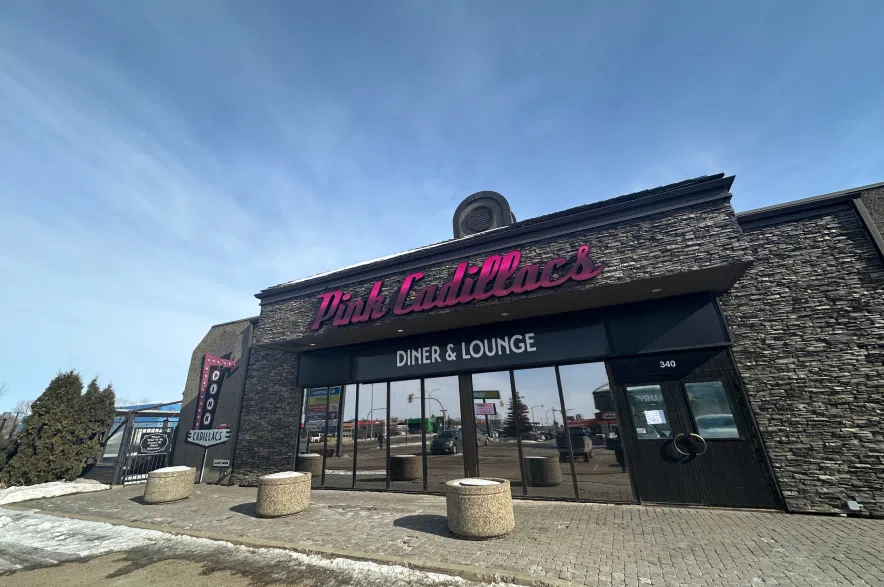
Tears filled Jon Tyson’s eyes after he read the email from the provincial health inspector, informing him that he could once again reopen his restaurant after a week-long closure.
“Please take this email as confirmation that your Public Eating Establishment licence for Pink Cadillacs Diner and Lounge has now been reinstated,” Tyson, the owner of Pink Cadillacs, read aloud in his empty restaurant.
Read more:
“I’m going to cry,” he said as his friend congratulated him. His staff, who have been working with him all week to deep-clean the restaurant after it closed abruptly last Saturday, cheered when he shared the news.
A post made to the Facebook group, (NEW)Saskatchewan Restaurants & Eateries: The Good, The Bad And The Ugly, by Tori Redman on Feb. 21 has gone viral, showing a photo of a cockroach on a grilled cheese sandwich that Redman said she ordered at Pink Cadillacs on 8th Street in Saskatoon that day.
Redman declared in the post that she would never eat at the restaurant again after receiving a sandwich with “black particles all over the top” that she picked off and a cockroach cooked into the bread.
“Absolutely disgusting,” Redman said in her online post. “The waitress didn’t even seem all that surprised. The way my stomach is still reeling hours later.”
Tyson said he found out about the incident when his server came to him and explained that a customer had found an insect in her food. He said he thought it was a piece of cheese at first.
“Of course, it wasn’t,” he said. “It obviously happened, but how did it happen?”
Tyson said before he had a chance to make it right, the customer had left without paying.
650 CKOM has reached out to Redman to confirm this.
The restaurant did not seat any more customers after the incident, Tyson said. Pink Cadillacs closed almost immediately after and has not reopened since the incident.
Tyson said his server was mortified over the incident. If given the chance, Tyson explained that he would have worked to make it up to the customer.
“I would have expressed my sincere apologies,” Tyson said. “I don’t know how it happened, we’ll make sure it doesn’t happen (again).
“Of course, I was surprised. I’ve been doing this for 30 years, and I’ve never had anything like this happen.”
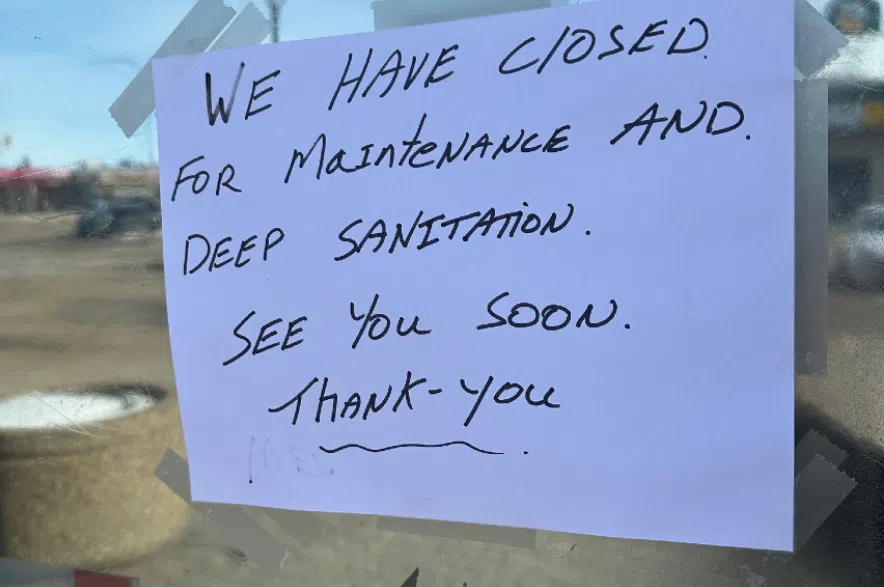
A notice posted on Pink Cadillacs Diner and Lounge’s 8th Street location’s front door on Fri, Feb. 27, 2026. (Libby Gray/650 CKOM)
He said the now week-long restaurant closure was done to try and figure out why and ensure his business is in tip-top shape for all future customers.
“The whole time that we cleaned on Saturday and Sunday night, and we ripped everything apart,” Tyson said. “We just took absolutely everything out.”
The owner expressed worry for his staff. He said harassing phone calls through the week to the restaurant and the negative responses online about the incident have been hard to deal with.
“A lot of them are younger, and there’s some pretty cruel people out there,” Tyson said. “A lot of (my staff) treat (the restaurant) like it’s their own.”
A post from the Saskatchewan Health Authority (SHA) said a health inspection was conducted at Pink Cadillac’s Diner and Lounge on Feb. 23.
“Recommendations were provided to the facility’s owner and the SHA is working with the owner to comply with The Public Health Act, 1994, The Food Safety Regulations and The Public Eating Establishment Standards,” the statement read.
The SHA said the restaurant’s Public Eating Establishment licence had been temporarily suspended until a follow-up inspection was completed and the necessary corrections were made. It also noted that the owner was cooperative with the SHA.
The report Tyson received Friday, reinstating his licence and allowing his business to reopen, noted that the restaurant is “not free of pests.” Tyson said this is because he still has more pest treatments to complete, first.
He hired an entomologist company recommended to him by other restaurateurs in the city. The restaurant has had two treatments completed this week and Tyson said he will continue to pay for monthly check-ins by the company. Each visit costs about $800.
A reopening date for Pink Cadillacs has not yet been determined. Tyson said the “hard part” begins now.
“You open up your doors, and you have to expect that everybody that walks in here is going to try and criticize everything you do,” Tyson said.
The owner said running a business in this digital era is “extremely difficult,” and said constant public scrutiny online can be a lot to handle.
Reflecting on when his business first opened, Tyson said the reason he started Pink Cadillacs is because he wanted to create a place where families could come away from the “hustle and bustle” to enjoy a good meal, laugh at some old cartoons on the televisions and enjoy the vintage atmosphere.
He expressed gratitude to those who have supported his restaurant through this time and offered kind messages.
“I just welcome them back. You know, all our regulars. I really, really thank everybody that has sent some really nice messages and shown us a lot of support in the community. I do appreciate them very much, and we just look forward to seeing people again.”
This situation is the first time Jim Bence, CEO of Hospitality Saskatchewan, said he can recall in many years hearing of a cockroach being in food.
“Oftentimes we’ll hear about other things,” Bence said, like hair or a bottle cap, but not a roach specifically.
“I was a little surprised to hear about it,” he said.
Operators, Bence explained, are usually very quick to respond to any kind of complaint.
“If they see things on their own, they want to take care of it and there is a heightened sense of making sure the customer is taken care of right away, simply because of the internet nowadays and social media,” he said.
As unpleasant as it would be to find a cockroach in your food, Bence noted how hard it is for restaurants to operate with customers able to take freely to social media with any complaint.
“It can be really tough,” Bence said. “whether it’s perhaps something you find in your food or it’s a bug in a (hotel) room, those kinds of reports — particularly how they spread — can be really problematic for operators,”
A decade ago, Bence said operators had time to respond to customers and rectify situations without the fear of it getting to social media, “where it can really get legs and take off.”
Bence said it takes time for restaurant and business owners to find their way to the other side of a viral social media moment, especially when it’s a sensational negative review.
In an industry like hospitality where the saying, “the customer is always right” goes, Bence said it’s typical to seek a quick rectification of the situation from the business first.
“Everybody wants to be responsive,” Bence commented. “If something’s discovered, hopefully it’s brought to management’s attention right away, so that there can be some restitution or some reclamation of the problem … before it hits social media and it really goes viral.”
Bence said it’s important for owners to ensure their staff are well trained and understand the importance of completing tasks like cleaning up regularly and to standard.
Margins are thin for restaurants today, but Bence said because staff can be so difficult to find, there aren’t many operators who have employees working at minimum wage. Often, tips can increase employee income in restaurant settings and back-of-house workers are paid more because of specialized skill sets.
Whether the standard is the minimum required, like health inspectors are looking for, or elevated standards at certain restaurants maintaining a brand or image, Bence said quality can come down to “the commitment to the employee and the training that they receive.”
Bence offered reassurance to the public, noting that this situation is similar to when a hotel might receive a public complaint about bedbugs.
“There’s a heightened priority around all of these different aspects and bugs,” Bence said, also having noted that mice can be a common issue in Saskatchewan for businesses to deal with.
“I’m sure that every other restaurant owner in the city right now is really doing double time … I think that you’ll see a lot of operators paying a lot of attention today and tomorrow.”
In the case of Pink Cadillacs specifically, Bence said he’s been a regular fan of the establishment.
“I’ve never had any complaints,” he said, suggesting that this instance could be a one-off problem.
“I’ll likely patron their restaurants again.”
Shawn Sherwood, branch manager of Poulin’s Pest Control in Regina, said restaurants can experience major problems with cockroaches.
“Cockroaches are great hitchhikers,” Sherwood said. “They’ll often come in with shipments into restaurants. And because restaurants see an awful lot of people coming through them, if you have people coming out to eat that have cockroaches at home, you quite often get them that route as well.”
Sherwood called restaurants “vulnerable” to the problem, given that back rooms house stockpiles of food and lots of spots in restaurants in hard-to-reach places get skipped for regular cleaning.
Failure to clean up food that falls behind cookers and deep fryers, underneath bar coolers, and other out-of-sight spots can build a habitat for cockroaches.
“It is what it is,” Sherwood said. “It’s the cleanest restaurant in the world I can walk into and I’ll find problem areas like that because I’m the one who gets down on his hands and knees and looks for it.”
Cockroaches and mice are the most regular culprits, especially with hot temperatures in kitchens in the summer, when doors will be propped open to help with air flow, Sherwood explained.
“Nobody wants to have cockroaches because they live in the unclean areas of the establishment, and in the dark when the restaurant is shut down they’re running across all the food handling surfaces. They’re contaminating food,” Sherwood said.
He estimated that at least half of Saskatchewan restaurants have a problem with roaches, and restaurant set-ups make them hard places to treat, with lots of ideal locations for the insects to hide, including mechanical areas of grills and in the walls of ice machines.
Read more: