

Sarah Mills: The perils of social media are indicated in a new ad playing in Ireland
Sarah Mills says a new commercial warning about the dangers of oversharing on social media should have all of us pausing...
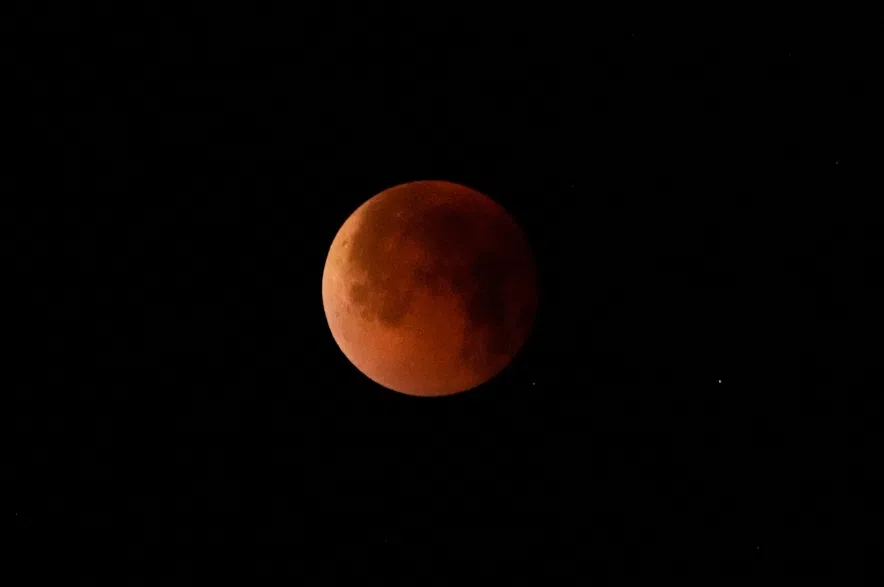
A total lunar eclipse will visible in Saskatchewan on Tuesday.
Samantha Lawler, an associate professor of astronomy at Campion College and member of the physics department at the University of Regina, said the eclipse will be visible across a huge portion of the Earth.
Read more:
Lawler, who is currently in New Zealand on a sabbatical leave, said the upcoming eclipse will be visible to her and to people in Saskatchewan.
“It’s visible across basically half of the Earth, and it’s visible for hours rather than just minutes,” she explained.
Lawler explained that solar eclipses, which occur when the moon passes between Earth and the Sun, are typically shorter than lunar eclipses, which happen when the moon passes through the Earth’s shadow. The next major solar eclipse, according to NASA, will happen on April 12.
“They’re very different looking events,” Lawler said, noting that special glasses and filters are needed to view at a solar eclipse without risking eye damage. No such protection is required when viewing a lunar eclipse.
Lawler said lunar eclipses can be a “freaky” sight, with the moon sometimes turning different colours as it passes through the planet’s shadow.
Heavy smoke in the air like Saskatchewan and other parts of Canada have seen over the past few summers can also make the moon appear red, particularly when it is low on the horizon. Lawler said a similar effect will happen with the lunar eclipse, but with the moon very high in the sky and appearing much darker.
“It’s just very strange looking, and it’s because the Earth’s shadow is basically every sunrise and sunset in the world all being projected onto the moon at once,” Lawler said.
Viewers who wish to witness the event only need to look at the moon before sunrise on Tuesday.
“As long as there (are) no clouds, this is a very easy celestial event to see,” Lawler said.
Lunar eclipses are visible from Saskatchewan about once every year, meaning the event isn’t especially rare. Solar eclipses, on the other hand, are much less widely visible. Despite that, Lawler said these events still don’t happen every day.
“It’s worth looking at,” Lawler said.
The six-planet alignment seen in the night sky on Saturday is an event that only happens about once a year, according to Lawler.
“It’s not super rare, but it is neat because it lets you see the geometry of where we are,” Lawler explained.
She said Venus, Saturn and Jupiter are easy to see with the naked eye after sunset, but Mercury can be more challenging. A telescope or binoculars must be used to view Uranus and Neptune, and astronomers need to know where to look.
“Even just with the three planets, you can see that’s our solar system,” Lawler marvelled. “It’s a nice way to kind of orient yourself inside the universe.”
She said viewers in very dark places might have also caught a glimpse of the broader Milky Way galaxy.
Though she hadn’t seen the videos circulating online showing mysterious lights dotting Saskatoon’s night sky last week, Lawler said it’s possible that the lights were satellites.
She said a number of Starlink satellites were slated for launch last week, but couldn’t offer a definitive explanation for the lights.
–with files from 980 CJME’s Jacob Bamhour