
Terrebonne could hold the key to Liberal majority, if Carney plays cards right
Murray Wood considers the potential for a Liberal majority, depending on the outcome of the upcoming Quebec byelection.
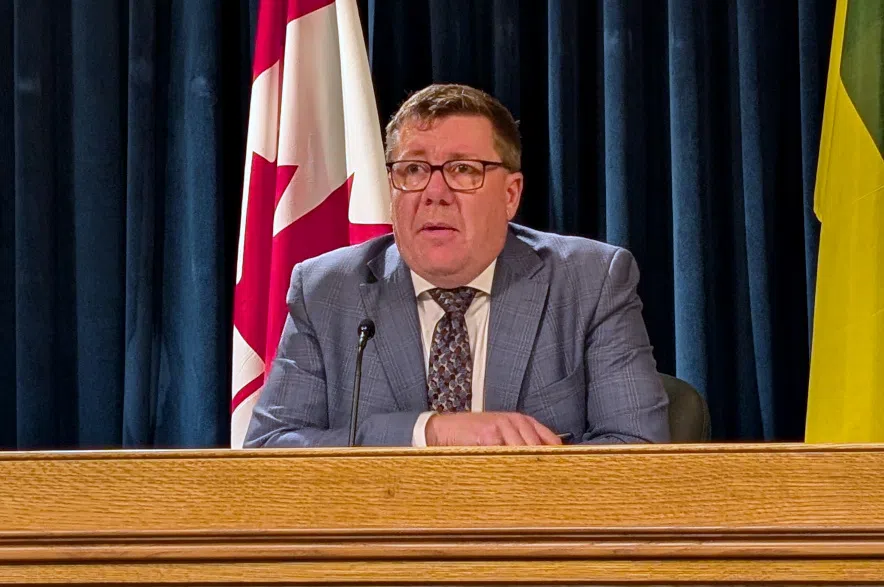
After announcing a new health care plan for Saskatchewan on Monday in Saskatoon, Premier Scott Moe
Read more:
Listen to the full interview, or read the transcript below:
The following questions and answers have been edited for length and clarity.
EVAN BRAY: I look at this trip to India, it seems like there were lots of positives from it. You must feel pretty good about where Saskatchewan stands today in relationship to this important trading partner?
PREMIER SCOTT MOE: Yeah, there are some positives and some deliverables, which you always, you don’t always get on a trade mission, for sure. So there is definitely some significant positives for our province and the people that live here, but there’s also some more work to do when it comes to things like the pulse tariffs and some opportunities in the expansion of trade, as well.
Those pulse tariffs that are on – our understanding is that they’re protectionist tariffs to protect farmers and agriculture in India. Is that correct?
MOE: That’s correct. We do cycle through this conversation every four or five years in many countries – India among them – and I’m hopeful we’ll have an opportunity for another conversation in a few months, maybe mid-summer or so. I’m also hopeful, and I think this was the indicator of a future deliverable of both Prime Ministers, Modi and Carney, had indicated they want to see the Comprehensive Economic Partnership Agreement with the SEPA or the Free Trade Agreement, which was under discussion a number of years ago when put on pause, when relations cooled. But it is up, and they’re at the table again as we speak, and both of them indicated they want to see that come to conclusion this year. If we’re not able to remove those post tariffs prior to that agreement coming to conclusion, I would hope it’s part of that broader agreement as well, and that’s an ask that we’d have a minister Sidhu and already have asked them, is make sure that agricultural commodities are included.
I saw you quoted saying the tone has changed between the two countries. How much does that help? I remember you doing trade missions to India when, essentially, Trudeau and Modi were fighting. Does it help when the countries get along?
MOE: 100% it helps in immeasurable weights. We’re able to actually get to the deliverable points. The relationship that Saskatchewan worked very hard at in multiple countries – India included – throughout some difficult nation-to-nation relations, has also helped. We have a number of these agreements and kind of the path forward, to some degree, from our perspective – which is food and energy security mapped out. Despite the challenges that I have had and we have had in the west with a federal Liberal government – and not to say that there aren’t still some challenges we will have – I think we’re pleased to see that we’re getting a few of these agreements across the line that we’ve been working on for literally years.
Do you have downtime with the Prime Minister? Do you have time to discuss behind the scenes, those tougher conversations and that relationship between Saskatchewan and the federal government?
MOE: We do have some with Prime Minister Carney. We had very little with the previous fellow. We had one piece of downtime. It didn’t go very well. However, Prime Minister Carney is much more open to a constructive conversation. (That) doesn’t mean we agree on it all, and I doubt whether we will on every point moving forward. But we’ve taken the attitude as a government here – and there’s been, some would say, far too much politics involved in everything the last decade or so, and we’ve been part of that – let’s just do the right thing where we can, and we’re trying to do that. I know you’re going to talk to the Health Minister when it comes to improving our health care system in the province. We’re trying to do that on international trade: let’s do the right thing and really take some inspiration from our forefathers. Our communities in this province, they were built when people came together despite their differences and started building a rec center or hall or whatever that is, and they work together for the greater good. So we’re trying to bring a little bit of that to the political sphere – whether it be with international relations, healthcare, delivery – just trying to do the right thing on behalf of Saskatchewan people.
Do you get a sense from the Prime Minister in these conversations that he’s hopeful there will be a deal struck with the U.S.? That’s something that has, in many ways, gone to page 10 from the front page, yet it’s still a looming issue.
MOE: Yeah, and I fear that it might be a book of pages, that page 10 may not be the end. We’re going to start our USMCA negotiations this summer. It’s a perplexing and a challenging situation with the U.S. and specifically with the President the United States, who is trying to reset trade relations with so many countries, including Canada, all at once. I think from our provincial perspective, we have to rely on the fact and knowing full well that we do have what the world needs. And I think increasingly in this very uncertain, unrestful, geopolitical, literally wars that are being fought as we speak, that the rest of the world is starting to appreciate what Saskatchewan can provide, as well. We see that in some of the energy pricing that’s happening right now due to the invasion in Iran and nowhere is a topic of conversation more important than food security, which Saskatchewan plays a significant role in. And I think at times, we’ve, I wouldn’t say undervalued, but Saskatchewan hasn’t been appreciated for the long term sustainable trade relationship that we bring to the global stage. I see a Prime Minister that sees that – our Prime Minister – and I’m seeing other countries that are seeing that, as well.
The Prime minister went on to some other countries in terms of trade. In Japan, struck an agreement for continued supply of particularly wheat and pork, which our province can play a major role in. Will this be new opportunity for our province, or solidified what we currently have in terms of trade with that country?
MOE: Both. I think, first and foremost, it solidifies some of the trade that we have, and then there’s some new opportunities. Here’s a case in point of being diversified and having as many agreements, arrangements, intentional documents with as many countries as possible. And you take our province as an example: We actually sell stuff to more than 160 countries around the world. We have some tariff challenges with India right now. Upon leaving China, we were focused on having the canola tariffs lifted, but we also had the pulse tariffs lifted there. And my understanding, talking to the pulse industry in India, Pulse Canada and their board members, is there’s 600,000 or 700,000 tons of pulses from Saskatchewan and Western Canada that’s on its way to China. Having access to multiple markets provides us some degree of diversity, and I would say, some sustainability to the pricing and the volumes that we need to see on behalf of our farmers at the farm gate.
You were there for the announcement (yesterday of the) Patients First Health Care Plan. This is something to try and tackle. I know it’s a big budget item for us in the province, and it’s a topical discussion that I think affects all of us in the province. How confident are you knowing that this is something that you’ve been working on since you became Premier? Is this plan going to get things over the finish line in a better way than than plans we’ve seen before?
MOE: It’s more of a gradual conversation and initiatives than start-and-finish-line in this space because health care is ever evolving. We’ve seen that in health care providers and they see it every day when they go to work – what has changed in our emergency rooms, our health care system in its entirety. What we put forward yesterday, here’s the focus. Let’s ensure that everyone in this province has a timely surgery, timely access to diagnostics and let’s make sure everyone is attached to a primary health care provider. There’s about 50 different initiatives in this plan announced yesterday. That’s not the end of the conversation by any stretch. There’s going to be more added. What we’re trying to do is to build and enhance what is working – like the UCC training more physicians and nurse practitioners – but also, then, to introduce some new tools and innovation that’s available that maybe wasn’t available three, five years ago, to support our healthcare workers in delivering the right care at the right time (in) the right place. An example of that is the expansion of the virtual care program that really has been piloted by Dakota Whitecap, with a partnership there servicing 29 rural communities as we speak. Building on some of those new innovations that weren’t available even just a few years ago.
One of the criticisms I heard (from the Saskatchewan NDP) is this is a regurgitation of a plan that was attempted a decade or so ago by the (Brad) Wall government. What is your response to that? Are there connections between these documents?
MOE: I would say there was some advancement in that plan prior to the pandemic on surgical wait times. That’s where some of the publicly-funded, privately-delivered surgery initiatives came out of that are delivering 15 to 20 per cent of our surgeries annually in this province today. There’s going to be all sorts of politics around an initiative like the Patient’s First Health Care Plan and those political questions are fine. That’s not the approach the government is taking to this. The government is taking a much different approach, actually pulling the politics out of some of this conversation, talking to patients, families, health care workers across this province, and coming forward with new innovation with new ways to deliver healthcare – building on successful methods that we had, some of those in that original plan 10 years ago. As I said earlier, taking that inspiration from our forefathers on building a healthcare system – despite the differences that we may have – building that healthcare system that is going to deliver that that right care at the right time (and) at the right place across the province, and improve the outcomes and the access that Saskatchewan families have. This is not a problem that not a challenge that is isolated to Saskatchewan. This comes up at every Premier’s meeting I go to, and there’s more work to be done in this space. I think Saskatchewan, and in many ways, is at least leading on the conversation and some of these initiatives.
I had Finance Minister Jim Reiter on the show the other day. We were talking about the upcoming budget. I’ve said you and I’ve had this conversation before. My dad instilled in me don’t buy it on credit if you don’t have to. Don’t get yourself in debt if you don’t have to. While I’m happy to see that we’ve got a health care plan, I’m happy to see we’re spending some money on education, I also know we’re growing our debt regularly. How do you balance those? I know we’re going into a budget cycle where forecasts are already showing we’re likely going to have another deficit.
MOE: I won’t speak for other premiers but I doubt whether you’ll see a balanced budget across the nation this year, just with all of the global uncertainty and the challenge on the revenue lines that provincial governments are seeing. That being said, the goal is to balance the budget. The goal is to have zero deficit year in, year out. We balance that with the economy that we have here, and the expectations that Saskatchewan people have. We had to make – and I won’t shy away from this – some very difficult decisions in the lead up to this budget about, should we start to cut services or do we want to protect something like the initiatives that we have in the healthcare space, the ability to build urgent care centers, not just in Regina, but continue with our outbuild into Saskatoon and Prince Albert and then double the the number in Regina and Saskatoon. Those are important initiatives, and I think it speaks to the difficult decisions that we’ve had to make as a government. I would point to one thing across provinces is watch the per capita deficit of the rail of relative provinces. That’s what we’re going to be watching for a comparison, and we’ve seen some significant deficits so far in British Columbia and Alberta. I think Saskatchewan is going to stack up very well. That being said, the goal is to balance.