
Sarah Mills: A neighbourhood debate raging in Calgary is one to watch for all of us in Sask.
Calgary council is hearing reaction to a city-wide bylaw change that allow multi-unit developments everywhere. But Sarah...

Saskatchewan-based uranium giant Cameco recently signed a major deal to provide uranium to India’s atomic energy department.
The agreement was signed in India, with Cameco CEO Tim Gitzel, Prime Minister Mark Carney and Saskatchewan Premier Scott Moe on hand, along with Indian Prime Minister Narendra Modi.
Read more:
The new arrangement, which replaces a previous deal that expired in 2015, will see Cameco ship $2.6 billion in uranium to India over a nine-year period.
Gitzel joined The Evan Bray Show on Tuesday to share more details of the major agreement, the renewed push for nuclear energy around the world, and the potential benefits the deal will bring to the province.
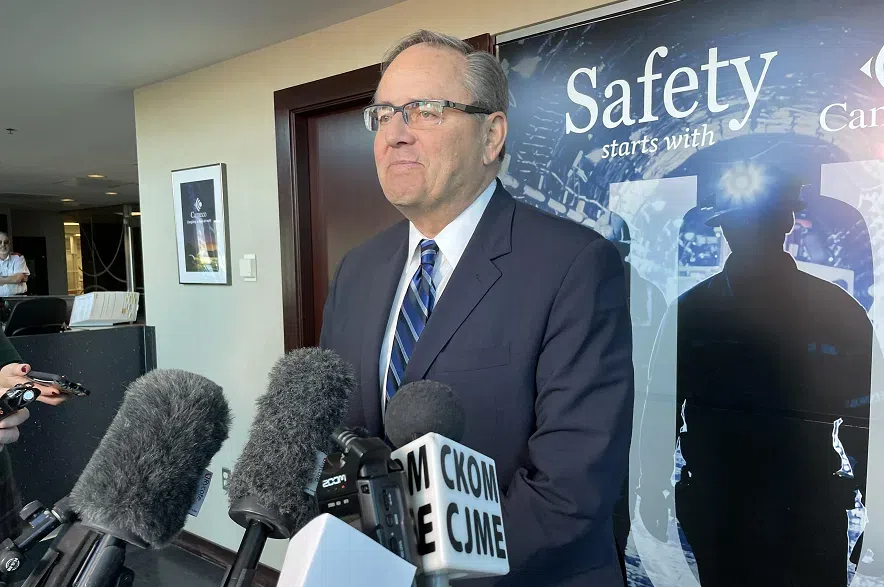
Cameco CEO Tim Gitzel said the new agreement to provide uranium to India for use in nuclear power will bring benefits to Saskatchewan. (Libby Gray/650 CKOM)
I am raw html block.
Click edit button to change this html
The following transcript has been edited for length and clarity.
EVAN BRAY: How big is this India deal? Seemed like a pretty big deal when the announcement happened.
TIM GITZEL: It’s a big deal. It’s a big deal for Cameco. It’s a big deal for Saskatchewan, for the nuclear industry. It’s been a while coming, Evan. Just a little history: We we had an agreement with the Indians from 2015 to 2020, where we were supplying Saskatchewan uranium to them. I signed that deal in 2015 in Ottawa with Prime Minister Modi and Prime Minister Harper. It ran out in 2020, then we had a bit of a COVID issue where nobody was doing very much. And then we had a an issue between countries, where the countries weren’t on a very good relationship level, and so nothing was happening. And so while the former prime minister was in Canada, the Indians would not sign an agreement. So it wasn’t until Prime Minister Carney kind of thawed the relations and broke the ice a little bit that we were able to move ahead. And I have to say, Premier Moe never stopped supporting us going over there. He went over there in the most difficult time, so it all came together. March 2.
How important is the geopolitical side of things when it comes to your business? Have you seen, often, geopolitical conflicts stand in the way of deals for you?
GITZEL: It happens from time to time. Most of our customers are big utilities, whether in Canada, Bruce Power, OPG in the United States, Duke Power, southern constellation, Exelon, so those are really business-to-business deals that we make under the umbrella of a government-to-government relationship, or nuclear co-operation agreement that allows us to do that. But in certain countries India, there’s only one state power authority, and they report right up to Prime Minister Modi, so if relations between governments aren’t good, that can affect our business.
We all watched and saw some of the pictures that came from India, the handshakes, the signing of the agreement. The province was there, the federal government was there. Do you need those levels of government to be there in order to ink these deals? Or are you able to go out and do that on your own?
GITZEL: Well, it’s nice to have them there. We can all celebrate together, because everybody plays a role. But I have to tell you, Evan, and I said this a week ago, I was in Toronto at a conference speaking, and I said we’ve been through some tricky times in the last 12, 14 months as a country, and between different countries and around the world. I was so proud to stand there with the Canadian government, Canadian prime minister, our premier, myself as a head of Cameco, and we actually looked like Team Canada. We looked like we knew what we were doing, facing the Indians. They said
“Wow, what a what a great country. What a great province. What a great company.” And I was pretty proud of that. And that’s how Canada should operate.
I think there’s a lot of Canadians that want to see that, right? We’ve been without that for a long time. That unified front, or that ability to to move forward in a positive way. You were talking about Bruce Power. I heard a stat the other day. I want you to confirm for me, six out of 10 of Ontario homes are lit by Cameco uranium. Is that right?
GITZEL: That is right. Whenever I speak in Ontario and Toronto, I just say “Look up and count the lights in the room. Six out of 10 of those are nuclear-fired lights.” Over 60 per cent of Ontario’s electricity comes from nuclear power.
It’s fascinating to me, and I wonder even what that’s like inside your company. For the longest time, if I put it in simplest terms, Cameco was a mining company. Now, you are a global presence when it comes to nuclear-generated energy. This is part of the future. What’s that transition been like for inside your company?
GITZEL: I’ve been in the chair here for a little over 15 years, I guess. And the first 10 years weren’t very much fun, where we went through a difficult time post Fukushima, and we really had to downsize and hold on. But we always believed. We never stopped believing, Evan, that nuclear was going to be part of the future in the world. So we just kept quietly and modestly building the company. We have the world’s best uranium mine conversion facility. We’re working on enrichment. And, two years ago, we took a bit of a gamble and went out and bought Westinghouse, thinking that if we can build large reactors, we can actually create our own demand. And now we’ve become this worldwide nuclear powerhouse that pretty much every country in the world wants to deal with us. India was one of them. Then I went over to France and met with President Macron, and then went across to the UK and met the king. That’s the levels we’re playing at now with Cameco, from right here in Saskatchewan, so we’re pretty proud of that.
I always like to hear you talk about the benefit of Cameco being a Saskatchewan company, based in Saskatoon. What are the benefits? We hear about these big deals. There was a big deal inked not long ago with regard to nuclear facilities for the United States. What is the impact that that has on our province?
GITZEL: It’s funny, because we travel around the world, and we ask people if they can spell “Saskatoon, Saskatchewan.” And you know what? A lot more people around the world are able to spell Saskatchewan now, because they know where we are. And so nuclear itself has come back. It started five years ago with, really climate security, then to energy security, and now national security, with what you see around the world, pipelines are tough. Getting ships full of oil is tough around certain areas of the world. You can put up a nuclear plant, you can put three, four or five years of fuel right at the site, and so you don’t have to worry about pipelines and things like that. And so the world’s finding that out. And when they go out to find their reactors, or their fuel, they come to the province of Saskatchewan. A little over a million people here, and most of us grew up here and went to school here and now work here, and so we’re super proud of Saskatchewan in the world.
About a year ago, I had you on the show and we were talking about what impact, if any, the tariffs have on your industry. Today, this war in Iran is causing lots of challenges for industries, including our farming industry here in the province. How is it affecting your company?
GITZEL: Well, it’s almost having a bit of a positive effect, in the sense that people are looking at their energy supplies and their electricity supplies and saying “Boy, relying on supply chains and transport chains is tough. We should be looking at building nuclear in our countries.” And we’re seeing that around the world. So the Westinghouse side is super busy. We’re talking to many countries, including – you mentioned – the United States, where you know they have 100 nuclear plants today. They want 400 by 2050. India has eight gigawatts of nuclear power. They want 100 by 2047. That’s the amount of growth we’re seeing, so that’s obviously good for our Westinghouse business. And what’s good for our Westinghouse business feeds Cameco, because that’s the fuel supply. So we like to say we’ve tried to create our own demand.
Is there a way to enhance that? Are you looking at increasing production on the Cameco side, the uranium mining?
GITZEL: We will, as as demand comes. We don’t front-run demand. We don’t build and hope they will come. We always have contracts in place. You look at the Indian contract, for instance, which is 22 million pounds over nine years. First deliveries aren’t until 2027, and it goes through to 2035, and so we always have time when we sign one of those to get the get new production going if we need it, or get more production. We’re working up at Cigar Lake to extend the life of that well into the mid 2030s. McArthur River, we’re doing some work there, and Key Lake, to to prepare that in case we want to increase production. So we’re always thinking about it, and we’re always prepared.
Just this past week, the provincial budget came down. We saw another projected deficit for this year’s provincial budget, and it caused lots of conversation, and that conversation is still happening, whether taxes should have been raised, services should have been cut, or revenue sources looked at to see if there’s the possibility of an increase. This brings about a discussion on royalties and royalty structures for the commodities that we have in the province. Tim, is the royalty structure and the deals that we have, are they adequate? Are they comparable to what you see on the global scale?
GITZEL: So let me just open by saying I don’t envy any government or any finance minister that has to set a budget in this environment we’re living in now, with oil prices, FX, fertilizer prices and all of that. So not an easy task, for sure. On the uranium and nuclear side, I think we have a very fair system in place in Saskatchewan. We pay a basic royalty on our production, so it doesn’t matter how much we produce at what price. We pay a basic royalty to the government. And then then we have a graduated royalty system after that, where as the price moves for our commodity, we have to pay more if it goes up. And so it kind of captures that windfall-type profit that most people are concerned about. And so I think it’s a fair system. It’s similar to the systems we see in other jurisdictions in which we operate, so I don’t think, at least on the uranium side, there’s any need to move on that.
We talked recently about a report that was done out of the Fraser Institute that showed Saskatchewan number three, globally, as jurisdictions that are attractive for mining and mining operations to happen. What does that say to you? Is that about royalty structure? Is it about policy and regulation? I mean, clearly it’s about location of resources. Your thoughts on that?
GITZEL: Yeah, it’s an absolute compliment and tribute to our province and the people of this province that support us. We did some polling and 86 per cent of the population supports us. It’s a province that has a supportive government, good infrastructure, great people. And the Indians come to us because they want a reliable supplier for the next 10 years, and Saskatchewan is that.