


Murray Wood: Lots of empty seats in the stands during Roughriders' home opener
Murray Wood says he saw plenty of empty seats at Mosaic Stadium during the Saskatchewan Roughriders' home opener against...
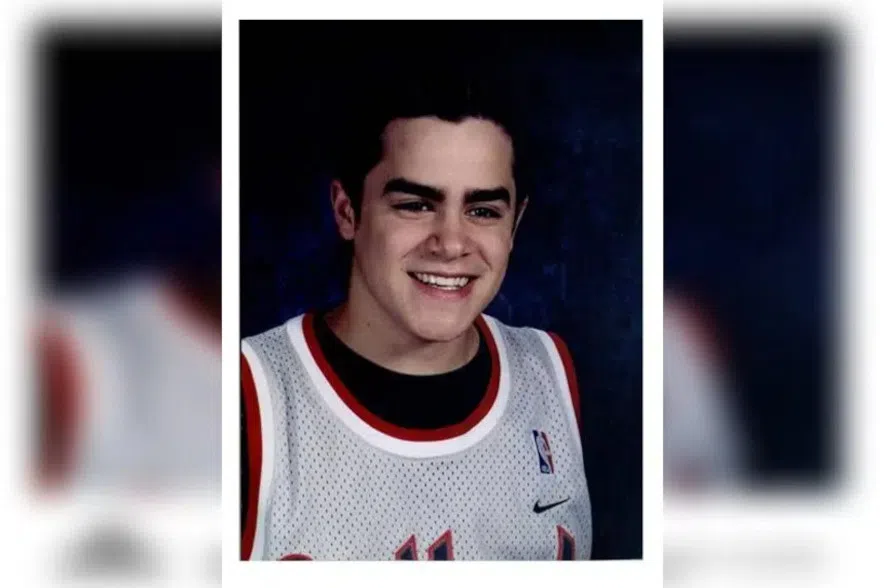
The reaction was mixed in a Regina courtroom on Monday, as it was announced the man who killed Misha Pavelick in 2006 would be sentenced as a youth.
Justice Catherine Dawson said she would deliver the full sentence on Tuesday after considering credit for time served, but a youth sentence means the man’s identity remains under a publication ban. He is now aged 37, but was 17 at the time of Misha’s death.
“I appreciate that the violence and the senselessness of this crime, as well as the fact that 19 years have passed since Misha Pavelick was killed will cause some to view this as an injustice, however I am bound to adhere to the law,” said Dawson in her decision.
The accused was charged in 2023 with second-degree murder for the killing of Misha at a graduation party at Knookimaw Campground on the May long weekend in 2006. He was convicted on the charge by a jury on Nov. 14, 2025.
Read more:
In reading out her decision, Dawson went through the evidence, the circumstances of the offender and the principles around sentencing laid out by the Supreme Court of Canada.
There is a two-part test that must be satisfied for a youth offender to be sentenced as an adult — the first is whether the offender had the diminished moral capacity of a youth, and the second after that is whether a youth sentence would be sufficient for the crime.
Dawson explained the Crown hadn’t convinced her beyond a reasonable doubt that the offender was so advanced as to have the moral blameworthiness of an adult. She went on to point to pieces of evidence about his conduct at the time, immediately after the killing, and in the subsequent years, saying much of it appears to point to the reduced maturity of a youth.
And Dawson said that continued immature behaviour in adulthood doesn’t mean the man had the maturity of an adult at 17.
As to the second part, Dawson briefly mentioned that she’d be hard pressed to find the relatively short youth sentence to be sufficient in this case, but because the first part of the test wasn’t met, the second part wasn’t relevant.
She said that the standard of “beyond a reasonable doubt” is a high standard set out by the Supreme Court.
“(This standard) is closer to absolute proof than probability, and the evidence fails to satisfy me beyond a reasonable doubt,” Dawson told the court.
A youth sentence for second-degree murder is seven years — likely broken up as four years in custody and three served in the community. An adult sentence for a 16- or 17-year-old convicted of second-degree murder is an automatic life sentence with no chance of parole for seven years.
Regardless of how he’s sentenced, because the offender is over 20, he will serve his sentence in an adult facility.
Pavelick was 19 years old when he died from a single stab wound to the chest.
In her decision, Dawson commented on the pain and misfortune of Misha’s death.
“His murder was tragic, senseless, heartbreaking and shocking to the community,” she explained.
After Dawson explained her decision to reject the application for an adult sentence, the lawyers gave their arguments.
Crown Lawyer Adam Breker asked the Justice to take no time served into account in her sentencing.
The offender has been in custody since October 2024. He’d failed to appear for the beginning of his preliminary trail, and ended up being charged with failure to attend court. He was also charged with assault of a peace officer stemming from the day he was taken into custody.
Breker said the offender had been in custody for one year, eight months and 13 days, but argued it was because of his own conduct. He said even a 1:1 credit for time in custody would leave an exceedingly short sentence, so he called for the maximum seven-year sentence to be handed down in full.
“In all the circumstances, we think that is the only fit sentence available to the court and anything short of that would fail to denounce and deter, would not promote a sense of responsibility in (the offender) and would not be proportionate to the seriousness of events,” said Breker in court.
Andrew Hitchcock, the offender’s defence lawyer, argued that he should be given a 1:1 credit for the time spent in custody, arguing that this case is the closest to a manslaughter that you can get under second-degree murder.
The court is expected to reconvene Tuesday afternoon to hear the justice’s decision.
Nearly three dozen people testified at the trial, including one of the responding RCMP officers, an RCMP forensics officer, the pathologist who did the autopsy on Pavelick and a DNA expert, as well as many people who were either at the party that night or encountered the accused afterwards.
According to the picture painted by the witnesses, the accused and a large group of uninvited people went out to the campground that night.
Two people in the group admitted to bringing knives with them.
There was either one long fight or two fights with a small break in between, depending on the witness telling the story.
In the first fight, witnesses said Pavelick approached a member of the uninvited group, Andrew Perkins, about Pavelick’s ex, who was Perkins’ new girlfriend. Witnesses said Pavelick hit Perkins with a glass bottle, and some said a fight ensued.
Some of the witnesses said the fight broke up and the groups separated momentarily, while others said it led directly into the second fight.
In the second fight, court heard from a number of witnesses that a handful of boys, including the accused, approached Pavelick and attacked him, eventually kicking and hitting him while he was on the ground.
The Crown asserted this was when Pavelick was stabbed.
Another fight between Scott Nelson and Derek Enns broke away, and many of the witnesses said that’s where their attention went. That fight ended, Nelson ran off and this is when the uninvited group ran back to their vehicles and left.
Nelson told court the accused told him he “got him”, referring to Pavelick.
At Regina Beach, where the group gathered a few minutes later, three people in a minivan encountered the accused. One person who was in the van said the accused told them “I stabbed a guy”, and the other said the accused told them “we stabbed a guy”.
Pavelickand his friends remained, some trying to give him CPR and put pressure on his wound, while waiting for police and EMS to arrive. Several said Pavelick died before first responders arrived.
As people in the uninvited group started to learn someone had died at the campground, those who were in the car with the accused told court the man accused of killing Pavelick became angry and upset and demanded the car be pulled over. They said he ran out of the car into the night, and they had to go collect him so they could leave.
The RCMP spoke to many witnesses at the party a number of times in the days after the killing and a number of times in the ensuing years. However, at least one witness confirmed she only came forward after listening to the RCMP’s podcast about the death in 2021.
The defence lawyer called into question many of the witnesses’ memories from so long ago, and the credibility of others like Scott Nelson. He argued to the jury that it was too difficult to know what really happened on that night beyond a reasonable doubt.
— with files from 980 CJME’s Gillian Massie and CJME News
Read more: