

Evan Bray: Canadians deserve more than vague explanations over poor trade results
Canadians elected Prime Minister Mark Carney to office to handle trade tensions between Canada and the U.S. Evan Bray sa...

Premier Scott Moe responded Wednesday to the latest U.S. trade announcement, reiterating that he believes the move will have a relatively small effect on Saskatchewan.
“The latest round of US tariffs will have relatively little net impact on Saskatchewan. While some Saskatchewan exports like wooden furniture and honey have had tariffs increased, other Saskatchewan exports like salt and electrical panels have actually seen the tariffs removed. About 94 per cent of Saskatchewan exports to the U.S. remain tariff free,” Premier Moe said.
Read more:
An executive order signed by United States President Donald Trump, which goes into effect Sept. 29, bans some Canadian alcohol products from entering the United States, after Canadian counter-measures also went into effect on Tuesday.
Trump’s order used Saskatchewan’s levy on American alcohol as an example of “discriminatory treatment.”
Moe acknowledged that while he believes Saskatchewan’s economy on the whole won’t be hard hit by the new measures, individuals and businesses in the province will see an impact.
“Some Saskatchewan businesses and workers have been disproportionately affected, facing market disruptions, higher costs and lost opportunities through no fault of their own. We will continue working alongside those businesses as we advocate for Saskatchewan’s interests,” Moe said.
Moe said the alcohol retaliation tax maintains the goal of getting the federal government and the U.S. to return to the bargaining table.
“Our goal should be 100 per cent tariff-free exports as tariffs hurt businesses, workers and families on both sides of the border,” Moe said.
“Our government will continue working to keep our economy strong and steady by expanding our export markets to other countries and working to restore free and fair trade with our largest trading partner, the U.S.”
Black Fox Farm and Distillery doesn’t sell its whisky and gin to the United States, but co-owner John Cote said the business is still impacted by the trade war.
“All these tariffs still have a profound effect on not just our business, but everybody’s, because it creates so much uncertainty,” he said.
Those who work in the hospitality industry are noticing people have less disposable income, Cote said.
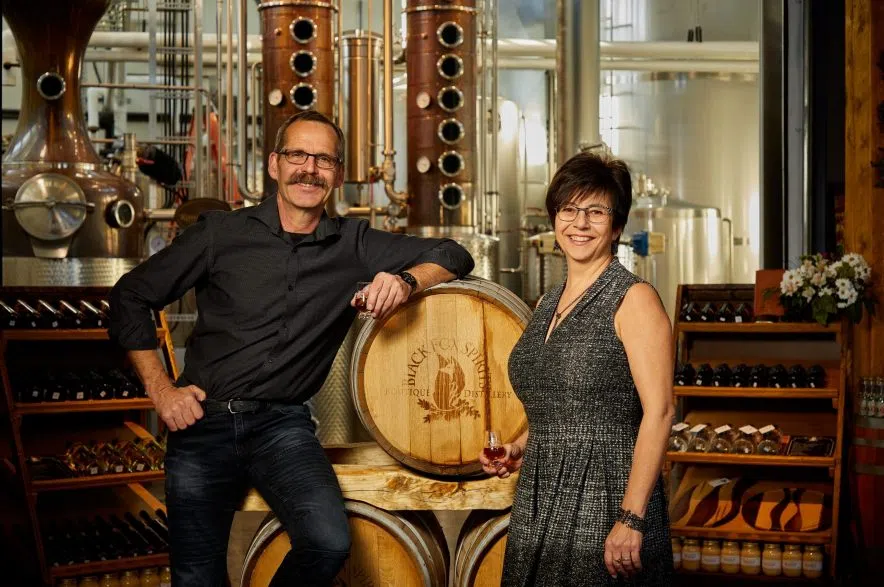
John Cote and Barb Stefanyshyn-Cote are proud of their sustainable farm and distillery. (Barb Stefanyshyn-Cote/Submitted)
“It’s that profound effect of the uncertainty (that) drives the hospitality business into the gutter, really,” he said. “Because people don’t know what’s coming the next day.”
Cote said Saskatchewan’s alcohol surcharge is necessary to retaliate against U.S. alcohol tariffs, but he doesn’t want to see trade negotiations “devolving into a schoolyard fight.”
“The goal is here (that) we want to get back to some kind of normalized trade between two countries,” he said.
Cote said the distillery gets some machinery parts from the United States, which will be affected by the countermeasures.
The Saskatchewan Liquor and Gaming Authority said American alcohol sales in the province dropped by 40 per cent over the past fiscal year.
Some provincial alcohol stores expect the percentage to plummet even further with the American alcohol surcharge in effect.
The SLGA said local sales have risen by five per cent in the past year.
Cote said he expects to see local alcohol sales to rise for all businesses.
“There’s a certain amount of Canadian pride now that people are going to say ‘well, here we’re going to try something that’s Canadian,’” he said. “That’s good for our business.”
—with files from 650 CKOM