


Murray Wood: Is it fake, or just stolen?
People looking for news on Facebook need to watch out for fake content. And even if it's true, it may have been stolen. ...
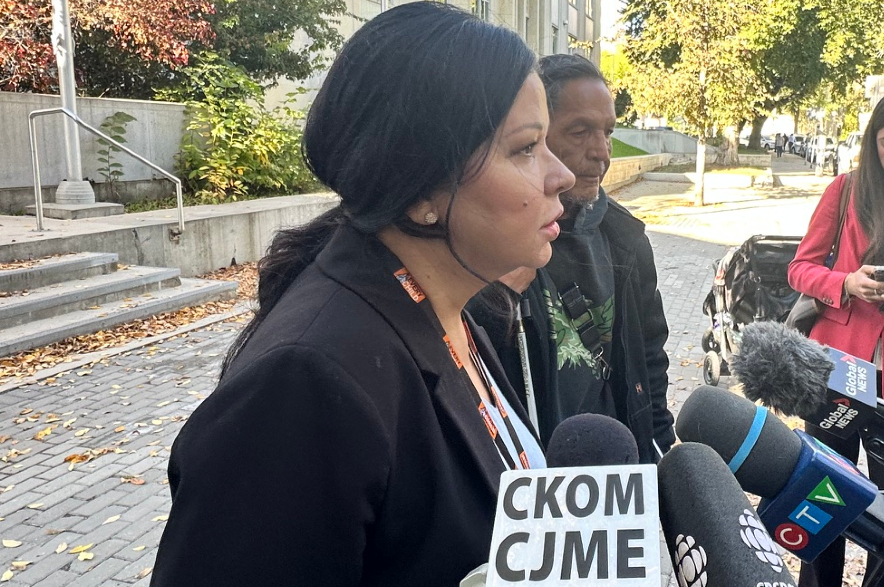
Justice Richard Danyliuk on Monday reserved his decision on an injunction to prevent the dismantling of a west-end encampment in Saskatoon.
Saskatoon lawyer Crystal Fafard had asked Court of King’s Bench to grant an interlocutory injunction to stop any action against the encampment until people there are properly housed.
A decision on the injunction is expected Tuesday.
Read more:
Fafard said in court on Monday that not granting the injunction and taking down the encampment would cause irreparable harm to the people living in the tent city. She said she wanted to avoid displacing people until sufficient shelter is available to house people.
Explaining that the application was neither frivolous or vexatious, Fafard said she was seeking a narrow, temporary and proportionate injunction, which would even allow for the City of Saskatoon to address its concerns over safety and sanitation at the site, as long as the encampment was not dismantled.
Should people be dispersed and cleared out of the area, Fafard said further strain could also be put on resources in the area, including police and hospitals.
During Monday’s hearing, Danyliuk and lawyer representing the City of Saskatoon, Alan Rankine, as well as Noah Wernikowski, who appeared by phone on behalf of Saskatchewan’s Attorney General, all spoke to issues of lacking evidence in Fafard’s affidavit.
Responding to those concerns, Fafard said she had hours instead of days to file the urgent application.
“There’s a public policy reason not to unhouse or to remove the unhoused people from this encampment. It’s a serious issue to be considered by the court, and I think everybody agreed to that, that there was a serious issue,” Fafard said outside of court after the two-hour hearing.
Rankine argued that the balance of convenience to be considered in the matter favours the city, with evidence suggesting that the encampment was putting the city-owned, private property at risk. He said there are plans for the future use of the site where the encampment is and also pointed out that those in the community have raised concerns over the tent city.
Speaking at the encampment on Friday, Fafard said she hoped the city would provide services if it can’t provide homes, along with garbage bins and sanitary supplies.
The attorney said it was a “good gesture” that the City of Saskatoon opted to hold off clearing the encampment and installing fencing on Thursday, as planned, until learning the outcome of the injunction hearing.
“However, the firemen did actually show up here,” she said. “It really did upset a lot of people. They were quite shocked by it, to be honest.”
Fafard said she’s hoping any further intervention at the encampment can wait “until we can, at least, get in front of a judge.”
“They need, like, the basic rights that every human is entitled to as a human right under Section Seven of the Charter,” Fafard explained.
Fafard said they’re entitled to life, liberty and security of the person, and that they don’t have that security right now.
Monday’s hearing involved the judiciary, the City of Saskatoon and Fafard, both as a lawyer and a representative of the Indigenous community – all entities she expressed confidence in.
“With those three entities, I suppose, coming together to make a reasonable decision, I have hope that we’re going to move in the right direction,” Fafard said.
“This is not the Saskatoon I know and appreciate, and I know so many Saskatoon residents are extremely concerned about these encampments.
“We all are. We don’t want them. We want security. But until they can get that actual housing security, they need to have proper facilities here.”
On Thursday, deputy fire chief Yvonne Raymer told reporters that in five years, an injunction has not been filed to prevent an encampment in Saskatoon from being taken down. Fafard said she understands that to be true.
The lawyer said her responsibility is to bring the safety concerns voiced by people in the encampment to the court on Monday.
Fafard said the city can speak for the rest of Saskatoon. She added that, as a homeowner who has lived here since 1982, she is very concerned about how people are being treated and said the city needs to do better.
Fafard said she thinks “anyone with empathy” would want to stand behind the encampment.
“We just have to do the best we can as Saskatchewan people and Saskatoon residents,” she said.
She also reminded people that the encampment is a community with its own governance structure, with David Fineday seen as “mayor,” dealing with issues that arise there.
Many people are seeking safety in the tent city. Fafard said some women she has spoken with at the encampment have voiced safety concerns after alleged assaults in some shelters in the city. While the lawyer has not verified those incidents, she said they worry some women.
People are also concerned with how they would get themselves and their belongings to a shelter, when many are a distance away from the encampment.
“There’s a lot of impractical, you know, just, hurdles for them to get around,” Fafard shared. “We really need the city to cooperate and find, you know, reasonable ways for them to … be housed.”
– with files from 650 CKOM’s Lara Fominoff
Editor’s Note: This story has been updated to correct a misspelling of Fineday’s name.