Murray Wood: 'One of the worst' should be on hats and T-shirts in Canada
U.S. President Donald Trump called Canada "one of the worst" this week, saying that soon we will come to him t...
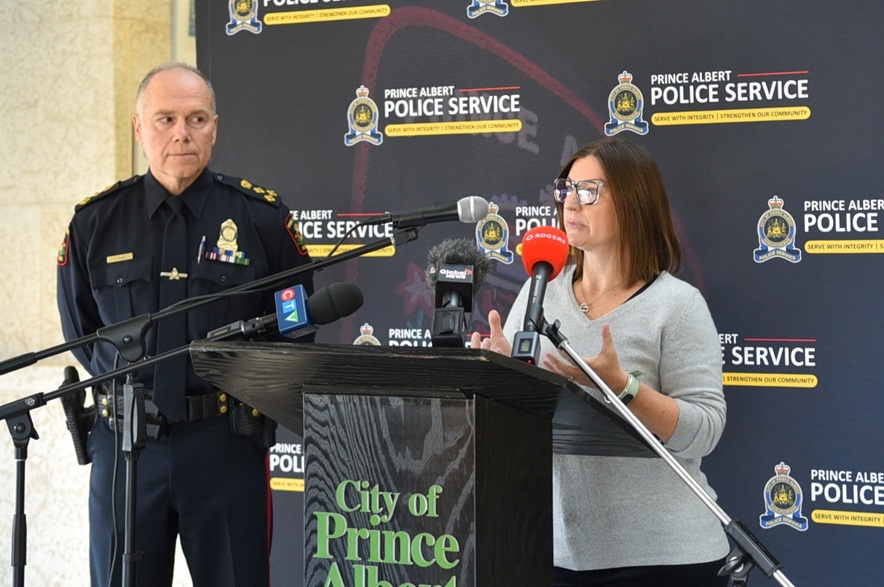
Prince Albert officials say new wastewater data that shows levels of cocaine and methamphetamine use in the city remain high should be treated as both a policing issue and a public health issue.
At a news conference Thursday, Anna Dinsdale, the city’s community safety and well-being co-ordinator, said the latest Statistics Canada wastewater results continue to show Prince Albert with high levels of use of both substances.
Read more:
When it first joined the program in 2023, Prince Albert had the highest levels of both drugs among the eight Canadian cities tested. That remains the case, and Dinsdale said the numbers give responders valuable information to help address the issue.
“Although I understand that this information may be concerning to the community, understandably, I think it’s indicative of the fact that as a community, we’re not looking away from the issues that we’re seeing and that we’re experiencing,” Dinsdale said.
The wastewater testing measures metabolites, meaning the substances have passed through people’s bodies before entering the sewer system. Dinsdale said that is important because it means the numbers reflect consumption, not drugs being dumped into the system.
It also means the data is tied to the wastewater system, not storm sewers or encampments.
The eight cities that participate include Halifax, Moncton, Montreal, Toronto, Edmonton, Vancouver, Saskatoon and Prince Albert, with results measured in milligrams/1,000 people/day.
Prince Albert’s cocaine metabolites show 5,296.48, Saskatoon is at 1,774.89 and Halifax is ranked third at 1,733.90.
There is less disparity when it comes to methamphetamine, although Prince Albert still has the highest values at 2,002.77. Saskatoon was 957.52 and the third highest was Edmonton at 624.18.
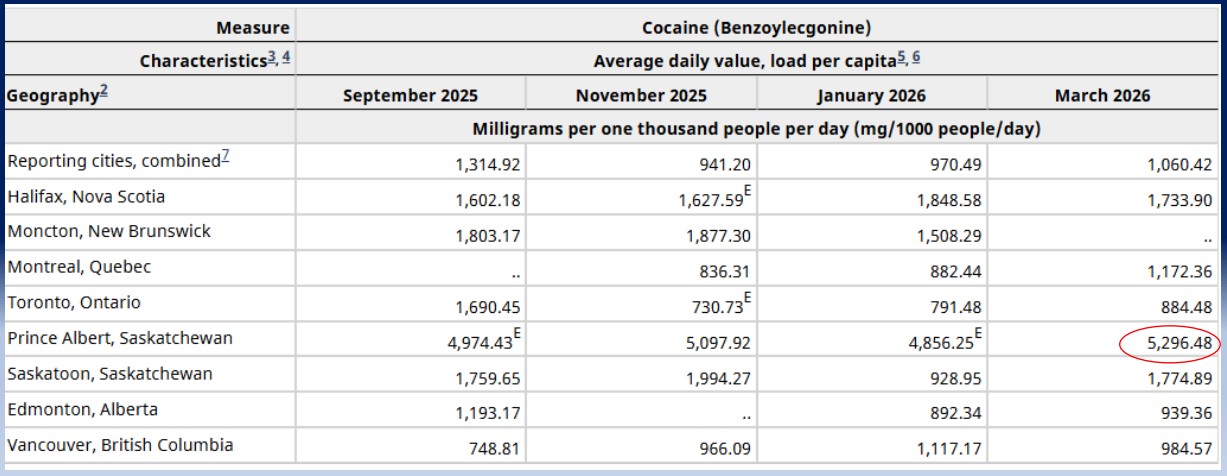
Wastewater results for cocaine metabolites in eight participating cities, including Prince Albert. (Statistics Canada/submitted)
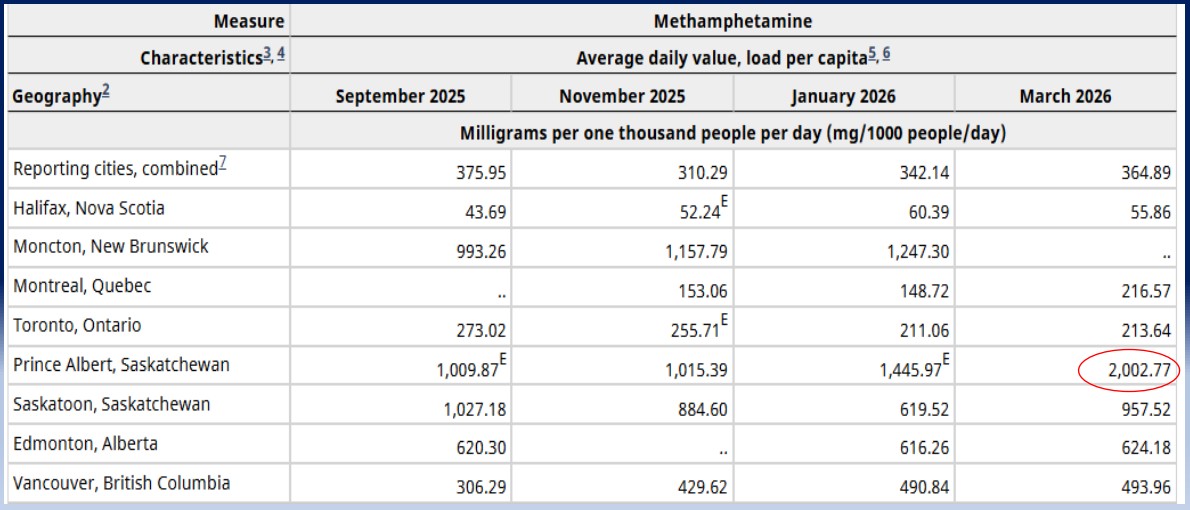
Methaphetamine metabolytes have remained more consistent, but have still risen. (Statistics Canada/submitted)
Police Chief Patrick Nogier said the results validate the direction police have already taken by focusing enforcement on suppliers and traffickers, while also showing the limits of enforcement alone.
“The answer to that is not more police more often,” Nogier said. “The answer is how can we be more surgical in our approach, be more dedicated towards using data to allow us to be more efficient in the way that we utilize our policing resources.”
Nogier said cocaine and methamphetamine are strongly connected to crime and disorder in the city, and the harm they cause to victims. However, he said police cannot draw a direct one-to-one link between a specific drug and a specific crime. He said recent police seizures in Prince Albert have involved kilograms, not grams, of cocaine and methamphetamine.
Statistics Canada has agreed to provide more detailed daily data to the city. That could allow officials to compare peaks and dips in wastewater results with other information, such as local events, overdose data, policing activity or calls for service.
The city may also explore more localized wastewater testing in the future, but Dinsdale said any move toward neighbourhood-level testing would have to be handled carefully.
“What we don’t want to do is inadvertently reinforce negative perceptions of any neighbourhood,” she said. “We don’t want to create fear of this Big Brother approach.”
Nogier said more granular data could help police understand both supply and demand, but said any new testing would carry costs and would need support from federal partners. For now, police will continue to rely on intelligence, calls from the public, Crime Stoppers tips, trends and investigations to guide enforcement.
Dinsdale said the wastewater results have already helped Prince Albert make the case for more support from other levels of government, including the mobile complex needs team and the complex needs facility now under development.
The mobile team received $3.6 million in federal funding and includes police community safety officers, Parkland Ambulance and Mobile Crisis. Dinsdale said Thursday the team’s caseload has already reached about 280 people, higher than the original estimate of 250.
The city has also joined a separate Health Canada wastewater project, which tests for a much larger number of substances, although it does not measure how much of each substance is present. Used together, she said, the Statistics Canada and Health Canada data could help identify emerging drugs and trends earlier.
Nogier said one of the key messages for residents is that recreational drug use can still contribute to organized crime and community harm.
Dinsdale said the city wants to shift the conversation away from stigma and toward substance-use health, including asking people to consider how their own consumption affects the wider community.
“If people are using recreational cocaine, there is a question to be asking themselves, which is: what contribution am I making to local gang activity, for instance, in our community?” she said.