Sarah Mills: B.C. election campaign goes from bad to worse for David Eby
Sarah Mills says the revelation that David Eby's family is receiving $10-a-day daycare when it isn't yet offered to ever...
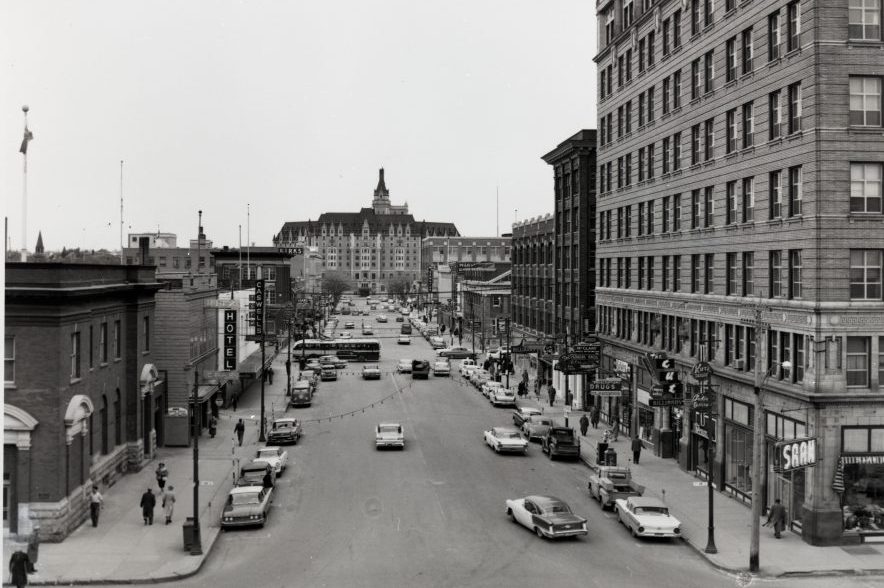
Everyone keeps telling Jeff O’Brien about a tunnel under 21st Street.
The city archivist has heard the story plenty of times: a secret passage connecting the old railway station with the Bessborough Hotel, allowing luggage and wealthy travellers to make the journey underground.
It’s a terrific story, but there’s just one problem: It isn’t true.
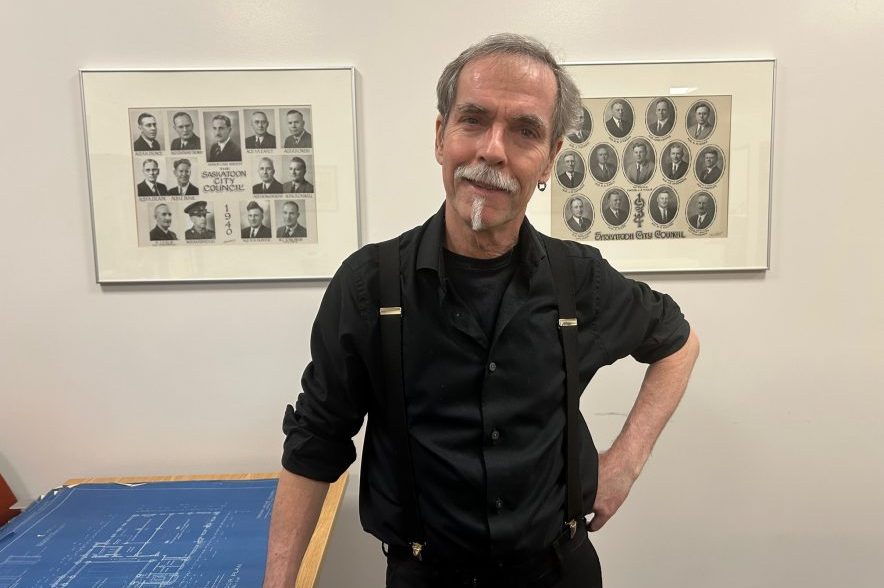
Jeff O’Brien is the City of Saskatoon’s archivist. He has searched high and low for any concrete proof of a tunnel beneath 21st Street, but has come up empty. (Brittany Caffet/650 CKOM)
Naturally, O’Brien did what any good archivist does when confronted with an intriguing urban legend. He looked for evidence. And, perhaps more importantly, he searched for the things that might explain how the story got started in the first place.
“People are fascinated by tunnels, right?” O’Brien mused.
The story of the 21st Street tunnel sounds plausible for a few reasons.
The Bessborough and the railway station were both built by Canadian National Railway in the 1930s at opposite ends of 21st Street.
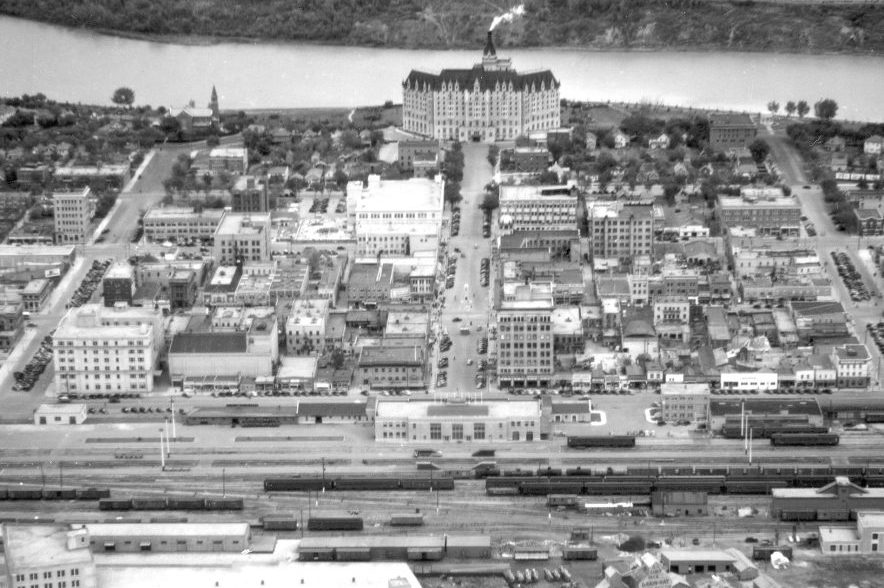
A tunnel connecting a grand hotel to a railway station makes for a great story. Unfortunately, city archivist Jeff O’Brien said in this case, it’s a complete myth. (City of Saskatoon Archives)
Put a grand railway hotel at one end, a grand railway station at the other and a Saskatchewan winter in between, and an underground passage seems almost inevitable.
Passengers could avoid the cold. Hotel employees could move luggage underground. It would also offer a discreet way for important guests to arrive at the hotel.
“There are places where railway stations have had connecting tunnels to local hotels. It’s actually not that uncommon,” O’Brien said. “But it didn’t happen here.”
He knows, because he went looking for it.
“We have the blueprints for the Bessborough Hotel,” he said. “I very carefully checked the foundation plan and there was nothing.”
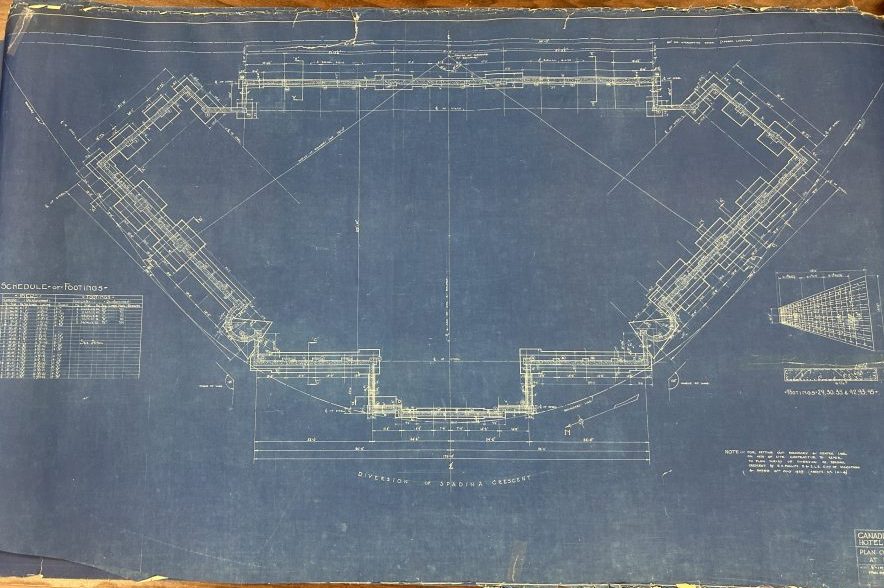
O’Brien has even pulled out the blueprints for the Bessborough Hotel. He says there is no indication there is, or ever was, a tunnel leading to the train station. (Brittany Caffet/650 CKOM)
And when you think about what would have been involved in building such a tunnel, the story starts to become a bit harder to believe.
“I would be a huge construction project to dig a tunnel down the middle of the busiest street in Saskatoon, move the Cenotaph, which used to be on 21st Street, and then dig this giant tunnel between the two buildings and then maintain it,” O’Brien said.
And he has a question for anyone still imagining the city’s secret underground passageway:
“A truck goes through. Who’s responsible? Who signed off on it? Whose dumb idea was it?”
It’s difficult to argue with municipal liability.
But the story had to start somewhere.
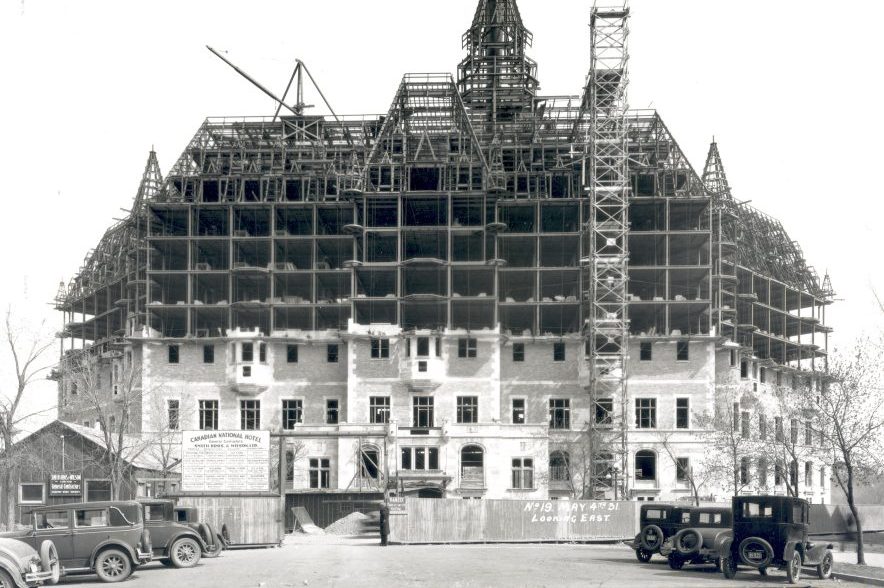
Construction began on the Bessborough Hotel and the railway station at roughly the same time. O’Brien believes that may have contributed to rumours of a tunnel connecting the two. (Saskatoon Public Library)
Construction on the Bessborough and the new railway station began at roughly the same time.
O’Brien can imagine people watching the work and wondering aloud: “Wouldn’t it be cool if they had a tunnel between the two?”
And that, he suspects, may be how the rumour begin.
“That kind of morphs into, ‘Oh, there used to be a tunnel,'” he explained.
Here’s where the story gets fun.
There actually is a tunnel near the Bessborough.
“It’s more or less right where we’re sitting right now,” O’Brien said, seated on a bench outside the grand hotel. “Crosses the road between the hotel and the underground parking garage.”
He said it was built around the late 1960s or early 1970s. So someone saying there is a tunnel beneath the street near the Bessborough isn’t exactly wrong. They’re just talking about a different tunnel.
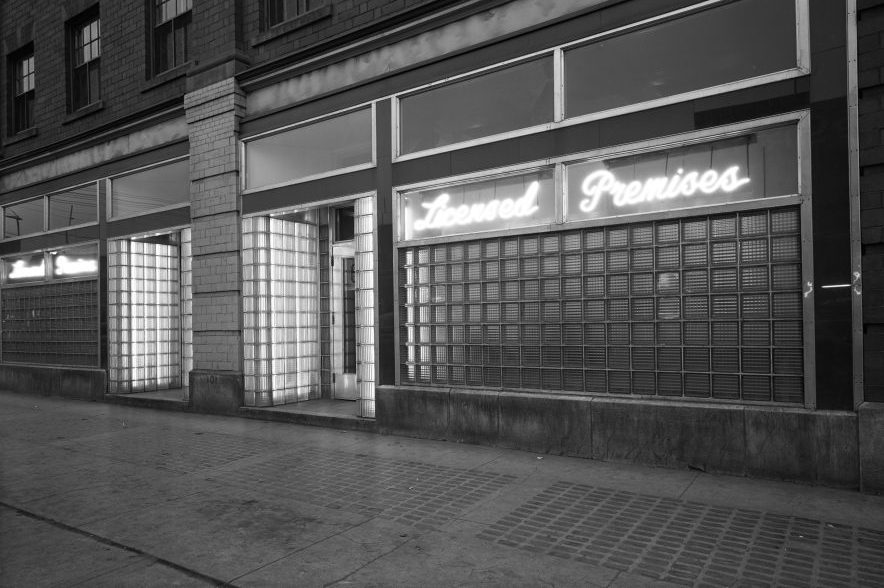
These prism lights in the sidewalk along 21st Street contributed to the lore of a tunnel running beneath the street. (Saskatoon Public Library)
And Saskatoon has other, real underground passages.
There were tunnels beneath the railway yards that allowed passengers to get from the station to the platforms without crossing the tracks.
The University of Saskatchewan has service tunnels.
Downtown buildings once had vaults extending underneath the sidewalks.
None of these were secret escape routes. They were just practical ways of getting from A to B or creating extra storage space.
But let a few decades pass, bury an entrance and forget who used it and suddenly, you’ve got yourself a fantastic tunnel story.
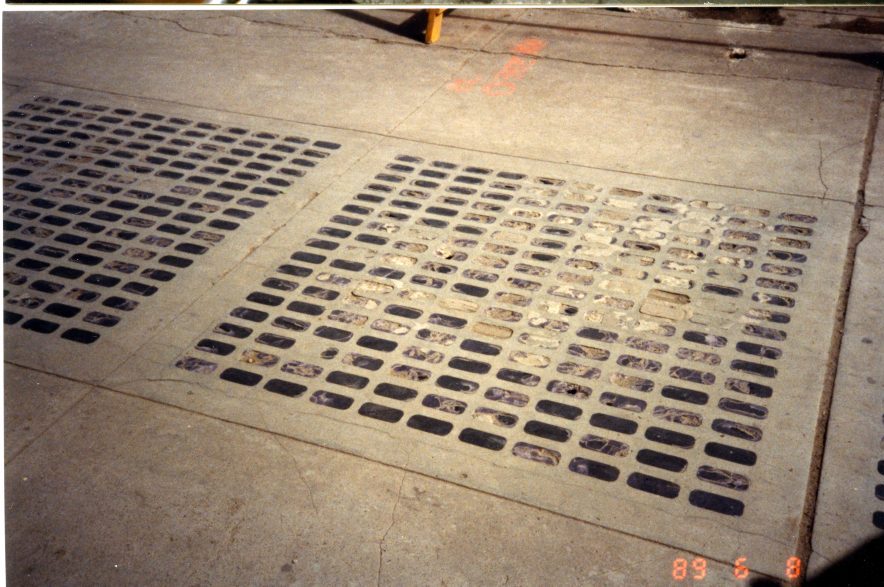
As time passed, the prism lights along 21st Street became increasingly damaged. Passersby would look down, see empty space and immediately presume there was a tunnel. Jeff O’Brien says in reality, they are sidewalk vaults extending from buildings. (City of Saskatoon Archives – Accession 2018-013)
A few years ago, workers at the Hotel Senator were renovating the basement, building out what would become the taproom.
Hotel owner Chris Beavis needed a doorway into a small area that had been walled off.
Behind about 18 inches of brick was dirt — packed in from the direction of 21st Street.
So they excavated it and, in the process, uncovered something nobody expected. A brick arch.
“I don’t know why that arch was there,” Beavis said. “It’s not on the plans.”
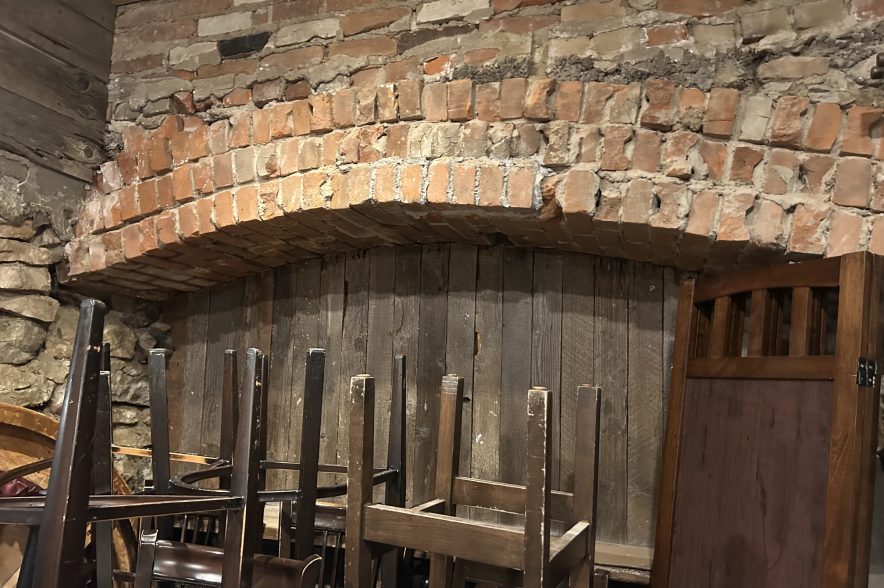
A mysterious arch was uncovered during construction at the Hotel Senator in Saskatoon. Jeff O’Brien said while it is intriguing, they quickly learned that the arch leads nowhere. (Brittany Caffet/650 CKOM)
The arch sits directly beneath the hotel’s old main entrance to the bar.
O’Brien said it’s possible that the original plan was to put an underground entrance there, similar to other buildings downtown.
“This is back in the day, and building material is expensive, energy is expensive,” O’Brien mused. “Maybe they just said, ‘Hey, this is a place where we don’t need 15 feet worth of of foundation wall. Let’s just build an arch, pack it full of dirt. No one will know.”
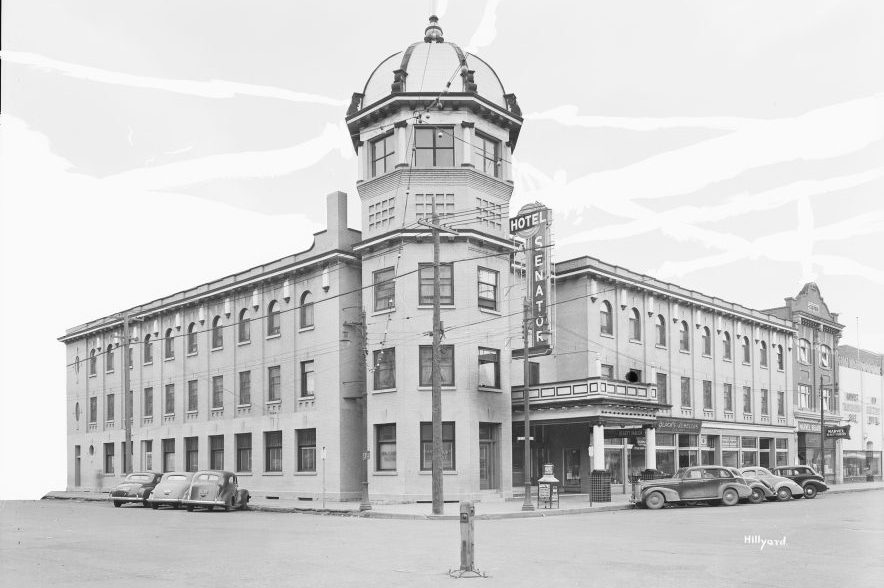
The Hotel Senator was built in 1907, and was originally known as the Flanagan Hotel. (Saskatoon Public Library)
But Beavis has a theory that is considerably more fun than the official record.
“My theory is that they were bootlegging back in the day,” he said with a wry smile.
There’s absolutely no evidence that’s what the arch was for, but Beavis said he likes the story anyway.
“It’s just an urban legend that I like to spread,” he laughed.
And honestly, it’s hard to blame him.
Saskatoon once had a small Chinatown, centred around what is now River Landing.
Stories circulated about tunnels running through downtown, connecting buildings along Second Avenue and forming a spiderweb around the small neighbourhood.
“The story was, in the 1920s that the police would would chase a wanted man into one end of Chinatown, and he would go through the secret ways and come out the other end, you know, chortling with glee as he goes,” O’Brien laughed.
The reality was much less dramatic.
“There were clearly places where people had had knocked holes in the basement walls to connect adjoining buildings,” O’Brien explained.
So there were connections, but it wasn’t the massive secret underground network people imagined.
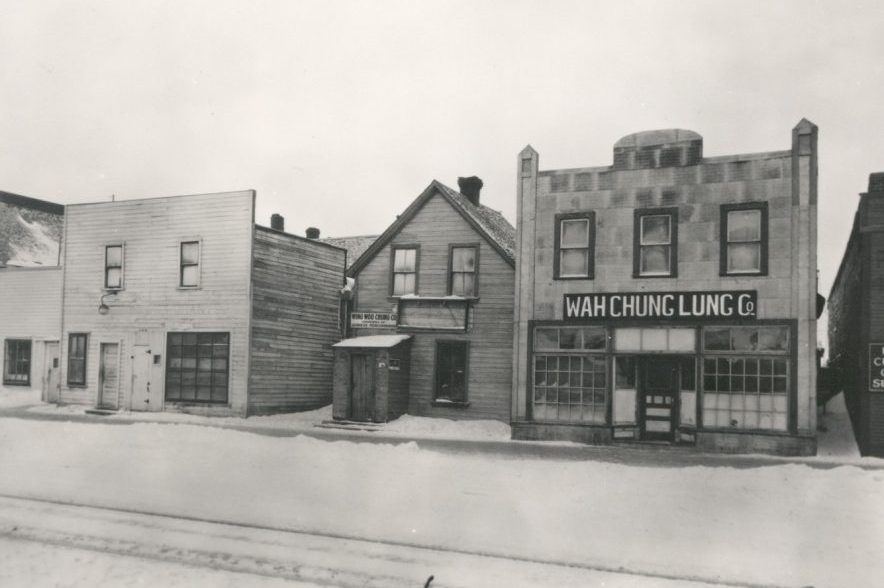
Nineteenth Street East in Saskatoon looked quite different in 1925 than it does today. (Saskatoon Public Library)
And that, O’Brien says, is how urban legends grow.
“Someone will put two memories together, and it becomes one story,” he said. Tell that story enough times and eventually “the fantasy becomes a reality.”
By the end of the walk, there is still no evidence of a secret passage beneath 21st Street.
No tunnel from the railway station to the Bessborough.
No underground highway for wealthy hotel guests.
No hidden route through downtown.
But there are forgotten spaces everywhere.
An archway buried beneath a hotel bar. Old railway passages. Sidewalk vaults. Service tunnels. Basement connections. Pieces of the city that most people walk over without ever knowing they’re there.
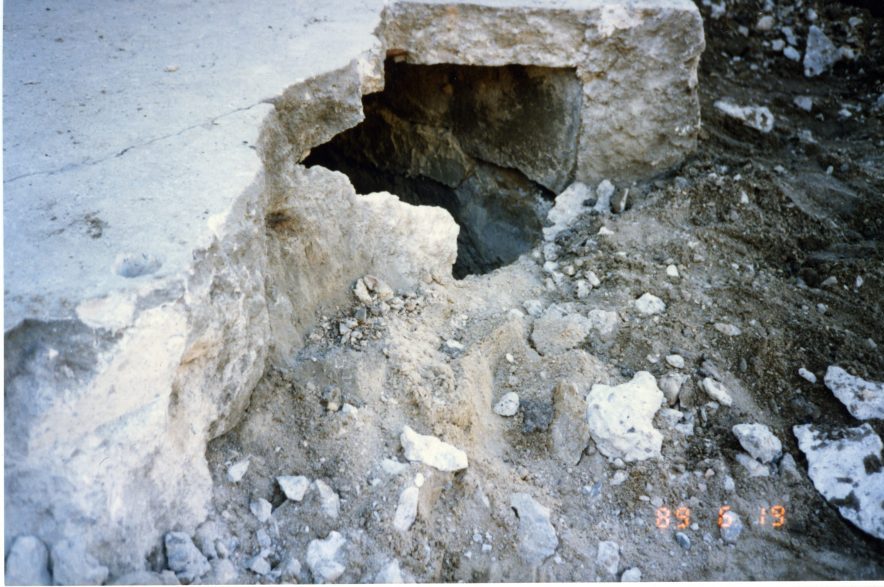
Construction work was done in the late 1980s to improve 21st Street. In the process, a corner of sidewalk was knocked off by equipment. The cavernous space below added more fuel to the fire of this tunnel legend. (City of Saskatoon Archives – Accession 2018-013)
And perhaps that’s why Saskatonians keep telling the tunnel story.
O’Brien certainly understands the appeal.
“I’ve been playing Dungeons and Dragons since 1979, and I’m all in favour of secret tunnels,” he laughed. “But alas, I fear the reality in Saskatoon, anyway, is a lot more prosaic.”
Then, almost as an afterthought, he started telling a story about Regina.
Years ago, O’Brien was working as a security guard in a building in Wascana Park.
He was alone in the building when he came around a corner and found a man standing there.
“I said, ‘What the hell are you doing here?'” O’Brien recalled.
The man said he worked at the power plant and had come through the tunnels to check some valves.
“I never thought about the fact that there were human tunnels that led from one building to another,” O’Brien said.
Which raises a rather obvious question: are there actually human-sized tunnels running into the Saskatchewan Legislative Building?
O’Brien’s answer was wonderfully matter-of-fact.
“Yeah, sure. They’re all connected.”
And just like that, the hunt for a mythical underground passageway leads us somewhere unexpected.
To Regina.
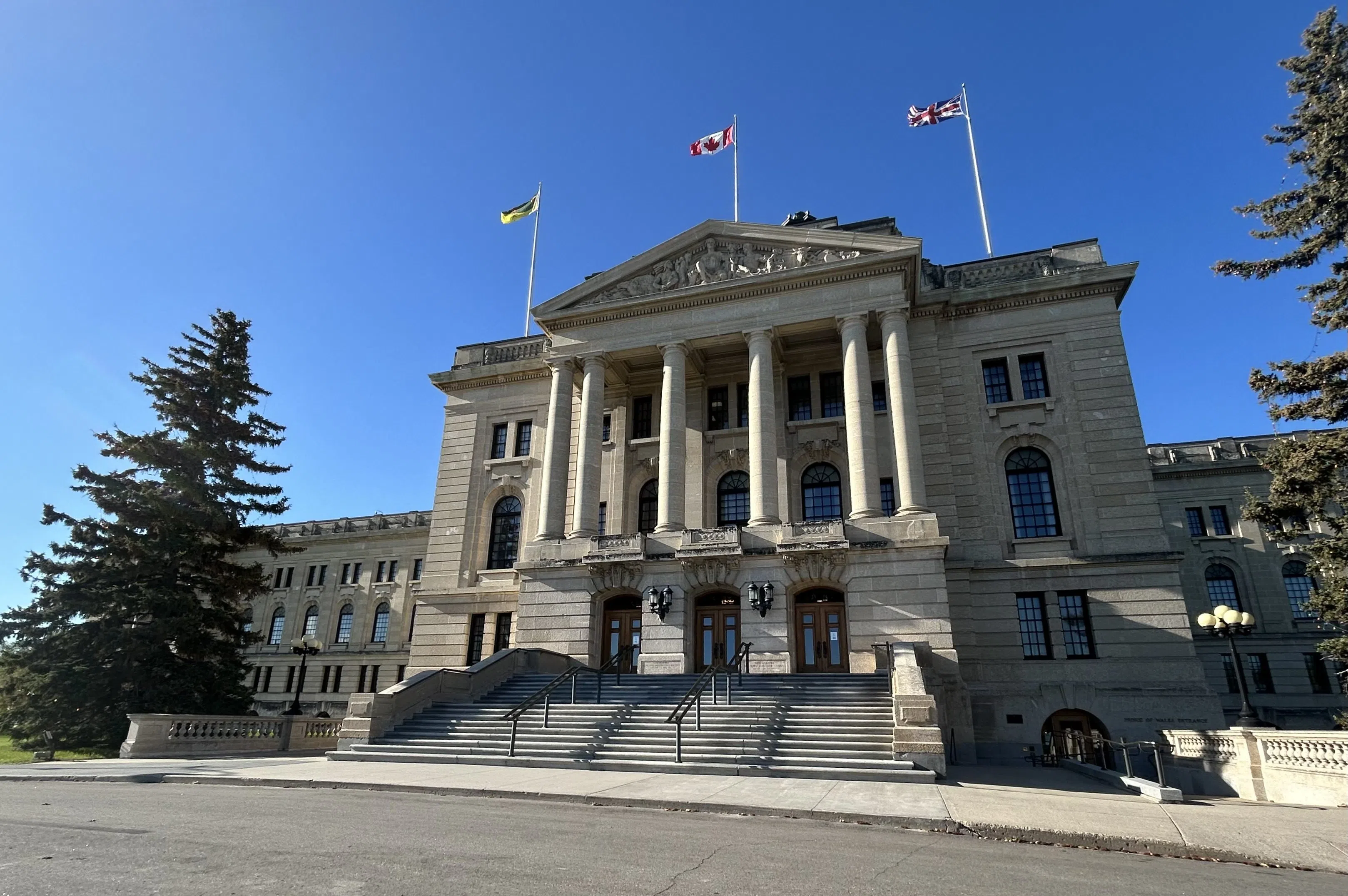
It is rumoured that nearly a kilometre of tunnels lie beneath the Saskatchewan Legislative Building. (Brittany Caffet/650 CKOM)