


Sarah Mills: There is no interference in the U.S. midterm elections
The U.S. ambassador to Canada is telling Canadian politicians to stay out of American politics. Sarah Mills says that's ...
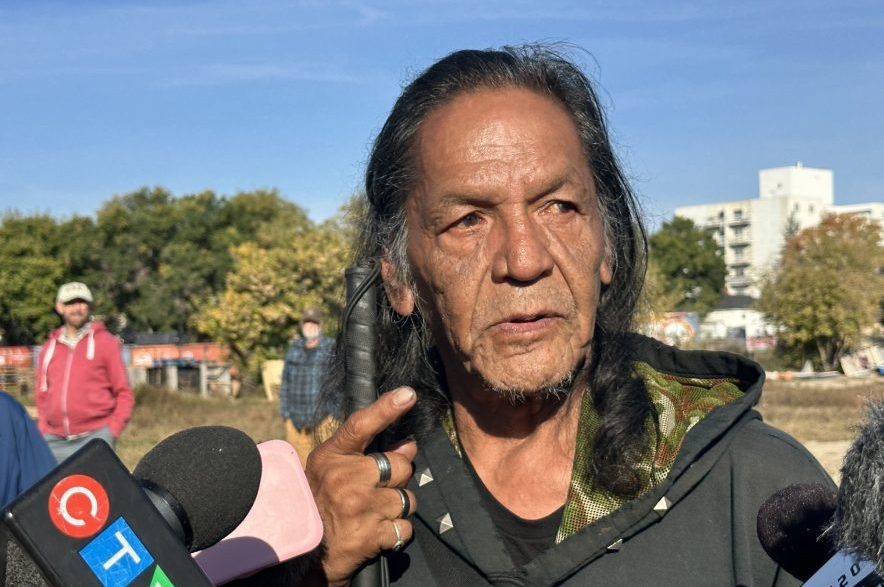
The arrest of the unofficial leader of the former encampment across from 20th Street West in Saskatoon – on the morning that encampment was taken down – has left him with questions and concerns.
David Fineday had just gone to get a coffee from St. Paul’s Hospital when he received a phone call that police were arriving at the 20th Street and Avenue K encampment on Oct. 8.
Read more:
“I came back, I grabbed my smudge bowl and my son was with me,” Fineday recalled. He said the pair approached the police officers to have a conversation.
Fineday was about to light his smudge bowl when he said officers grabbed him by each arm.
“One grabbed my stick,” Fineday, who is blind, said, “and they put me in a paddy wagon.”
The housing advocate and unofficial leader of the encampment had been living in a teepee on the property for about three weeks at the time.
Fineday was arrested on a charge of mischief over $5,000 and released with no conditions other than a promise to appear in court.
“I don’t know. I didn’t do nothing. I didn’t touch nothing,” Fineday said. “I just wanted to sit down and smudge and pray with them.”
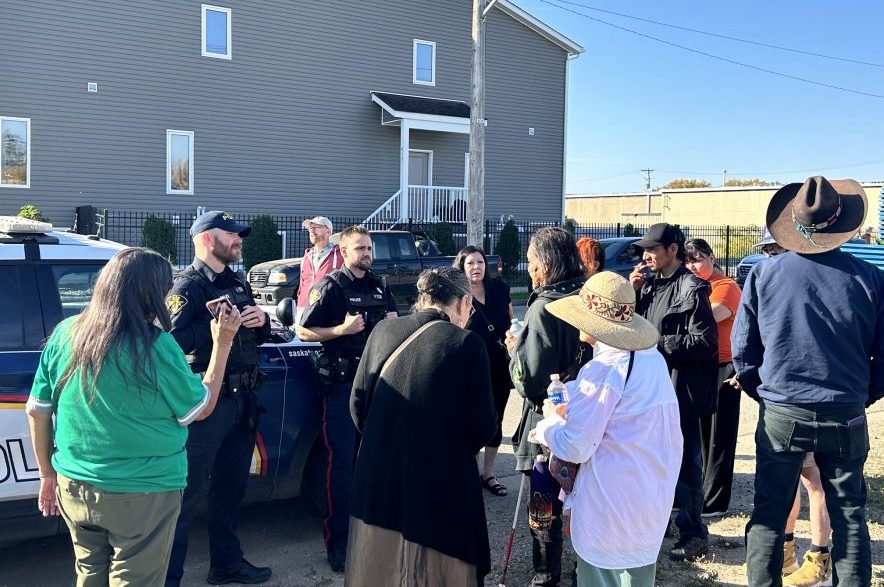
David Fineday speaks to police, surrounded by supporters of the encampment, on Sept. 24, 2026. (Libby Gray/650 CKOM)
Fineday said police took him and his son downtown to the police station.
“I had on a size 40 pants that I was given at The Bridge because I had a shower there, and I had to take off my belt and my pants fell down,” Fineday recalled.
He said police gave him a blanket to wrap around his waist while he remained at the station.
Fineday said he was told by officers he could leave by 11 a.m., but then was later told he couldn’t be released until the encampment had been cleared.
“They made me stay there until 5:30 p.m.,” the man recounted. He said he could see his son across the hallway in another holding cell. Fineday said they could see each other through the doors.
“I never got into mischief,” Fineday protested.
A release from Community Legal Assistance Services for Saskatoon Inner City Inc. (CLASSIC) stated that Fineday was held more than eight and a half hours, with “‘processing’ delays” cited to justify his length of time in custody.
The encampment, by that time, had been dismantled and fenced off by the City of Saskatoon.
“The prolonged detention raises serious concerns about the arbitrary use of police powers and whether the stated administrative process was used to prevent him from returning to the encampment while the police carried out a raid,” CLASSIC stated in a release shared on Oct. 9.
“What police described as ‘processing’ effectively kept an unhoused person and advocate away from the encampment for most of the day, at a critical time when his presence and support mattered,” CLASSIC further stated. “It also resulted in Mr. Fineday not being able to ceremonially take down his Tipi, which was home at the Encampment.”
“The timing and circumstances of the detention raise serious questions about whether the process was lawful.”
CLASSIC explained in its news release that it often has seen people released at the site of calls with an undertaking.
“An 8.5-hour detention of a legally blind, Indigenous person, on a mischief charge, is deeply concerning,” the release stated, adding that administrative procedures must not be a reason to restrict people’s freedom or advocacy. As well, CLASSIC stated that police must be able to appropriately justify their detention of any person.
“The mere invocation of ‘processing’ should not shield a prolonged deprivation of liberty from scrutiny,” CLASSIC said.
Responding to questions about Fineday’s arrest, Saskatoon police said in an emailed statement that the “duration of processing someone who has been arrested and charged can vary” due to changing “circumstances and demands occurring within our Detention Unit at any given time.”
Saskatoon police said a formal complaint can be made to the SPS Professional Standards Section, the Provincial Complaints or the Federation of Sovereign Indigenous Nations, if Fineday has concerns about his treatment.
With the matter now before the courts, Saskatoon police said they cannot provide further details about the charge or the reasons for it being laid against Fineday.
Lawyers with CLASSIC filed an injunction application on Oct. 5 to prevent the city from clearing the encampment. An earlier injunction application, made by lawyer Crystal Fafard and community advocate Sheela McLean, was not granted by Justice Richard Danyliuk in a decision released on Sept. 29.
A legal brief filed in response to the injunction application by the city argued for the dismissal of the injunction, stating there is no serious issue to be tried, no irreparable harm is occurring and evidence favours the city.
“The Encampment is on Private Property. The Applicants are trespassing. The Encampment is negatively affecting the safety, health and welfare of people, property and the environment and is affecting the amenity of the surrounding neighbourhood,” the city argued in its brief, according to court documents.
An application by CLASSIC challenging the constitutionality of the city’s bylaws relied upon to clear the encampment is also being argued.
“The application alleges that those bylaws violate sections 7 and 15 of the Canadian Charter of Rights and Freedoms, which protect the right to life, liberty, and security of the person, and equality without discrimination. It asks the Court to declare the bylaws unconstitutional and strike them down,” CLASSIC wrote in a news release shared earlier this month.
According to court documents, CLASSIC alleged the removal of the encampment would deprive people there of life, liberty and security of the person in various ways, including preventing people from feeling safe from the violence in Saskatoon shelters, increasing risk of mental unwellness or illness caused by exposure that could come from displacing people to a less-safe encampment, increasing social marginalization and depriving people of the privacy of their tents or tarps, among others.
Speakers at @cityofsaskatoon Governance & Priorities Committee Mtg. So far, a social worker and retired university prof. asking city to "do better." Also highly critical of Min. of Social Services w/ "impossible hoops" for many to access safe housing. @CKOMNews https://t.co/3Wg6aPU4s1
— Lara Fominoff (@LaraFominoff) October 14, 2026
Under section 15 concerns, the court documents pointed out that women and persons with diverse gender identities face additional safety risks and have greater difficulty accessing safe shelter spaces. It also noted that people with disabilities disproportionately experience homelessness and endure more unique risks. Indigenous people are less able to access safe shelter and have and continue to face experiences of racism and discrimination, impacting their ability to find housing, the court documents allege.
The documents also noted the lack of shelter space for people who are homeless in Saskatoon and said they “are not an appropriate solution for homeless people with complex needs for many reasons.”
CLASSIC listed portions of city Bylaw No. 7990, The Fire and Protective Services Bylaw, 2001, and Bylaw No. 8175, The Property Maintenance & Nuisance Abatement Bylaw living in the encampment.
David Fineday will have his first court appearance at Saskatoon Provincial Court on Nov. 10.
–with files from 650 CKOM’s Lara Fominoff