

Sarah Mills: Alberta's referendum is Canada's wake-up call
Sarah Mills says Canada needs better collaboration between Ottawa and the provinces. She says what's good for Quebec sho...
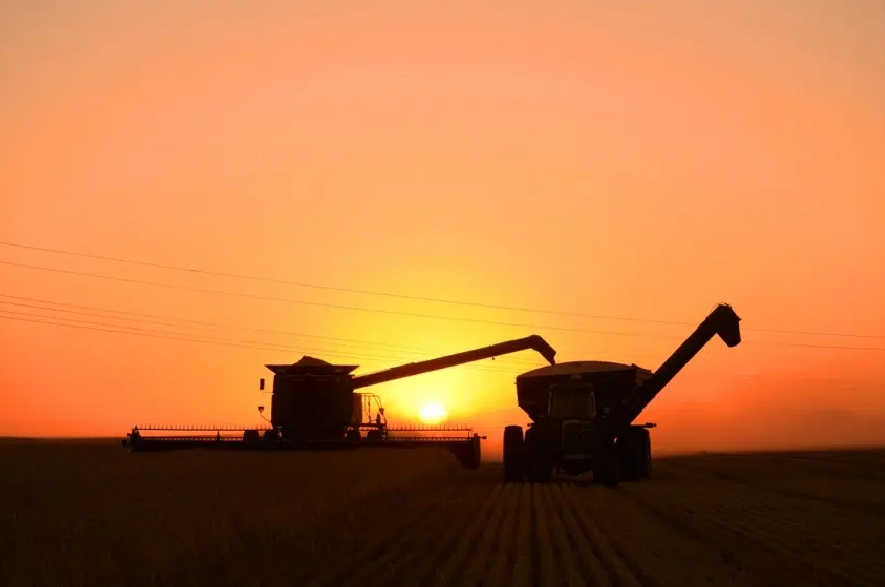
It has been a difficult harvest for Saskatchewan farmers.
The weather has had a significant impact, contributing to a late harvest, while geopolitical issues are affecting the cost of one thing that farmers can’t do without at this time of year: fuel. Shaun Haney of RealAgriculture joined The Evan Bray Show on Tuesday to discuss the issues disrupting this year’s harvest.
Read more:
The following questions and answers have been edited for length and clarity.
EVAN BRAY: I’ve talked about diesel prices quite a bit on the show, but I took a bit of time off to help my brother with harvest this year, and it’s pretty tough filling up. Even if you’re getting the benefit of the agriculture diesel prices, it’s still double what we were paying last year.
SHAUN HANEY: Yeah, absolutely. There’s been a lot of sticker shock, and if you have a lot of on-farm diesel storage you bought at lower prices, you’re feeling pretty good right now, and have a bit of a competitive advantage versus people that are buying in the spot market. It’s just added to the list of some of the concerns that farmers have about input prices. I was talking to Kate Sauser, who is the interim executive director of the Grain Growers of Canada, this morning. She said there’s an additional cost of like $17,000 per combine. That grabs your attention, right? Variables are out of their control. This is a good example of one, and quite honestly it’s kind of out of Canada’s control, because a lot of this has been caused by some of the bombing happening on refinery assets between Russia and Ukraine, and of course we still have the issues with the Strait of Hormuz, and so this has been the story through the whole summer season.
A few farmers have called in and talked on open lines, pointing out the fact that diesel is not one of those things you can opt out of. People can make choices around other input costs, and there may be consequences to it. But they can opt to do less of it or none of it at all when it comes to fertilizer, spray, those types of things. But diesel, you have to get the harvest off. You don’t really have a choice.
HANEY: Yeah, you can cut back on some of your fertility from a fertilizer perspective. You can maybe choose a cheaper herbicide product if you choose to go that direction. When it comes to diesel, I have to run that combine. There’s no questions about it. And even inside of a growing season, the opportunity to cut back on diesel consumption, maybe doing one less pass, you may not have the implements and be able to do that. So your volume is quite consistent, and farmers are incurring that cost, along with the trucking industry. We need diesel fuel to really power our economy.
You talk about costs being out of the control of the farmers, with the wet fall that we had, and being able to get into the field and get the crop off while it’s dry. A lot of people had problems both with the ground being dry enough and then the grain itself, so there was a lot of grain drying going on, and that in and of itself is a big expense.
HANEY: Yeah, without question. We talked about this before, where it’s not just about the annual precipitation. It’s when you get the moisture that is just so critical. Timing is really of the essence when it comes to moisture, and during harvest it is very untimely. And not just the grain drying costs and access to drying, but it’s also the downgrade in crop grades. Farm Credit Canada put out some numbers recently. If you go from a number one to number three on wheat, that’s like $50 an acre. Whereas we’re just talking about the diesel cost, that’s somewhere in that $15-20 an acre of increased cost. So in some ways, the untimely weather during harvest season causing some of the downgrades, moving from a one to a three on wheat, it’s even a bigger story than the diesel cost story at this point.
I know there are a few farmers still cleaning up the last bit of harvest right now. It feels late. I know as a province, they will do these markers of so much of the provincial harvest is done. Often that is of little solace to those farmers who still have some crop in the field. But it’s not totally without precedent to have farmers still harvesting on the 20th of October.
HANEY: No, it’s not. We’ve been behind that five-year average for most of the harvest season. Also behind the 10-year average, but not as much. If it’s still out in the field because maybe it was a late-maturing crop, that’s different than if it matured a long time ago and it’s been sitting out in the field or in a swath for weeks on end, continuing to get rained on. That’s a whole different story. So we have to take those numbers and apply some context to them, but for the most part, for farmers in Saskatchewan in total, it’s been a very challenging harvest.
The relationship between western provinces and Ottawa is obviously a pretty hot topic, given the fact that we saw the referendum in Alberta. I just wonder if you have thoughts on that when it comes to the implications for agriculture? Not that long ago we saw the federal government announce a major tax deduction to try and encourage and incentivize investment, which I’m being told could, in some cases, benefit farmers. But how does all of this interplay, Sean?
HANEY: Yeah, 76 per cent voting for Alberta to remain a part of Canada, that’s pretty much in line with what a lot of the pollsters were finding leading into this vote. I think it’s going to be very interesting to see what happens to Alberta Premier Danielle Smith, as I think she has people on both sides of that question upset with how she rode the fence. I also think it’s going to be interesting to see how Prime Minister Mark Carney reacts. Does he continue to follow through on this push for increased energy investment in the transportation sector and pipelines and the brutally slow Canadian approval process of projects? Does he continue to push forward on that, or does this sort of give an opportunity to sort of back off? I really hope that’s not the case. I think his relationship with Premier Danielle Smith has been relatively decent, a lot better than with former Prime Minister Justin Trudeau. Getting rid of that tanker ban on the B.C. coast would be a big, big change that would really get a lot of attention in Alberta. Now that this vote is behind us, it’s going to be interesting to see what the relationship is between Prime Minister Carney and Alberta, along with the other prairie provinces like Saskatchewan. You mentioned this mega deduction, which would allow 100 per cent immediate expensing on the majority of capital investment on a permanent basis. I think farm groups have reacted, saying this is a very positive change. It does potentially spur some investment, but again, farm profitability is so-so this year. The health of balance sheets is going to be really called into question. If you don’t earn the money, it doesn’t matter what the tax deduction is. You’re not going to spend it. So we’ll see, but it definitely has gotten a positive response from agriculture as being a good policy for the sector.
What are the top things on your radar as we get closer to the end of 2026?
HANEY: Well, I guess two things come to mind right away: resolution of some of these geopolitical issues. What happens with the Strait of Hormuz? That has a major impact on supply of things like sulfur and urea to the global fertilizer market. Obviously, we mentioned Russia and Ukraine already, and the impact that has had on the energy sector. Again, that works its way all the way back to the farm gate. And I think the other one that comes to mind is what happens here in terms of Canada/U.S. trade negotiations. We’re in that wait-and-see sort of situation. I thought it was kind of ironic that the U.S. and Mexico have been negotiating as of late, and it feels a little bit familiar at the late stages of those talks, all of a sudden, Commerce Secretary Howard Lutnick inserts himself and says he won’t accept some reductions in some of the steel tariffs. More and more, all of this comes down to steel and the auto sector, which are outside of agriculture. But we need to have, from a North American perspective, some certainty when it comes to trade and how Prime Minister Carney proceeds going forward, trying to find some sort of a deal with the Americans on some of these trade issues.