


Murray Wood: Who's hot... and who's not
Every Friday, Murray Wood takes a look back at the week's news and decides who's hot... and who's not. This week's list ...
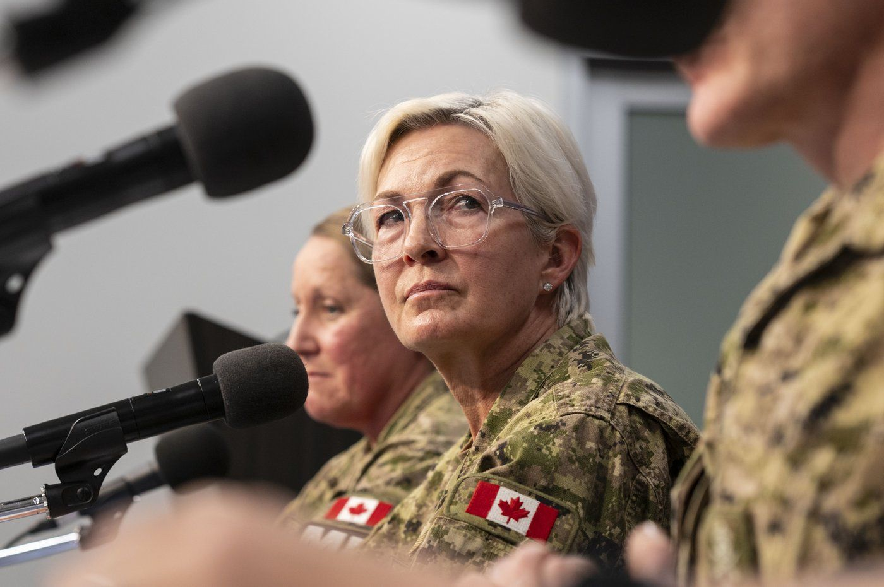
EDMONTON — Military officials provided an update Thursday on the investigation into the deadly fire at CFB Wainwright earlier this month.
Officials say four soldiers were killed and dozens more were injured when a fire swept over the base on Oct. 17. On Thursday, officials said 27 injured soldiers remained in various hospitals, with 13 in critical condition. Twelve others have since been released.
Read more:
The dead have been identified as: Pte. Shaun Farrell, 23, of Prince Albert, Sask.; Pte. Aidan Goulding, 23, of North Vancouver; Pte. Hayden Lykkemark, 19, of Langley, B.C.; and Sgt. Morgan Wong, 26, of Edmonton.
Here’s what we know and don’t know so far about the events of Oct. 17.
When and how did the fire start?
The fire started “as a result of a training event that was taking place on the anti-grenade launcher range,” Brig.-Gen. Vanessa Hanrahan, head of the military police, told Thursday’s press briefing. She said the training was “routine.”
It’s not clear exactly how the fire started. Officials said no gas infrastructure was damaged. Hanrahan told reporters there was “no indication that there was an explosion of any kind that resulted in the fire” or that an explosion was triggered by the fire.
Maj.-Gen. Wade Rutland of the 1st Canadian Division told reporters that, just before 4 p.m. local time, the fire spread to the pairs range, where soldiers train in pairs to provide covering fire.
Why did they continue training despite the fire?
Military officials wouldn’t touch on that question when pressed by reporters Thursday. Hanrahan said it’s part of the military police investigation.
“The investigative team is still out there determining all of the decision-making that happened once the fire started, up to and including when they responded to the incident involving the tragedies of today,” she said.
“So it would be inappropriate for me to speculate now about all of those decisions and any of the other aspects of the investigation. Once the investigative team has time to review all the evidence and do what it is they need to do, I’ll be in a better position to provide accurate information.”
How did the fire spread so quickly?
On Thursday, Rutland said high winds contributed to the fire’s spread.
“Uncommonly high winds took a pre-existing range fire towards the pairs range and it overtook (the soldiers’) position,” he said.
“The fire crossed the base fire guard and burned beyond the training base.”
Hanrahan said in her opening remarks that firefighters were unable to suppress the fire because it was in a “permanent danger area” of the base. Instead, the fire was being monitored, she said.
Permanent danger areas can be contaminated with unexploded munitions.
What were the soldiers doing at the time of the fire?
Rutland began his part of the briefing by correcting information he had given previously.
“I said the injured soldiers were conducting a section attack range. This was incorrect,” Rutland said.
“They were setting up for a pairs range. This is where two soldiers attack a target, taking turns covering and firing for one another. In our training sequence, soldiers re-qualify on their weapon individually, then conduct a pairs range, and then move on to the next progression, which is a section attack range.”
Who is leading the investigation and how long will it take?
There are several investigations in the works and it’s not clear how long they’ll take.
A military-led board of inquiry will look into the broader circumstances and make recommendations.
“Normally, those investigations are done to illustrate systemic issues for us to take actions on,” Chief of the Defence Staff Gen. Jennie Carignan said Thursday.
The military says a board of inquiry is “a fact-finding investigation” to determine how an incident happened and how similar incidents can be prevented in the future.
Rutland said previously the overall investigation would take at least a month, but on Thursday he broadened that timeline to account for the inquiry.
“This underestimated the scope of the upcoming board of inquiry, which will take as long as it takes to examine all facets of the situation,” he said.
Hanrahan said that inquiry has not been launched but it will be in the “near future.”
Hanrahan said the military police investigation is being conducted “independently from the Canadian Armed Forces chain of command.”
“Their role is to establish the facts and determine whether any criminal or service offence may have occurred,” she told reporters, adding 30 people are working on the investigation.
“The involvement of the military police should not be interpreted as an indication that an offence has taken place.”
She said the investigation’s findings will “be provided to Canadians” but did not say how long it will take.
The Alberta Chief Medical Examiner’s office, which probes fatalities in the province, is also conducting an investigation. No timeline was provided for that investigation either.
This report by The Canadian Press was first published Oct. 23, 2026.
— With files from Kyle Duggan and Nick Murray in Ottawa
The Canadian Press