

Sarah Mills: 'Associate member' is wrong wording in any Canada-EU pact
It appears Canada officially tying itself to Europe isn't part of what any future trade relationship looks like. Sarah M...
There’s been a lot of debate in Saskatoon on whether a new Downtown Event and Entertainment District arena should be built, or whether the current SaskTel Centre building could be renovated.
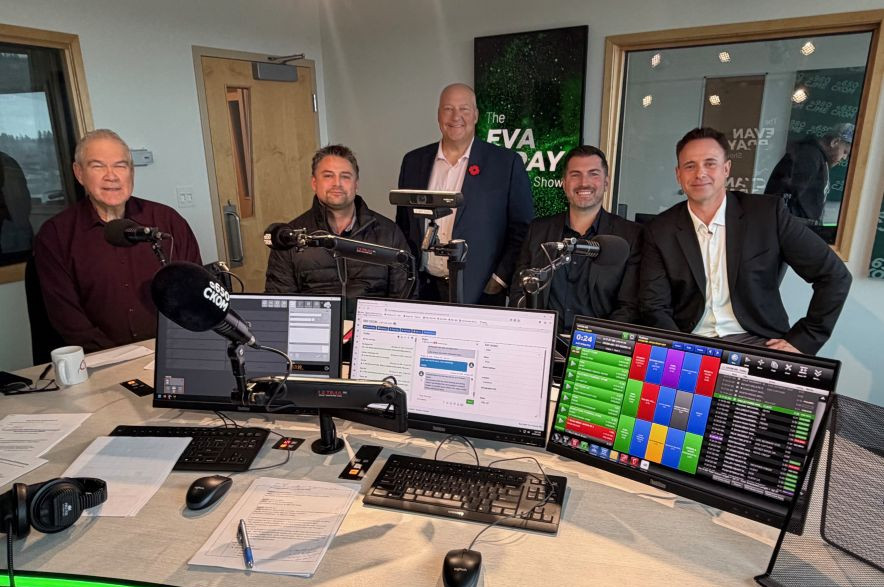
On Thursday’s Evan Bray Show, four community leaders, including Ward 4 Coun. Troy Davies, current SaskTel Centre CEO John Howden, former SaskTel Centre CEO Ken Wood, and 2024 city council candidate Courtney Saliken debated the merits and practicality of building a new downtown arena.
Read more:
Listen to the full interview, or read the transcript below:
The following questions and answers have been edited for length and clarity.
EVAN BRAY: This has been a 10-plus year journey. You (Coun. Davies) are one that says this is the right way to go for the city. You believe this is the right direction to go. Rather than review the whole history of it, can we jump into where we’re at today? How close are we to saying this is a go, and do we have an up-to-date cost estimate?
TROY DAVIES: It has been a journey, how we got here. I would say we can’t even have a debate today because in order to have a debate, you have to have what I call the two Fs: funding and facts. The updated facts – because right now we’re using 2024 numbers on really all communications that are going out there – we know those numbers are going up 100 per cent. The cost of steel alone, we know those numbers are going up. So I think January is the projected target date for those facts to come to council on not only the current facility and the renovation costs associated with SaskTel Centre and the update for the TCU renovation and the current arena downtown, if it were to move forward. Right now, this is an unfunded city priority. I want to make that clear. There are no funds associated with this currently. There is a plan, though, and I would say I’m hopeful that this comes through. The province has, for the first time, stepped up with Minister (Ken) Cheveldayoff and made an announcement probably just over a month ago that they are supporting an entertainment district downtown and an arena downtown to host, you know, I’d say the province’s concerts. That was great. We’ve heard nothing from the federal government – which we made clear in 2018 and 2021 that we need these funds – and we’ve heard nothing from our current partner that we signed an MOU (memorandum of understanding) with, Muskeg Lake Cree Nation.
Regardless of this referendum happening or not, is there a possibility that the funding estimates could come in and that puts an end to this? Is it possible it could be too high, too expensive?
DAVIES: I would say right now, if we don’t have the federal government come in, I can confidently say with this council – not that I like to speak for council – we’ve made it clear we need provincial, federal and a private partner on this project or it’s not happening. Our priorities right now that are funded that we’re seeing, pretty much every city has – police, fire, homelessness, snow removal, construction. Those are our top five that are funded. That being said, you have to have a plan and you have to look forward. And I think that we can get that funding, and I do think that downtown is a place to be.
I feel like my observation of this from the outside, you (Ken Wood) were one of the main leaders that came forward and said, “I want to start gathering signatures.” Is that fair?
KEN WOOD: Yeah, I’ve been talking about that for quite a while. That’s true. I think that right now, we do, indeed, have enough information. We know the scope of what we’re looking at, in terms of building this downtown entertainment district, and my position is that there just is not an adequate GDP lift for the city. I understand the arena business and moving it downtown versus a reasonable renovation at SaskTel Centre. The difference between the two over the next 10-20 years is just not there.
Courtney, your passion behind this and why you got involved (with the Saskatoon Citizens for a Referendum)?
COURTNEY SALIKEN: When I ran in 2024 for city council in Ward 4, it was one of the top topics that came up. It’s safety, all the other stuff that usually comes up, but one of the main questions I got right at the door is, “Where do you stand on the DEED?” So it was a hot topic starting to percolate then, and I think it’s just continued to grow because now more numbers are slowly coming through, and it seems like it’s going forward, but yet, we’re not getting quite the information. So when I met up with Ken about this, I thought, yeah, this is a very important thing. We’re not just a small group of people that need to have a say in this and we’re seeing that by the signatures that we’re collecting. It’s a lot of people have some questions, valid questions, on a project of this magnitude that we feel that it just should be put to a public vote to say, “Do we really need this right now or not?”
What is the main question? Is this about stopping or letting people have a say on the entire DEED? Is this specifically about the arena downtown?
WOOD: That’s right. Our resolution is with regards to the arena. We want planning for the arena to stop. We have enough evidence right now to demonstrate that this is just not viable for Saskatoon at this time. We’ve got an excellent arena. It is in need of renovations, but those renovations have to be reasonable and prioritised. We can’t turn it into a near-NHL facility, which we’re trying to build. But we do not need a near-NHL facility.
John, we’ve talked before about the upgrades or renovations that are needed. Give us a sense of what is needed and which ones you would say are essential infrastructure must-dos versus ones that we’d like to do because it would make us more competitive.
JOHN HOWDEN: I hear Ken say we have a lot of evidence to say that we don’t need it, and I would say Ken did a great job of running SaskTel Centre for close to 20 years, but he hasn’t been there in 15, and the industry has changed a lot in that amount of time. I have a lot of evidence to say that we do need to do something. We were told recently we’re a Triple-A band in a B building, and every band and every tour does a report card on our facility, and that doesn’t just stay with that tour. That is shared amongst Live Nation and AEG – the two big promoters, if they’re bringing it in – as well as all these bands, which have some of the same managers or production people. That affects what shows we’re getting at SaskTel Centre, and it’s all the things we’ve talked about before: We don’t have proper loading docks, which means we need more forklifts and more staff to actually unload the trucks and reload the trucks. It takes more time, costs more money. We don’t have a proper rigging grid in our facility, so that means, again, we need more riggers and more time to put up a show and take down a show.
Was it proper when the centre was built?
HOWDEN: When SaskTel Centre was built, concerts were definitely a part of the business plan. But actually, the main thing that was going on was a lot of trade shows, and so a big part of the design was to do around seven or eight major trade shows. But we did a lot more of those things that would take eight to 10 days out of our schedule for each one of those every year, and now we’re at the point where we do zero trade shows and we’re doing 25 concerts a year, plus the other things like PBR, monster trucks. There’s not an adequate number of dressing rooms. We’ve talked about ceiling height. We missed out on a Paul McCartney show, a Bruce Springsteen show, Roger Waters and Cirque du Soleil, just to name a few, because our ceiling was too low to hold those shows. Those are sellout shows, and we know that a sellout show at SaskTel Centre is at least $10 million of economic impact to the city for every single one. I can go on and on.
You’re talking about renovations that – it’s not that it’s crumbling, it’s that it is needed to entice performers or give us access to these bigger shows. Is there infrastructure needs that are dire and need to be done today?
HOWDEN: A lot of the things we talk about that are the dire pieces aren’t actually things that improve the fan experience. They’re just ageing infrastructure. It’s just no longer built for what today’s world looks like with our two customers. We have the touring act that needs certain things, and then there’s the fans that come to the arena. The concourses are jammed up. We don’t have proper retail spots for merchandise. We don’t have enough locations for food and beverage service. We need to double that number to be competitive in today’s environment. We need double the washrooms that we have – we’re bringing in porta potties for shows because we don’t have enough bathrooms. We get complaints on surveys after every event. “Your seats are so uncomfortable, I just don’t think I can come back. I love the content you’re bringing in, but I just can’t sit through a show.” Or, “I can’t get to the bathroom when there’s lineups. I can’t go to your event anymore.” And so there’s this interesting thing with our two customers that we service. Who’s going to stop coming first? Is it the band stop coming, because we don’t have the amenities for them, or is it the consumer, the ticket-buying public says there are too many compromises. And eventually, the tours go, “We can’t make money in Saskatoon because no one’s willing to come to the show and suffer through some of the issues.”
Funding is going to be a big part of this discussion. Like, what will the cost be to get the SaskTel Centre up to the point that it would be able to not turn away the Paul McCartneys of the world, but I don’t want to go there just yet. Ken Wood, you spent a lot of years as the former CEO of SaskPlace Credit Union Centre. What are your thoughts on what you heard John say? Do you accept that times have changed to the point that maybe some of these substantial renovations have to happen?
WOOD: Absolutely, and I have kept up with those times. I’ve consulted in the arena business over the past few years. I’ve stayed up to date with the business. I’ve spoken recently with executives at the Winnipeg Arena, senior executives. I think for an arena like this, you need a big sporting anchor tenant. So, we’re contemplating a near-NHL arena, and we’ve got a WHL team. The Blades draw 3,000-4,000 people. We’ve got the Saskatchewan Rush that now are down to 6,000 people per game. Both of those leagues are facing significant challenges. I think all franchises are having financial issues. The WHL, with NCAA eligibility rules, the whole CHL is facing an issue attracting talent.
You’re saying without an NHL team, you don’t feel it makes sense to build a new arena or to renovate the current one?
WOOD: It doesn’t make sense to build a near-NHL facility when you don’t have strong anchor tenants. The facility we have now has some minor issues. For non-NHL cities, we have one of the top three facilities in all of Canada. Cities larger than us would love to have our facility. Look at downtown Halifax. Their capacity is 10,000-11,000 people, 13,000 for concerts.
Do we know a cost? Because I think that the notion of, should we renovate versus should we build new maybe comes down to cost.
WOOD: I’d like to know the parameters. The parameters seem to be, when they look at the renovations at SaskTel Centre as an architect, how can we make this SaskTel Centre into a near-NHL facility? Well, we’ve never said that. It’s a non-starter. Like, why are we looking at an expansion around the entire concourse?
HOWDEN: Because that’s what’s needed to service the fan that comes to the event, so that they buy a ticket, so that we can bring in the bands to create the economic impact that’s required. You’re fighting against yourself. You’re saying don’t do the renovations, and eventually, if we don’t, no one’s coming. Our economic impact a year is between $120-$200 million for the City of Saskatoon. And your argument is, if we do nothing or we do a small renovation – and I don’t know what small means to you – but nothing’s cheap anymore, we are going to be at the point where shows stop coming, and we become a flyover city. Right now, Saskatoon and Saskatchewan punch above their weight. We are known across North America as a major concert market. We need to make sure we keep getting those shows into the future.
WOOD: I was happy to set that up. The boards initially said to run it like a business, and we took risk positions in concerts in order to get them. And that tradition has been continued, that I set up. The bottom line is not all the amenities in the facility, it’s, does your market have enough people to attract the event and pay the prices. Guarantees are getting huge, and Saskatoon is challenged.
This isn’t really about the rest, the convention centre, that stuff. You’re not standing in the way of that?
WOOD: That’s right. Our resolution is entirely on the arena aspect.
Are we a big enough city/province to build this arena? We just heard Ken talk about the fact we’re we’re looking to build an NHL-style arena without an NHL team. What are what are your thoughts and how has this been discussed as a city?
DAVIES: I would never sell Saskatchewan short, and we did that in the ’90s. And half my friends moved to Calgary to go to school and still live there. So, my role as a councillor is to continue to look forward on how we’re going to continue to make sure that Saskatchewan is a place that businesses want to invest in, that CEOs want to live in, and that our children – my children, my daughter who’s going to university – stay. These are types of legacy projects. But at the same time, you can’t do it on the backs of taxpayers, which I made clear at the start of the show. We don’t have actual funding on this project yet, but to say that you know we can’t punch above our weight class, it’s funny. I just had John pull these numbers and Hilary Duff’s concert – complete sellout, right off the top. Twenty-four per cent of the people are from Saskatoon. So you have 3 per cent of the people from the rest of Saskatchewan, 30 per cent from the USA. Nickelback sold out in, I think, nine minutes. Seventeen per cent of those people were from Saskatoon.
I lived most of my life not in Saskatoon, and so, is it easy for what could be up to 80 per cent of concertgoers outside the city to say “yes” when maybe taxpayers in the Saskatoon are worried?
DAVIES: Yeah, and I would be worried as well, which is why this council – I don’t want to speak for future councils – has made it clear from the beginning that in 2018, and again in 2021, to administration that we need to find funding partners for this. And as mentioned earlier, to have Minister Cheveldayoff and the province of Saskatchewan come out and say they want to promote this, similar to what they did in Mosaic. I drive to Mosaic Stadium to go watch Rider games. Same scenario. You know that’s a huge step forward that we’ve never had before, and I think it shows that the province of Saskatchewan is comfortable with us being the indoor concert hub for the province, whereas maybe Mosaic is that outdoor concert hub for major concerts.
The estimates that we have on costs are from 2024. We’re in the process of getting those numbers updated, but it may not be until January. $632 million for just the arena build, was the estimate. Many people saying, well, it’s going to clearly be more than that now.
WOOD: I’d like to correct that. Within the BTY report, it’s $749 million. That’s the cost report that had the $632 million, but that was if you built it suddenly in 2024, in 2024 dollars. The BTY report has escalated dollars to around 2030 because you’re not going to build it immediately. We can’t even build it now by 2030.
I see what you’re saying. The same argument could be used on the cost estimate, though, for the upgrades to SaskTel Centre, which were $300 million. I’m guessing there would be a report that’s showing that could be higher. Do you take exception with the $300-million number?
WOOD: Absolutely, because of the scope. The scope of what they are proposing is unnecessary and unneeded. You look at the private management team from the United States, the OVG 360, that they considered to run the facility. They built a facility in Palm Springs, California, and it’s smaller than SaskTel Centre, and smaller concourses and doing very well.
Is the scope out of whack? Do you think that $300-million estimate covers the things that are necessary?
HOWDEN: We brought in experts that took a look at things, and they’re saying that’s what it’s going to take to get us to a standard where we can be in our building for another 30 years. We need to upgrade the facility so that we can compete with everybody else. And when you look around at our neighbours in the provinces on either side, Winnipeg’s arena is definitely 15-ish years newer than ours. Edmonton’s is 10 years old now, believe it or not, but it’s still new. Calgary’s getting a brand new one, of course, Vancouver. So, yeah, we’re competing with them and trying to get on the same routing as them. It’s one of those things where they look at Canada and they want to route those shows through western Canada, and we want to be on the map for that. These are the things we need to do. Like I said, to service those two customers, it’s not just about back of house and it’s not just about more concession stands. It’s the totality of the whole building is 40 years old and needs a significant amount of work to be made modern, so that we can keep bringing in the big events.
SALIKEN: I just want to touch base on that arena number of $632 million because I take objection to that, and this is where it all boils down to transparency and what we’re hearing from the public. You can take a number from a quick snapshot and build a case based on that, but if you actually look at the BTY report, which I have in front of me, $632 million escalation cost built over time. $750 million. You add the parts and stuff that are surrounding the arena, which is going to be part of the need, the plus or minus 15 to 20 per cent – which is built right into that report, which we know is going to come into factor. We’re getting closer to a billion dollars now. That’s not even including land costs that have already been purchased. So, upwards of maybe $1.2 billion. And now you add two years down the road of 2026 numbers. We’re probably looking at that $1.6 billion and I will almost guarantee north of $1.6 when those figures come in January of 2027 of what the cost is. So $632 million, yes, but we’re not going to build an arena one day.
If we get a report in January, Courtney, that shows what kind of that inflated cost is, and it is not in line with what you just said, do you accept those numbers or are you still sceptical? When the new numbers come in, there’s going to be plus or minus added to that, right? There’ll be a number, and then there’ll be give or take on either side.
SALIKEN: We’ll have to see when the numbers come in. But at the end of the day, it’s boiling down to is it affordable, and I know Councillor Davies and John have mentioned, as well, that, yes, we’re still waiting on other factors of funding, which I totally agree with. It’s, again, the conversations that are being had, we still hear it’s not going to fall on the taxpayers which, okay, that’s great if it can happen, unbelievable. I don’t see how that can happen at this point, but the project is still slowly moving. We’re still spending money in the background.
When I had you on my show previously, I said to you, if we could secure a significant amount – I don’t know what that is – of private funding for this, does that change your opinion? And you said, “yes.”
WOOD: Oh, absolutely. And that’s the thing about this type of project.
You’re worried about cost to taxpayers, mostly?
WOOD: That’s right. We are an outlier in this project in North America. About the only other example you can point to is in Quebec City, where it was 100 per cent basically government-funded. Here, we’re trying to do 100 per cent government-funded on a near-NHL facility. There should be a private advocate for this facility and there is none.
DAVIES: I agree, 100 per cent.
Is there a private advocate?
DAVIES: We’re in conversations with a potential private partner right now, Muskeg Lake. And it was reported at council two weeks ago – their words, not mine – that they’re looking for a significant capital injection into this program, into this opportunity. The other thing is the consultant reports that keep being brought up here. These were all public at council two weeks ago. It would have been great for these questions, if you have concerns, to have come to council because all 51 of those public reports were shared. I made the motion. I asked administration to bring it back so that these specific questions could be asked in public.
WOOD: Troy, they were public in 2024 and that’s the basis that we’re upset about.
DAVIES: It’d be great for you to come ask the question in public, then to let the administration respond. You can agree or disagree with what administration has to say to it, but to not show up and even ask the question.
SALIKEN: I’ve actually asked the question various times through emails, which I’ve documented and have gotten no response.
DAVIES: This is fantastic that we’re having this conversation because it’s happening and it’s good. It’s Saskatchewan. I have this at the Y with a lot of members every morning, having these great chats. But you know, just from the perspective of how we got to the vision for downtown, because everyone keeps saying arena. Just my personal opinion is, we have the opportunity in Saskatoon to be the first of its kind, where we have our province’s largest mall, we have our convention centre, we have our arena, and we have two hotels all flanked, where you could actually walk underground with a T-shirt on in minus 50-degree weather, and access all five. You have a hairstylist working in Midtown Plaza. You could have the opportunity of downtown thriving, and in all major cities, you see, you need a thriving downtown. That’s kind of where I’m at. There’s no funding for it, though. So it’s a vision, but it’s in order to plan, you need vision.
HOWDEN: I think it just really comes down to Saskatchewan and Saskatoon really want to be places where people want to stay and live, and have these events coming to our city, which do create jobs and the economic impact, and hopefully keep people in our city and attract, like Troy said, CEOs and other positions to come and want to live in Saskatoon. And if we don’t do something substantial –this isn’t a small renovation that costs $20 million – we’ve looked at it. The path is to go to a new facility because the renovations would be so substantial. That was the last reports, and so we need to do something substantial to keep and make sure that we are on that map for the future, so that people have that entertainment here. They shouldn’t have to drive somewhere else to get it.
SALIKEN: We wouldn’t be here today without the volunteers that we’ve had step up to the plate for and against the arena, signing the petition. We’ve had many people who are for the arena signing the petition just to put it to a vote. So I thank you, each and every one of you volunteers that is out every single day collecting signatures. Applause to you, because we would not be here right now if it wasn’t for you guys.
WOOD: I think we have to understand, you know, what an arena is, and it is not the be-all and end-all that is being set out by city council. It is not what Prime Minister Carney calls a nation-building project. An arena business is an import business. They import talent, and the major expenditure that is made goes down the road. The artist takes the money out of the province, so you’ve got to consider that. There are tonnes of studies – economic studies, independent economic studies – that show that an arena facility does not have a huge impact on the economy in proportion to the investment that’s been made. So, what you know, what we need to do to convince people is to show the difference between a reasonably renovated SaskTel Centre versus a very, very expensive new facility. When you look at this project compared to any other capital project before in Saskatoon, it’s way too big.
Let’s say the referendum goes ahead, and the referendum shows the majority of Saskatoon citizens say no. Will council abide by that? And if the referendum fails and the DEED goes ahead, will you be okay with that?
WOOD: I won’t be okay with it, but you respect the process.
Or does the fight continue?
WOOD: It’s going to be a long journey, and I think these discussions have to continue.
DAVIES: We have 310,000 bosses at city council, and if they tell us and majority of it, it hits the bylaws and the numbers it needs to make, those are the rules. We’ll follow that process. It’s black and white, actually. Shout out for Cameco, though. Whether you agree on the new downtown entertainment district or renovations or not, I would say all of us are in agreement that it’s great that Cameco is making a major announcement today to take over the 10-year naming rights for TCU Place and also a shout-out to TCU Place for being the naming rights previous to that.