

Sarah Mills: 'Associate member' is wrong wording in any Canada-EU pact
It appears Canada officially tying itself to Europe isn't part of what any future trade relationship looks like. Sarah M...
What started as a promise made in a hospital room after the death of an 11-year-old Regina boy could help save lives across Canada.
“Henry’s Law” takes effect in Saskatchewan on Sunday, requiring carbon monoxide alarms in every residential suite in multi-unit buildings, regardless of their proximity to fuel-burning appliances.
Read more:
But the changes may not stop at Saskatchewan’s borders.
Eric Schmalz, Saskatchewan’s government relations minister, announced on Thursday that six other provinces and territories are seriously considering similar requirements following the death of Henry Losco in Regina last December.
He said Alberta, British Columbia, Manitoba, New Brunswick, the Northwest Territories and Yukon are all reviewing the possibility.
“Henry is going to save lives. He’s going to save lives not only in Saskatchewan. He’s going to save lives across this country through the advocacy of his parents,” Schmalz said.

Henry Losco died and his father Sergio Losco was treated in hospital as a result of the carbon monoxide incident on Dec. 19, 2026. (Geoff Smith/980 CJME)
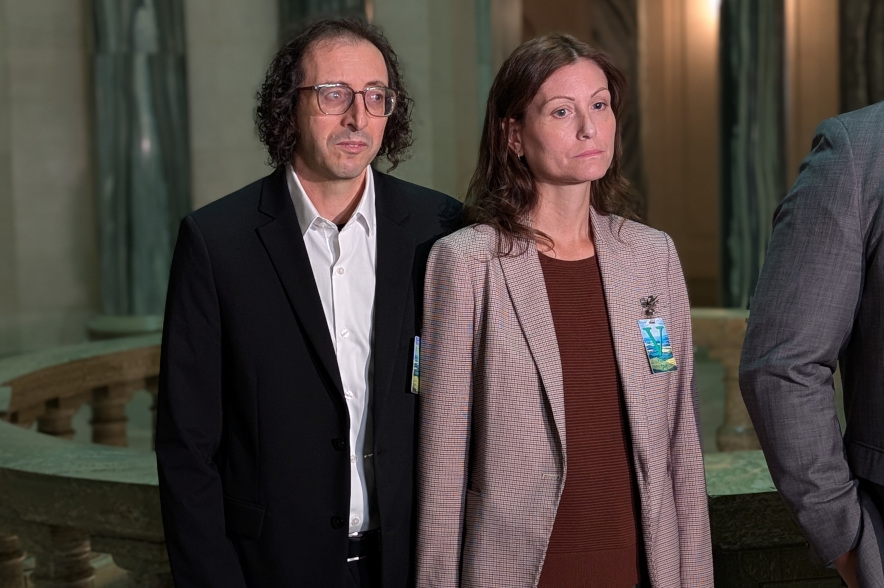
“Today was a good day, but it was also overwhelming,” said Henry’s mother, Marina Hills.
Hills recalled sitting beside Henry’s father, Sergio Losco, while he recovered in hospital following the carbon monoxide leak that killed their son on Dec. 19, 2025.
“I sat down on his bed and I said, ‘We have to do something about this. This isn’t right,’” she said.
The couple set two goals: to prevent another family from experiencing the same tragedy and to seek justice for their son.
“When Minister Schmalz sat us down a few minutes ago and told us that six provinces were on board and that this could go federal, to the National Building Code, we found it hard to process because the government did exactly what they said they were going to do,” Hills said.
Schmalz said he shared Henry’s story with ministers from across Canada during meetings earlier this year. While no other jurisdiction has yet committed to adopting the requirements, he said the interest is encouraging.
“I can’t speak to their timelines at all,” the minister said.
Henry Losco died after carbon monoxide spread through an apartment building in the 1800 block of Albert Street in Regina.
His father survived, but required hospitalization.
Since then, Henry’s parents have pushed for stronger carbon monoxide safety requirements, working with both the provincial government and the Saskatchewan NDP.
But Thursday’s announcement was bittersweet for the family.
“Our son was kind. He still believed in Santa. He believed in the magic of Christmas,” Hills said.
“We, unfortunately, didn’t get to have our Christmas with him last year because he died on the 19th, and this has forever changed us.”
She said the family is still struggling to process how far their advocacy has come.
“Henry’s legacy at only 11 years old is going to live on,” she said.
Schmalz said under the new rules, carbon monoxide alarms must be installed in sleeping rooms or within approximately 16 feet of them. Municipalities will enforce the law, with the province expecting a gradual approach that could begin with warnings.
“If you don’t see any carbon monoxide detection, talk to the landlord about it,” Schmalz said.
Although the legislation is taking effect this weekend in Saskatchewan, Hills said the family’s fight isn’t finished.
The couple continues to advocate for carbon monoxide awareness while pursuing legal action related to Henry’s death.
“The lawsuit, yes, it’s ongoing. The wheels of Canadian justice are unfortunately really slow, but we have nothing but time now,” she said.
–with files from 980 CJME’s Lisa Schick