


Sarah Mills: LEGO prices are becoming ridiculous
Gone are the days of a basic LEGO set. Sarah Mills says sets for adults are so intricate and large they run up to $1,000...
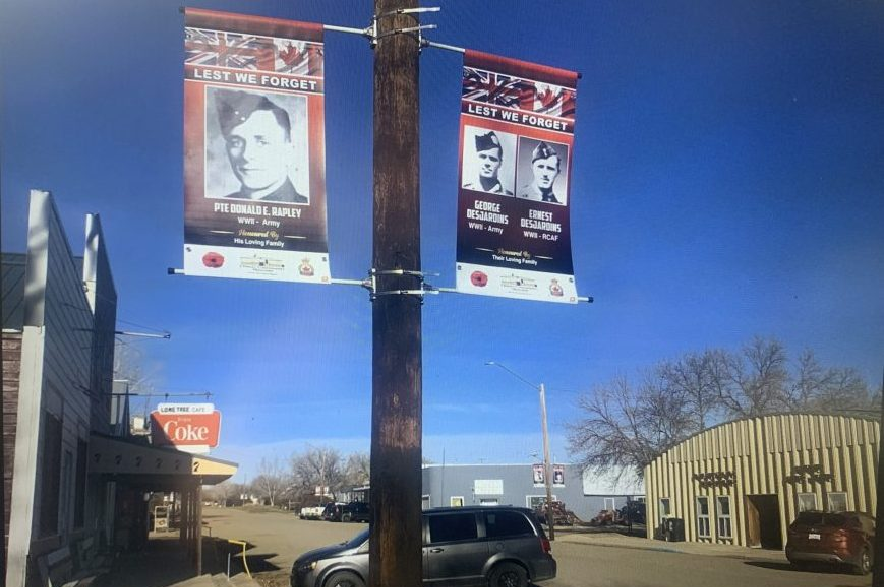
Veterans’ faces are appearing along main streets in several Saskatchewan communities, giving residents a chance to learn about the men and women who served their country.
Ahead of Remembrance Day on Nov. 11, towns and villages across the province are displaying banners featuring photographs, names and service details of local veterans.
Read more:
In the village of Climax, near the Saskatchewan-U.S. border, the tradition is entering its fourth year.
Marina Gryde, curator of the Climax Community Museum, said the idea came after she saw similar programs in other parts of Canada.
“I thought, ‘Why shouldn’t we have them in our small villages?’ You know, our small towns,” Gryde said.
She said she began researching the programs by contacting museums and Royal Canadian Legion branches across the country to learn how they operated.
After gathering information about everything from applications to banner production, she brought the idea back to the museum board.
“They agreed, and thought it was a great idea, so that’s how we got started,” Gryde said.
The community’s response has been positive, Gryde added.
“It’s amazing how many people that will drive up and go really, really slow to each banner, or stop, get out, stand below the banners,” she said.
The banners are displayed on power poles throughout Climax, with organizers sometimes placing them near locations that held special meaning for the veterans.
“We had a postmaster who used to be there many years ago, so we put his banner at the post office,” Gryde explained.
“This year we have another postmaster who is going to be on a new banner, and so we will put his banner there.”
The displays have also become a way to introduce younger generations to the experiences of those who served in the armed forces. Gryde said the banners have prompted questions from young kids. She said seeing photographs of veterans as young men and women helps make their experiences more personal.
But the banners are only part of the story.
When Climax first introduced the program, organizers held an unveiling ceremony, inviting families to share memories of their relatives.
Gryde said it was a personal and poignant event, with many heartfelt stories shared.
“We really got a glimpse into the lives of experiences of some of these men and women who have served,” the curator said.
Some families shared stories that have been passed down through generations, Gryde said, while others spent years researching relatives who rarely spoke about their military service.
Among those honoured in Climax is Pte. Melvin Bakken, who served as a signals operator with the Essex Scottish Regiment during the Second World War.
According to the Climax Community Museum, Bakken was captured in July of 1944, alongside approximately 115 fellow servicemen. He was transported to Germany in a railway boxcar, a journey which many soldiers did not survive.
Bakken was held at the prison camps Stalag XII and Stalag VIII-B and was forced to work in an underground coal mine.
As Allied forces advanced in January of 1945, Bakken and other prisoners were sent on a forced march through Germany and Czechoslovakia, a second journey that claimed many lives.
According to his family’s account, Bakken helped bury fellow prisoners and later recalled how women in Czechoslovakia secretly left food along the roadside to help keep the Allied prisoners alive.
By the time he was liberated on April 24, 1945, Bakken believed he was only seven to 10 days away from death.
His family has preserved his story, including the identification tag he wore while imprisoned.
Gryde said the Bakken family has spent years researching Melvin’s experiences.
“They have done extensive research to find out more about him, so they shared some pretty heartfelt stories there,” she said.
Another banner honours Gryde’s uncle, Lt. Kenneth W. Gryde, who served with the Royal Canadian Artillery during the D-Day landings.
Gryde recalled a story passed along by another veteran who served in the same regiment. According to that account, her uncle’s troop ship was struck and began circling because of steering problems during the invasion of Normandy. A serviceman from another craft reportedly entered the water and used a tool to help straighten the rudder, allowing the vessel to move closer to shore.
Gryde said stories like the ones being shared in Climax demonstrate why preserving veterans’ experiences matters.
The project has also helped inspire similar efforts in neighbouring communities.
Gryde said organizers in Climax shared their application forms, biographical forms and other information with communities, including Val Marie and Shaunavon. Other Saskatchewan communities, including Humboldt, Hudson Bay and Moose Jaw, have developed their own banner programs to honour veterans.
“It’s just spreading the word. It’s helping each other,” Gryde said. “We’re glad to welcome and support any of the people that want to do banners.”
This year, Climax is adding five new banners, including two recognizing women who left Saskatchewan during the Second World War to work in munitions factories in Eastern Canada.
Gryde said their stories highlight the contributions made by people who supported the war effort without serving on the battlefields.
“We’re honoring them this year to show that everybody did their part,” Gryde said.
Non-military war contributions included everything from growing victory gardens and knitting socks to sending care packages and purchasing war bonds, she explained.
The banners in Climax are scheduled to be displayed from Nov. 1 until shortly after Remembrance Day.
The community will also hold a gathering at the village hall on Nov. 8 at 2 p.m., where families will share stories about veterans featured on the banners, including some being honoured for the first time this year.
As the generations who experienced the world wars grow older and fewer veterans remain to tell their stories, Gryde said she hopes the banners will encourage the public to reflect and remember.
“Their children and grandchildren are the ones to carry those on,” she said.