


Sarah Mills: Critics don't define whether or not a movie is good
Filmmaker Taika Waititi has thrown a hissy fit on social media because critics don't like his movie, and neither do movi...
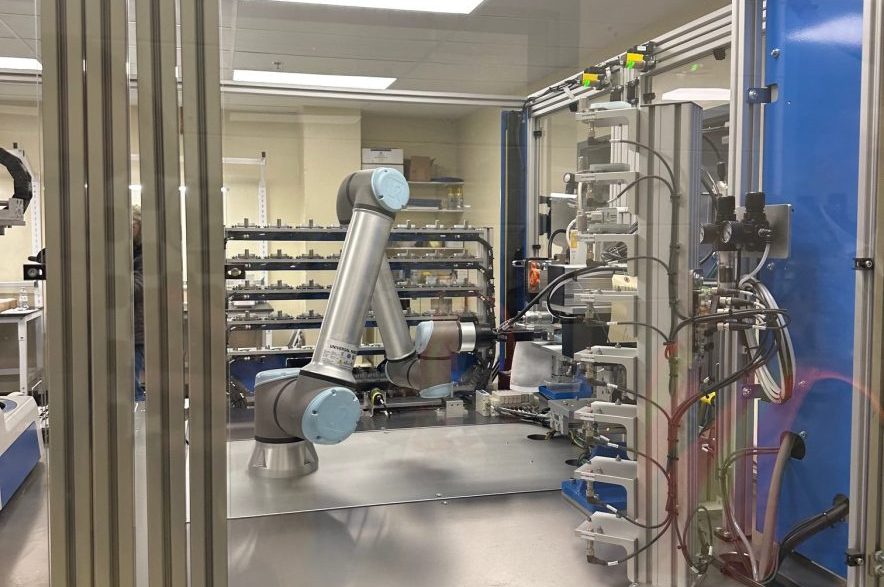
The Saskatchewan Research Council (SRC) has unveiled a new circuit of services in Saskatoon that will improve and speed up the process of identifying possible mineral deposits based on samples of singular mineral grains.
“Today, we are unveiling technology that will reshape the way mining companies approach their future exploration efforts,” said Michael McCubbing, director of sorting and separation services at the SRC.
Read more:
The Tracepoint Workflow, developed by the SRC and Hitachi over the course of five years, is the world’s first fully automated process for mineral analysis.
Officials say that mineral exploration companies will have more access to comprehensive mineralogical information, more quickly. It will also allow the SRC to revisit previously-tested mineral samples to see if further information can be gathered from them.
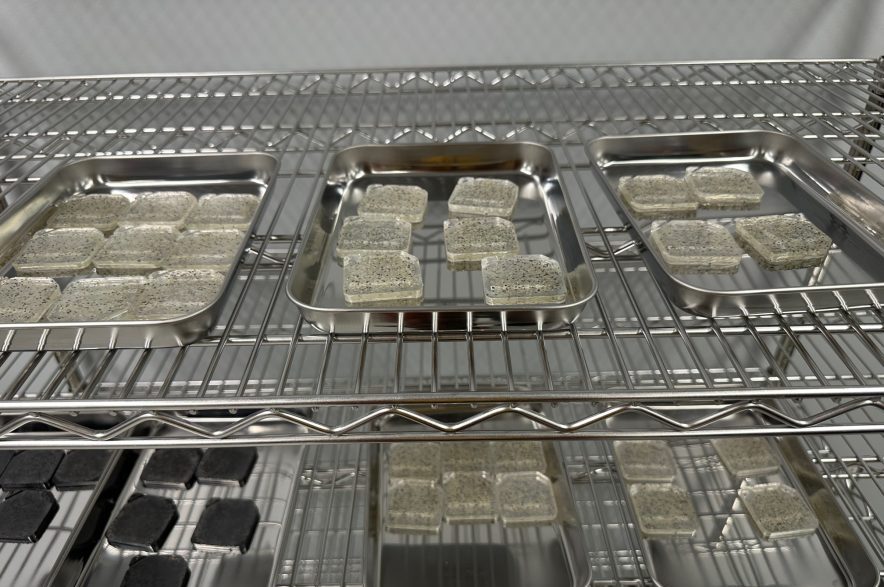
Mineral deposit samples in resin on trays in a lab at the Saskatchewan Research Council on Nov. 4, 2026. (Libby Gray/650 CKOM)
“We are opening new possibilities for mineral discovery and helping Canada and the world find the critical minerals it needs,” said Mike Crabtree, president and CEO of the research council.
“Its practical value is straightforward: faster analysis, more detailed information, and better evidence to guide exploration.”
Crabtree said indicator minerals are small, like grains of sand, and offer clues to the location of a major mineral deposit.
“Founding materials such as glacial till, they act like a trail of breadcrumbs, leading the exploration company to the mineral deposit. They essentially allow the mineral exploration company to focus their efforts,” Crabtree explained.
He said finding and examining each grain has typically required a lot of time and skill to complete the process, which the research council’s sorting and separation team saw an opportunity to improve.
“Work that could take a highly skilled technician a full week can now be completed in a matter of hours using the automated equipment,” Crabtree said.
He added that this can help companies plan their next drilling programs and inform decisions, even while an exploration team might still be in the field.
Crabtree said larger quantitative data sets are also being generated through the system, which means more information is being gathered, providing a better image of clients’ samples.
Minister responsible for the SRC, Warren Kaeding, described Wednesday’s event as “like taking the wrapping off of a Christmas present at Christmas time.”
“Our province has the resources that the world needs,” Kaeding said, “along with the people, and it has the expertise and certainly the determination to develop a lot of new ways of finding and producing them.”
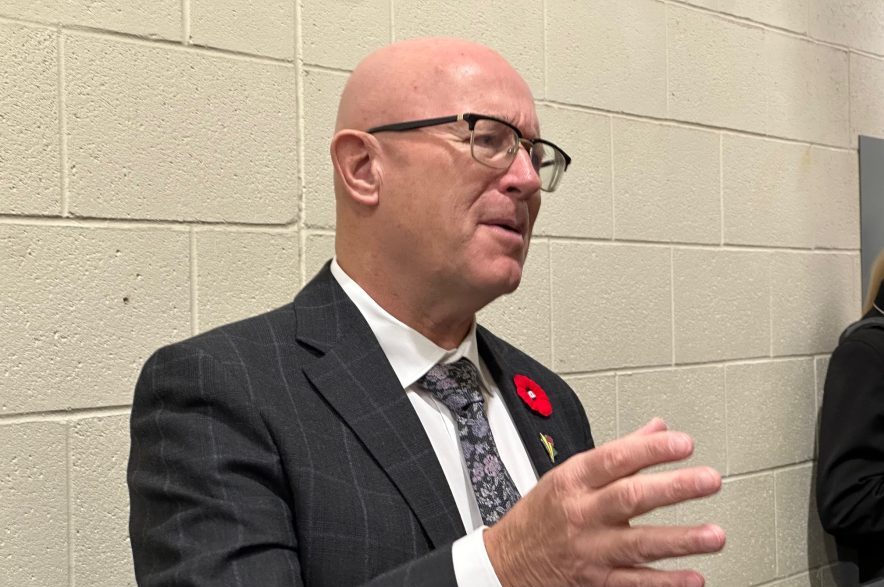
Minister of Trade and Export Development, Warren Kaeding, at the Saskatchewan Research Council on Nov. 4, 2026. (Libby Gray/650 CKOM)
Kaeding noted that 27 of the world’s 34 critical minerals have been found in Saskatchewan.
“I fully expect we’re going to find more now,” Kaeding said, in a nod to the SRC’s new mineral exploration technology.
The minister said the new technology will help guide exploration and investment in Saskatchewan and across Canada.
“That exploration – with the evidence and with the decision to investigate what may lie below the surface – those decisions carry significant costs and a lot of uncertainty. So, better information certainly is going to help companies focus their efforts and make more informed investments, and that is why the capability that SRC is launching today truly matters,” Kaeding explained.
Hitachi High-Tech America president Chad Ostrander said the strategy that was put together for this mineral exploration technology 15 years ago was done without knowing how energy and AI demands would explode in the future.
Ostrander said the significant global demand has created challenges and opportunities for companies and provinces.
“What is most exciting about this is the impact that our solution, our combined solution, will have on the global mining industry at such a critical time,” Ostrander said. He highlighted that combining automation, analytical capabilities, AI and digital solutions is transforming traditionally manual processes into “a faster, scalable, data-driven workflow.”
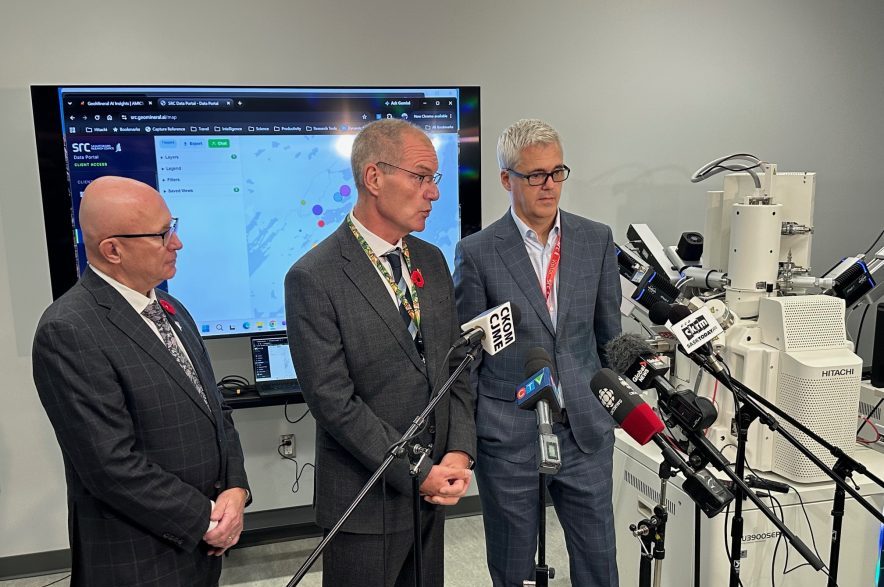
Saskatchewan Minister of Trade and Export Development Warren Kaeding (left), Saskatchewan Research Council director of sorting and separation services Michael McCubbing (middle) and Chad Ostrander, COO at Hitachi High-Tech America, speak in an SRC lab on Nov. 4, 2026. (Libby Gray/650 CKOM)
The research council has committed $2.5 million for the initial purchase of equipment.
Last year, the SRC expanded its Saskatoon-based Minerals Liberation Sorting Centre with a full-scale laser sorter, making it the only independent facility in the world to offer production-scale laser and X-ray transmission (XRT) ore sorting.