

Sarah Mills: American politics has become a wild rollercoaster ride
The blue wave of Democratic wins in the U.S. midterms provides no guarantee for any of the major players. Sarah Mills sa...
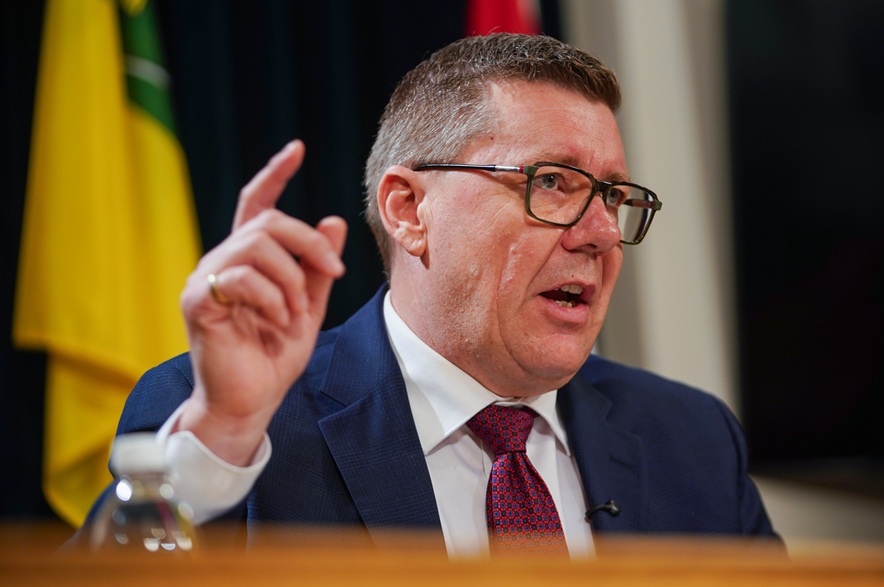
Saskatchewan’s premier says the Democrats’ big gains in the United States midterm elections this week create an opening for Canada to reset its rocky trade relationship with its southern neighbours.
Scott Moe joined The Evan Bray Show on Thursday morning, sharing his thoughts on the U.S. elections, Canada’s forthcoming federal budget, agricultural trade with China and more.
Read more:
The following questions and answers have been edited for length and clarity.
EVAN BRAY: The U.S. midterms happened this week. We’ve been following it and covering the reaction since. Your thoughts on what you feel this means for Canada, and maybe even for us here in Saskatchewan?
PREMIER SCOTT MOE: I’d say this is an opportunity for a reset. Maybe the the House and Senate now being from the opposition party will bring some checks and balances to this trade-related conversation that is really hurting everyone in North America. It’s not doing anything for our affordability metrics in our personal life, in our businesses that are are creating value and jobs in our communities from north to south in North America, and is really, I would say, hindering us from being competitive globally as a continental economy. The caveat I would put in place is, if you look back over the last number of decades, the Democrats have been a little bit tougher to deal with when it comes to free and open trade than maybe a George W. Bush, for example. But in saying that, you know the president. There’s no doubt that his trade policies and tariff-related policies have been entirely damaging to both American and the Canadian economy. so, I think this is an opportunity to reset those discussions, bring some more logical or common-sense points to the table, and hopefully get us to a better place in the next number of weeks or months. But that caveat might be working in our favour at this point in time, so we’ll be talking and working with the federal government as well. If we need to be in Washington again to advance some of the relationships we have, we’re certainly going to be always looking at that.
Today is federal budget day. It comes down this afternoon. Anything in particular you’re watching for, from the province’s perspective?
MOE: First and foremost, to continue the path that the federal government is taking. It’s not quick enough, in my mind, but at least they are taking concrete steps in removing unnecessary regulations. Not all regulations, but unnecessary regulations, and putting in some timestamps on how we can actually build out some of the industries and create the jobs that we are seeing happen here in Saskatchewan. Second to that, we have a municipal infrastructure and I’d say provincial infrastructure gap that needs federal attention, and that conversation and that effort needs to continue, and largely work as we’ve seen in a much better fashion the last year than the nine years before that. Work collaboratively with the provinces on how we’re building our economy, how we’re supporting our residents when it comes to health care. How do we work together to support our Indigenous population here in the province to provide access to health care and a higher level of access to health care for all? This is a challenge across Canada, but how you approach it might be a little bit different in different areas of the nation.
Do you worry at all, premier, about the deficit and what that number is going to be? And do you want to see some form of spending control in a federal budget?
MOE: We have a deficit provincially as well, and we’re intent on finding our way to where both sides of the ledger are zero, and that has to happen at the federal level as well. That isn’t going to come without some tough discussions on what our expectations are for governments to actually provide, and are they getting out of those laneways in some way, shape or form? We’re asking ourselves those questions in our budget deliberations as we find our way to spring already, and the federal government will likely not do that in this budget. I’m not expecting a balanced budget, but they need to be having those discussions about how we are actually finding our way to balance in a very concrete and achievable way, and that hasn’t happened for a decade in this nation. It needs to start happening very, very shortly, or it’s going to hit us much like it’s maybe hitting our neighbours to the south with the federal deficits that we see down there.
It sounds like we’ve got a two-year extension on those canola tariffs that were coming from China.
MOE: Yeah, we do, and this is a good thing. Two years, some will say, is not long enough. However, in today’s environment globally, this is likely as long as you’re going to get assurance, or at least relative assurance, on any strategic trade agreement that we might have. I think we’d take a two-year deal with the United States of America right now if it was offered with terms that were acceptable to us. So this is, I think, a very timely advance in that relationship. And we do sell China a lot of goods, in particular agricultural goods and potash, and so it is a market for us. It’s a premium market. It’s a growing market. So this is really, I think, an impactful agreement and a timely agreement for our ag community in the province, given we had an average or slightly above-average crop this year.