

Sarah Mills: Birthdays bring a sense of wistfulness and nostalgia
Sarah Mills says getting older isn't for the faint of heart, and turning a year older can make a person think about youn...
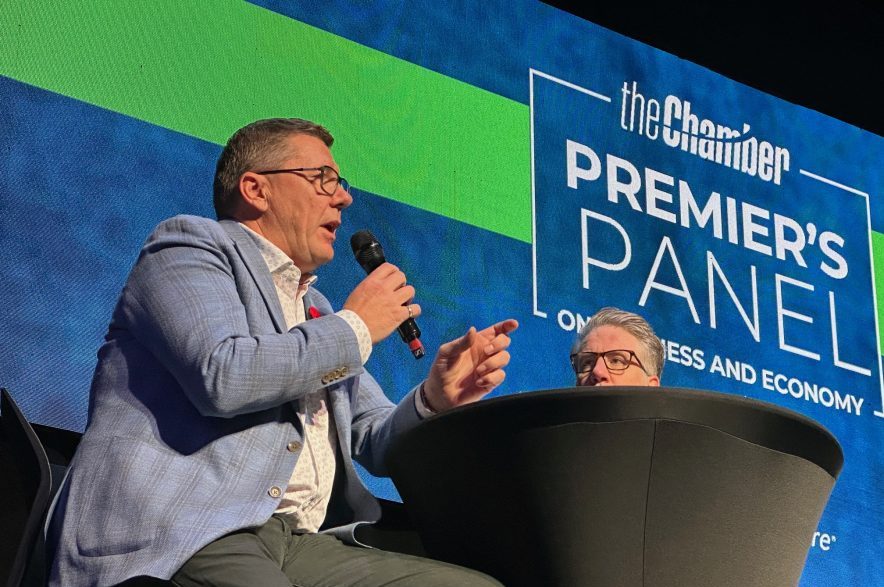
Saskatchewan’s premier is “generally positive” about this year’s federal budget.
Speaking at the luncheon with the premier hosted by the Saskatoon Chamber of Commerce, Premier Scott Moe commented that the budget is the best he’s seen in the last decade, although he joked that isn’t saying much.
Read more:
Speaking during the premier’s panel portion of the event, alongside various Saskatchewan Party ministers, Moe responded to various questions about issues concerning people in the province, from budget reaction to helium, Saskatoon’s DEED and AI data centres.
Moe highlighted the tax incentive for capital buildouts as “positive for many industries.”
“I would say many corporations that are employing Saskatchewan residents — of all sizes, from the SMEs, the small and medium-sized enterprises that we have, as well as you know some of the larger construction projects that we’re seeing happening in the province, and some of those that you know have yet to happen — where they have committed investment and are just starting to construct those those particular projects like some of the uranium mines, for example.”
The one criticism the premier and Finance Minister Jim Reiter offered on the budget was a lack of funding for infrastructure.
Referencing previous programs like Building Canada and the Investing in Canada Infrastructure Program (ICIP), the premier said the current Canada Housing Infrastructure Fund (CHIF) isn’t enough.
Moe said he and other ministers have travelled to Ottawa several times to impress upon the “importance of having a sustainable capital infrastructure programme for our communities.”
Reiter also highlighted the $6 billion promised over the next six years for Jordan’s Principle — a human rights principle ensuring First Nations children do not face gaps, delays or refusal of access to government services due to their cultural identity — as a positive budget item.
New federal tax changes aimed at the helium industry are expected to spur more investment.
“Now helium is recognised under oil and gas right now, getting the same tax treatment, and the mega deduction actually is going to benefit our helium partners in a significant way,” Reiter commented, adding that a helium liquefier is in the works for the southwest part of Saskatchewan, near Swift Current.
Responding to Prime Minister Mark Carney’s declaration of a goal to end homelessness in the next 10 years, Moe called it a “pretty bold commitment.”
Moe said his government will have a “significant provincial role” in that plan as it proceeds, emphasising the need for addictions recovery and further details.
Minister Responsible for SaskPower, Jeremy Harrison, also highlighted the specific mention of Saskatchewan regarding intra-provincial transmission of nuclear energy. He said the $518.5 million for the Nuclear Energy Strategy is “really a significant and important initiative.”
He said partnering with the federal government to join two separate power grids in Saskatchewan is “a very significant thing for reliability in the long term for our power grid.”
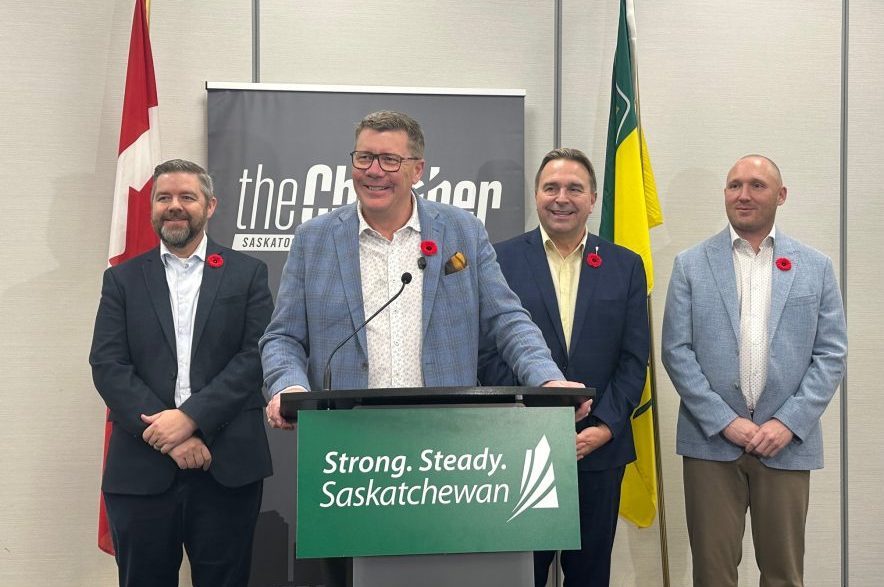
Saskatchewan Premier Scott Moe (second from left), stands alongside Ministers Jeremy Harrison (left), Ken Cheveldayoff (second from right) and Chris Beaudry (right) on Nov. 6, 2026 at Prairieland Park. The Sask. Party Government was optimistic after this week’s federal budget. (Libby Gray/650 CKOM)
Premier Moe said the Saskatchewan government is willing to match the financial contribution of the federal government to further the downtown arena and entertainment district in Saskatoon.
The federal government has not yet committed to that funding, but Moe said the province is asking for the federal government to fund DEED, as well as two other major projects in Prince Albert and North Battleford.
“If they do, we will be there with the provincial share, unprompted or unrequired, to make the projects real,” Moe said during the panel.
The premier said there are plenty of good questions with good answers to them about the AI date centre near Regina and encouraged people with concerns to reach out to Bell.
Moe said the interest in having data centres in Saskatchewan comes with the expectation of opportunities for jobs and long-term careers for people in the province.
“If you’re bringing a data centre and you want to build the thing, and then you’re going to hire two electricians and two caretakers, you should go somewhere else,” Moe said.
He also spoke of the need to separate the discussions around AI and data centres, explaining that the greater conversation about AI and what we use it for is a different debate than whether or not a centre should be built.
The premier also emphasized the need for data sovereignty.
“Each of us should ask ourselves where do you suppose that’s being stored today, because it isn’t in Canada,” he said.
Moe also mused that AI data centres may be built at a slower rate now, after the results of the U.S. midterms.
Read more: