


Sarah Mills: Critics don't define whether or not a movie is good
Filmmaker Taika Waititi has thrown a hissy fit on social media because critics don't like his movie, and neither do movi...
This story was first published on RealAgriculture.com on Nov. 3, 2026.
Federal Agriculture Minister Heath MacDonald and International Trade Minister Maninder Sidhu are in China this week for bilateral trade meetings, pressing for long-term predictability in trade as China’s temporary suspensions of some agricultural tariffs are set to expire at the end of the year.
The dual-ministerial mission is a precursor to the APEC summit happening Nov. 18–19 at Shenzhen, China, where Prime Minister Mark Carney is slated to meet with Chinese leader Xi Jinping. It follows a thaw in Canada-China relations that coincided with Carney’s visit to Beijing in January 2026.
Read more:
According to their federal departments, MacDonald and Sidhu’s visit to China started with ministerial sessions in Beijing, followed by attending a major trade show in Shanghai:
Nov. 3–4 – Beijing – Joint Economic and Trade Commission (JETC): Minister Sidhu is co-leading the JETC meeting alongside China’s Minister of Commerce, Wang Wentao. This marks the first time the commission has met at the ministerial level. China’s Ministry of Commerce (MOFCOM) oversees anti-dumping investigations, which have been used to justify tariffs on Canadian agricultural exports.
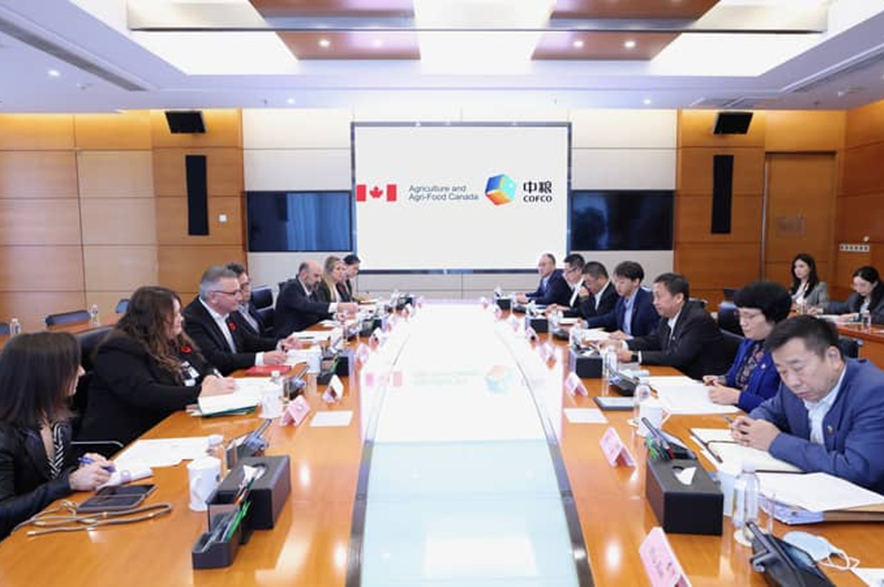
Nov. 3–4 – Beijing – Agriculture and Regulatory Access: Agriculture and Agri-Food Canada says Minister MacDonald is meeting directly with Zhang Zhu, Minister of Agriculture and Rural Affairs, and Sun Meijun, Minister of the General Administration of Customs of the People’s Republic of China (GACC), which oversees import clearances and facility registrations. MacDonald is also meeting with Chinese importers, including the president of state-owned COFCO. He kicked off his visit meeting with Canada’s lead trade negotiator Aaron Fowler.
Nov. 5–10 – Shanghai – China International Import Expo (CIIE): Both federal ministers—alongside provincial agriculture ministers—will travel to Shanghai for the opening of CIIE on November 5. Minister Sidhu will conclude his China visit in Shanghai on Nov. 6 after meeting with government officials, investors, and commercial businesses, while MacDonald and provincial delegations are slated to participate in events highlighting Canadian products throughout the expo, where Canada is designated as the “Guest Country of Honour.”
While the Carney government’s messaging is focused on broader economic targets—such as growing Canadian merchandise exports to China by 50 per cent by 2030—the immediate priority for Canadian agriculture is to avoid the re-imposition of tariffs at the end of December.
Carney’s trip to China in January resulted in the resumption of Canadian beef exports and a significant cut to the anti-dumping duty on Canadian canola seed—slashed from 75.8 per cent to 5.9 per cent for a five-year term starting March 1, 2026. However, several other commodities were granted only temporary reprieves, which are set to expire on Dec. 31, 2026.
China suspended its 100 per cent retaliatory “anti-discrimination” duties on Canadian canola meal, canola oil, and field peas on March 1, but that relief is formally scheduled to end on Dec. 31. A temporary suspension of 25 per cent retaliatory tariffs on Canadian aquatic products, including lobster and crab, also concludes at year’s end.
Canadian pork was notably excluded from earlier tariff relief, leaving pork exporters contending with 25 per cent duties. MOFCOM is also conducting an anti-dumping investigation into Canadian pea starch—which led to provisional tariffs of 73.5 per cent imposed at the end of June.
According to Global Affairs Canada, Canadian merchandise exports to China surged 31.4 per cent in the first half of 2026 to $21.5 billion. Agri-food, seafood, and agriculture accounted for $6.7 billion of Canadian exports to China in 2025.