


Sarah Mills: Birthdays bring a sense of wistfulness and nostalgia
Sarah Mills says getting older isn't for the faint of heart, and turning a year older can make a person think about youn...
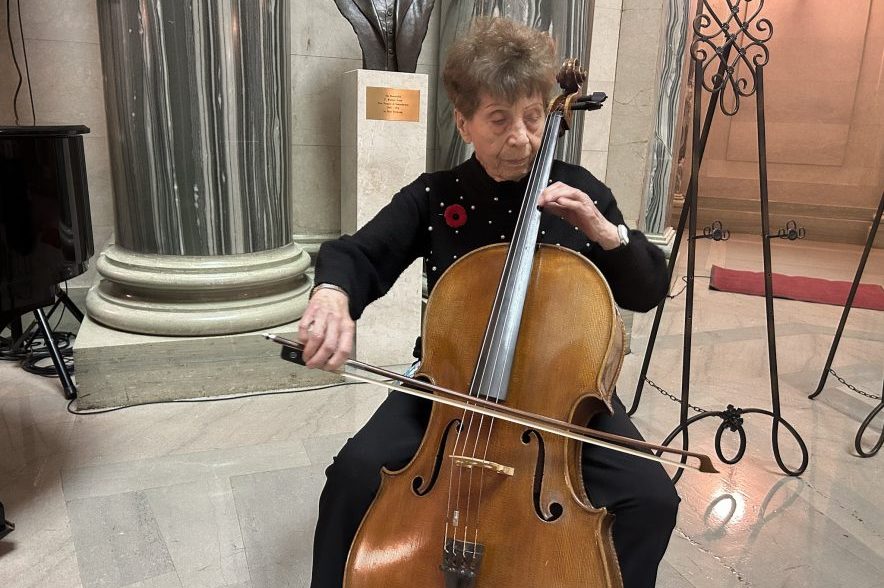
The room was quiet as Klara Belkin made her way to the chair.
She settled herself, positioning her cello and carefully adjusting the instrument.
Her hands, weathered by 96 years of living, found their familiar places. She lifted the bow. Then she drew it across the strings.
For a moment, the marble walls of Saskatchewan’s Legislative Building seemed to disappear for Belkin.
The grand room, the dignitaries and the solemn gathering for the Service of Remembrance for the Public Service gave way to another time, another place.
A German countryside. A crowded cattle car. The terror of not knowing what comes next.
For the world renowned cellist, this was much more than a performance.
It was a thank-you 80 years in the making.
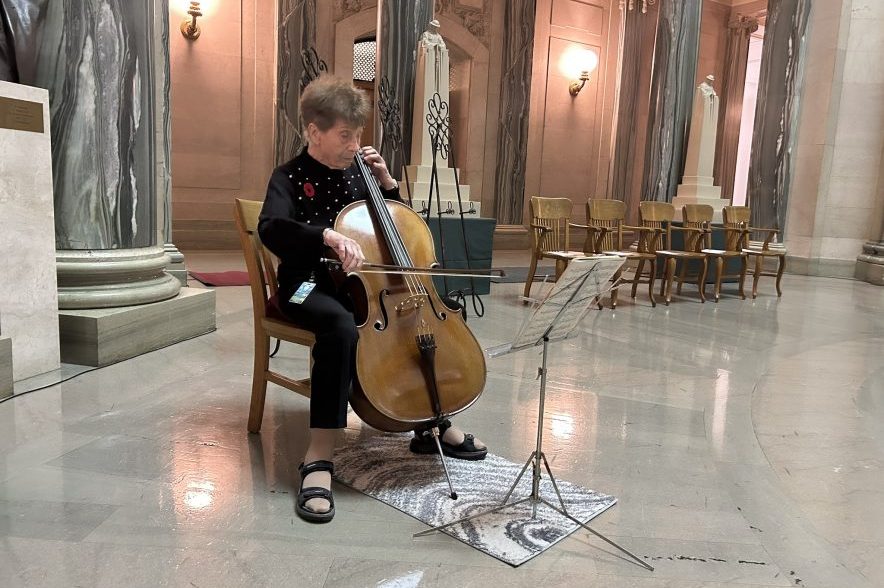
Klara Belkin said this performance was a way to thank soldiers from around the world who selflessly risked their lives to help liberate her and so many others. (Brittany Caffet/650 CKOM)
Belkin was just 14 when she and her family were deported from Hungary during the Holocaust.
After being forced into the Jewish ghetto in Szeged, they were transported to Bergen-Belsen concentration camp in a cattle car packed with more than 80 people. They endured starvation, disease and unimaginable suffering.
In April 1945, Klara was aboard a train leaving Bergen-Belsen when American soldiers intercepted it near Farsleben, Germany. She was among those liberated.
She was 15 years old.
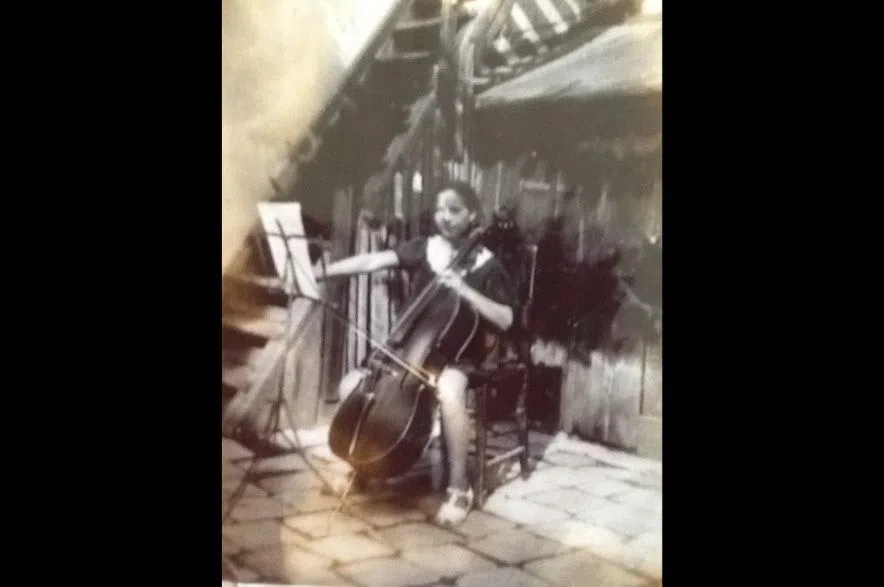
Klara Belkin was six years old when she began learning the cello. Her music studies were interrupted in 1939 due to the many restrictions placed on Jews during World War II. She wouldn’t resume her studies until 1946. (Submitted)
The soldiers who came upon that train were young men, many barely into their twenties. They had left their homes and families to fight a war in a country far from their own.
“Americans, Canadians, English, Russian. At the end, they were all fighting there,” she recalled.
She said she thinks often about what those young men must have experienced, and the sacrifices they made for people they had never met.
“They left their home. They went to a country or countries where they never seen, they have nothing to do with. And they went there to, who knows what, even to die.”
She said attempting to explain the depth of her gratitude was a nearly impossible task.
“If you saw those people, those young soldiers who left their home, they went to another part of the world fighting for liberation. This is absolutely… You can’t put it in words.”
For Belkin, Remembrance Day is personal. She knows exactly what their actions meant.
“I’m thanking (for) my life. I mean, I wouldn’t be here if they weren’t there. It’s as simple as this.”
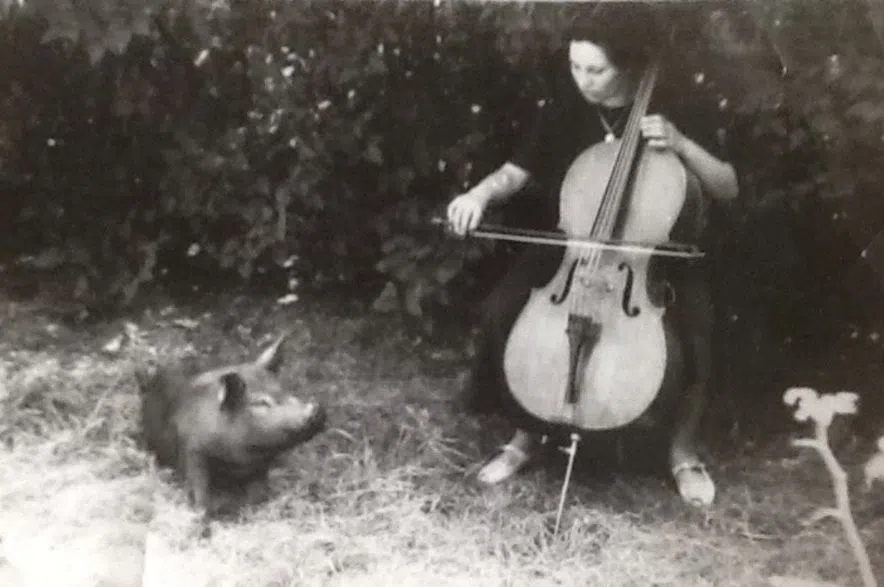
Klara Belkin reflected on a moment of unexpected joy after the war, recalling a summer in a small town where she played music outside. A curious pig, captivated by her performance, responded to different pieces, its ears perking up for classical music and drooping for romantic tunes. “It’s true!” she laughed, sharing a cherished photo of the pig, ears alert, in the garden. (Submitted)
After the war, she returned to Hungary and continued her musical education. When the Hungarian Revolution broke out in 1956, she escaped again, carrying only her cello.
Her journey brought her to Canada, where she built a remarkable career as a cellist, including performing with the Winnipeg Symphony Orchestra and teaching at the University of Manitoba.
Today, she lives in Saskatoon.
Her story, told in the series The Remarkable Klara Belkin, is one of survival, resilience and an extraordinary life made possible by people who were willing to risk their own.
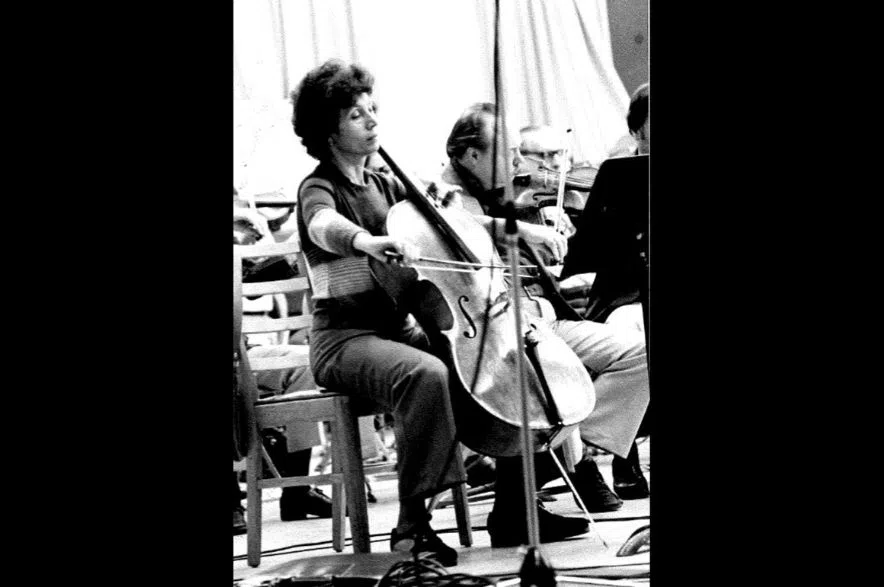
Klara Belkin was the principal cellist with the Winnipeg Symphony Orchestra and the Canadian Broadcasting Orchestra for many years. She toured extensively and later became a professor at the University of Manitoba’s School of Music. (Submitted)
At the Legislative Building in Regina, as she played Bach’s Sarabande, those memories and that gratitude came together.
“After 80 years, I played in a time when we remembered those people who actually died for us,” she said. “And I see them fighting. So I really feel it put me back to that time.”
She wants the next generation to understand why remembrance matters.
“First of all, to remember them because they left their young life,” she said. “And the second, why they should remember, it should never happen again.”
Belkin’s message extends beyond the soldiers who physically liberated her. It reaches across countries and generations, to every young man or woman who left home and never returned. To every family forever changed by their sacrifice.
“We must never forget them.”
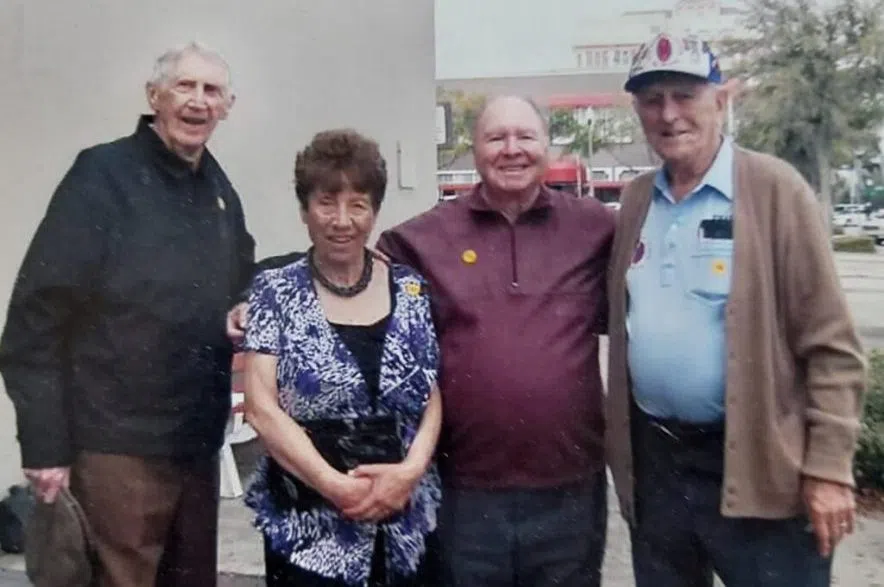
In this 2010 photograph Klara and her husband Emile Belkin are pictured with Frank Towers and Carrol Walsh, members of the 30th Infantry Division. They were part of the team that liberated Klara on April 13, 1945. Belkin said the reunion was incredibly emotional. (Submitted)
As the final notes of Belkin’s performance faded, the room held a moment of remembrance for those who gave so much, and for the lives they made possible.
Eighty years ago, young soldiers gave a frightened teenage girl the chance to live.
At 96, she is still here. Still playing. Still remembering.
And still saying thank you.
At 96, Holocaust survivor Klara Belkin played her cello at Saskatchewan’s Service of Remembrance for the Public Service. Eighty years after liberation, she had a message for the young soldiers who made her life possible. (Brittany Caffet/650 CKOM)




