


Murray Wood: Who's hot... and who's not
Every Friday, Murray Wood takes a look back at the week's news and decides who's hot... and who's not.
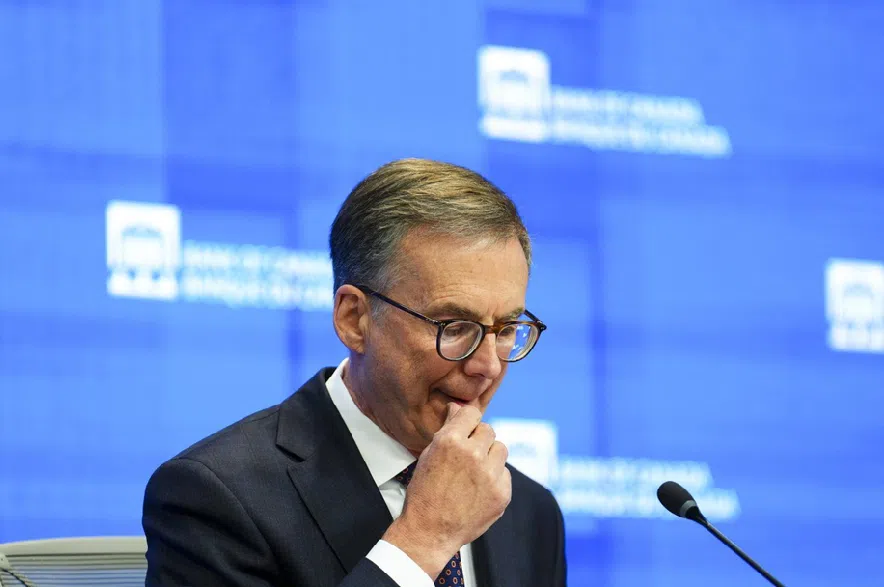
OTTAWA — Economists widely expect the Bank of Canada will hold its benchmark interest rate steady this week and move to the sidelines to cap off a year dominated by trade and economic uncertainty.
The central bank’s policy rate stands at 2.25 per cent heading into its final rate decision of the year on Wednesday — a full point lower than where it started 2025.
Read more:
As of Friday afternoon, financial markets placed odds of nearly 93 per cent in favour of a rate hold at this week’s meeting, according to LSEG Data & Analytics.
A series of surprisingly strong job reports from Statistics Canada and an unexpected annualized jump of 2.6 per cent in real GDP for the third quarter solidified most economists’ calls for a hold to end the year.
“Pulling these strands together, there is now no doubt the bank will stand aside,” said BMO chief economist Doug Porter in a note to clients Friday.
The Bank of Canada lowered its key rate by a quarter point four times this year. The central bank started 2025 with cuts in January and March before hitting pause through the middle of the year and following up with reductions at back-to-back decisions in September and October.
At its last decision in October, monetary policymakers signalled they might be satisfied with where the policy rate sits unless incoming economic data strays significantly from its projections.
Forecasting a path for Canada’s economy has been no simple task this year.
The Bank of Canada did not publish a central forecast for the economy for much of the year, instead offering a series of illustrative scenarios for how inflation and economic growth might evolve under different outcomes in U.S. trade policy.
Governor Tiff Macklem repeatedly warned through the year that the bank needed more clarity on how tariffs from the United States and Canada’s retaliatory measures would affect prices.
“I think the Bank of Canada did act prudently through this period of heightened uncertainty,” said Randall Bartlett, deputy chief economist at Desjardins.
The Bank of Canada sets its key borrowing rate with the goal of keeping the annual rate of inflation at two per cent and boosting the economy with cuts when needed. While central bank officials were clear about a sharp economic hit looming from U.S. tariffs, what wasn’t as certain was what it would mean for inflation.
While a slowing economy usually takes the steam out of prices, higher costs from tariffs themselves and businesses forced to shift their supply chains could simultaneously fuel inflation.
“The Bank of Canada found itself at a bit of a crossroads where it was heading toward a stagflationary shock, which combines weak growth and higher inflation,” Bartlett said.
Uncertain whether inflation would spike higher in response to tariffs, the bank left its key rate unchanged across the spring and summer.
The central bank returned to more formal economic forecasting after its second consecutive cut in October. It projected weak growth of 0.75 per cent in the second half of 2025 and a modest recovery in the years to follow.
After a cumulative half-point of cuts in the second half of the year, Bartlett said the Bank of Canada is probably satisfied with its work to date guiding the economy through the tariff transition.
With the federal budget now passed, he said the bank likely has a bit more confidence that fiscal policy can take over from monetary policy in offering targeted supports for the economy.
“We’re expecting the Bank of Canada to stay on hold at its December meeting, and we expect the Bank of Canada to stay on hold throughout 2026,” Bartlett said.
Heading into the new year, Bartlett is looking for more clarity on how the central bank’s mandate might evolve with a renewal set for 2026.
Officials at the bank acknowledged earlier this year that the core inflation metrics monetary policymakers use to gauge underlying price pressures were distorting the actual picture. Tariff influences and changes like the removal of the consumer carbon price added plenty of noise to the inflation readings this year.
Bartlett said he’ll be watching to see how the Bank of Canada plans to fine-tune its preferred measurements to get a clearer picture of inflation after a year of substantial changes in the economy.
This report by The Canadian Press was first published Dec. 8, 2025.
Craig Lord, The Canadian Press