


Murray Wood: No collector plate for you!
Murray Wood is puzzled and annoyed by all of the "collector" licence plates on vehicles that will never be def...
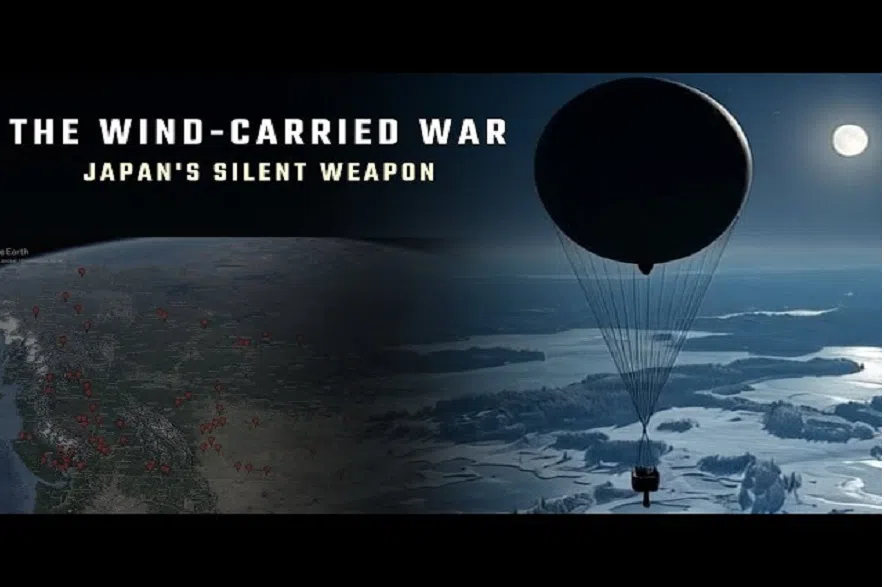
The deployment of thousands of hydrogen balloons carrying deadly explosives sent to North America during the Second World War is the subject of a documentary make by Saskatchewan filmmaker Scott Woroniuk.
Woroniuk, a videographer and owner of Crosscut Films has just released FU-GO: Japan’s WW2 Balloon Bombs Over Canada, on YouTube.
Read more:
https://www.youtube.com/watch?v=y0woW5Em000
The film follows the military operation by the Imperial Japanese Army in the Second World War where 9,300 balloons, each carrying four 11 lb incendiary devices and one 33 lb anti-personnel bomb, were deployed over the Pacific Ocean using high-altitude air currents, also known as the jet stream, between 1944 and 1945.
The operation and technology, which had undergone multiple hurdles in its development, was finally green-lit following the 1942 Doolittle Raid, where 16 American bombers launched from USS Hornet and conducted bombing missions on Japan.
The operation served as the United States’ initial retaliation to the attack on Pearl Harbor.
Of the 9,300 Japanese balloon bombs released, an estimated 1,000 are believed to have made it to North America.
Of that 1,000, only 300 of the incendiary balloons were ever found and documented throughout Mexico, the United States, and Canada.
Woroniuk’s film focuses on the balloons that were found on the Canadian side of the border.
He said that he was surprised to find that the Prairies had a big connection with the operation.
“Once I really started digging into it, I realized how much took place in the Prairies, especially with the first one that was recovered on Canadian soil, which happened in Minton, Saskatchewan,” he said.
“Some did land in Saskatchewan that were found — (in) Ituna, Kelvington, Stony Rapids, Minton — but that means there’s a possibility that some of these may have landed intact.”
Woroniuk said that while the Japanese operation suffered many flaws, such as relying solely on the wind to guide the balloons, they did have some features that made them a desirable alternative to a standard bomber squadron.
“There was very little risk on their part, because there were no pilots being put in danger and there was no need to plan for a return flight, because the balloons were supposed to drop their bombs and then just disintegrate,” he said.
Only one of these balloons reportedly resulted in casualties.
On May 5, 1945, six civilians were killed by one of the bombs near Bly, Oregon, in the Fremont National Forest. Reverend Archie Mitchell and his pregnant wife Elsie had driven up to Gearhart Mountain for a picnic with five of their Sunday school students.
While Mitchell was parking the car, Elsie and the children discovered the balloon and carriage lying on the ground before a large explosion occurred. Four of the children were killed instantly another child and Elsie were ftally wounded.
An investigation found that the bomb had likely been kicked or dropped after lying undisturbed for roughly a month before the incident.
As for the Fu-Go operation that took place nearly 81 years ago, Woroniuk said the bombs are still being discovered to this day.
“Some of the balloons ended up drifting as far south as Mexico, and some were way up in Alaska.
“They found an intact bomb back in 2014 in B.C. from these balloons, and there was another carriage that was found in B.C. in 2019.
“So here we are, coming up on 80 years later, and it’s still possible that these bombs could still be lying around,” said Woroniuk.
The full version of the film can be found on the Crosscut Films YouTube channel.
Read more: