

Sarah Mills: Ending door-to-door is the future for Canada Post
Rural Sask. has picked up mail from shared mailboxes for decades. Now, it will be the same in some parts of in Regina an...
Saskatchewan is continuing to make strides in pursuing nuclear energy.
On Monday, the provincial and federal governments jointly announced funding support for the University of Regina to build a Small Modular Reactor Safety, Licensing, and Testing centre (SMR-SLT).
Read more:
The province is providing $4 million through Crown electric corporation SaskPower, while the Government of Canada is providing $1.96 million through PrairiesCan.
Innovation Saskatchewan is also providing $1 million.
“I really believe that this nuclear space is an area where we can have cooperation across the country that really will be a unifying factor,” said Crown Investments Minister Jeremy Harrison.
“Saskatchewan uranium, Ontario experience, New Brunswick experience, and beyond that — the need and requirement to have base load power generation and in significantly increased quantities over the course of the next 20 years. I really believe this is a nationally unifying project.”
The Government of Canada estimated the project would create about 18 direct jobs and support 10 small businesses in the short-term while advancing the province’s preparation for the creation of 2,500-3,500 jobs needed to build and operate nuclear plants by the mid 2030s.
Buckley Belanger, Canada’s Secretary of State for rural development, said it was important and incumbent for governments to explore numerous energy options, especially since demand for oil has been predicted to peak within the coming years.
“As we look at climate change and the whole notion of oil and gas, you look at some of the efforts around conservation — it does save a lot of energy as we conserve,” Belanger said.
“As you look at some of the other options, be it hydro, be it wind, solar — these are all options, as well as oil and gas — that we have to examine as a country … to ensure that every available power source that could fuel our economy and bring down the cost of living for families is (paid attention to) with each of those sectors.”
The Innovation Saskatchewan Research and Technology Park, which is adjacent to the U of R, will host two different test loops meant to simulate conditions that will be present in the reactor.
Arthur Situm, Canada Research Chair Tier 2 in Small Modular Reactors Safety and Licensing, said that could include examining chemistry or corrosion.
“Reactors are expensive, you’re making a large upfront cost and you’re looking to run it nicely and effectively as long as you possibly can to get your money’s worth from the investment so you really want to make sure you have a good understanding of any kind of corrosion or materials effects present within the facility,” Situm said.
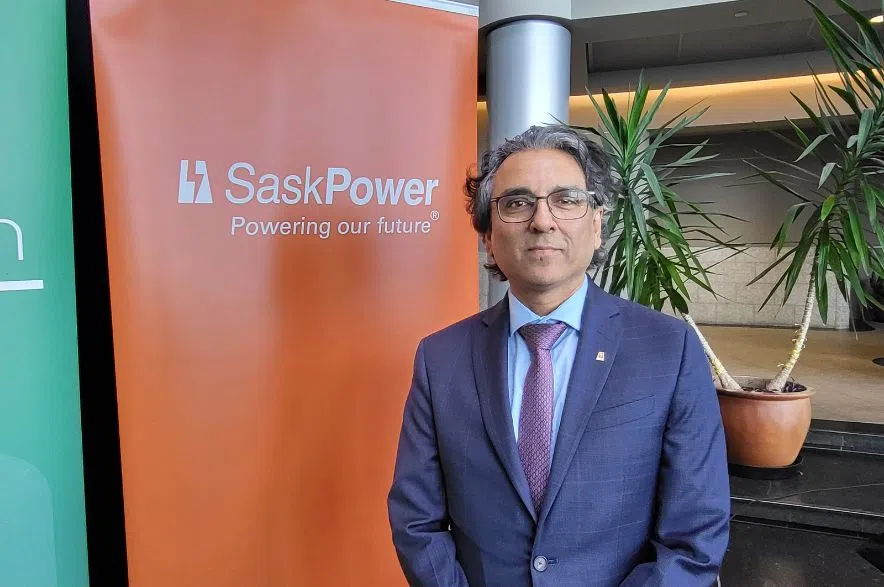
Rupen Pandya, president and CEO of SaskPower, said the partnership helps set the foundation for SaskPower’s work in nuclear power.
“Going forward, it’s going to allow us to train and retain staff here in Saskatchewan who will be able to work directly on our nuclear project,” he said.
The development of nuclear power in Saskatchewan will also involve Indigenous equity ownership. Pandya said SaskPower is seeking engagement with nearby First Nations and Métis communities within a few hundred kilometres of Estevan, where Harrison said the nuclear plant would likely be.
Pandya said SaskPower is still aiming to have a full-scale SMR by 2034.
He said the regulatory process SaskPower is engaging in right now takes the Crown corporation to 2029, which is when SaskPower hopes to start construction.
Read more: