


Murray Wood: Who's hot... and who's not
Every Friday, Murray Wood takes a look at the week's news and decides who's hot... and who's not. This week's list inclu...
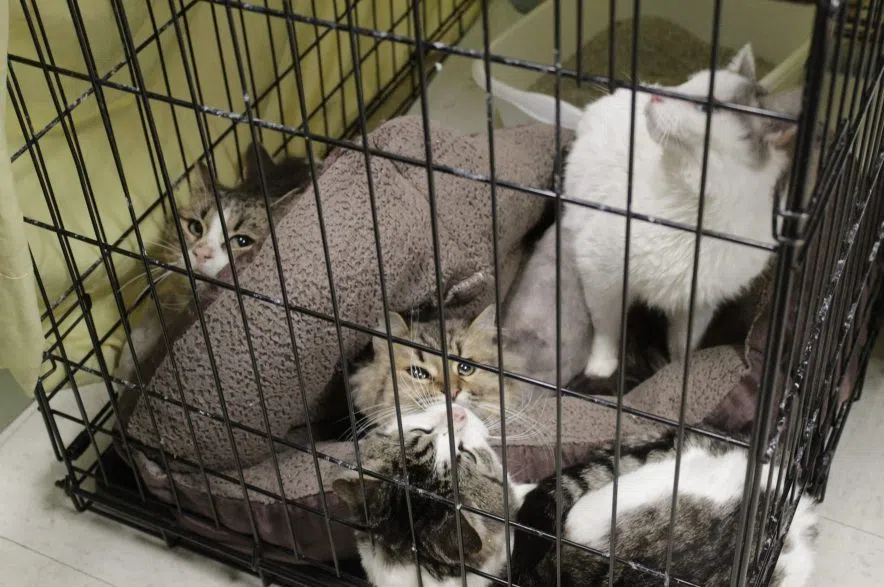
One month ago, animal rescues in Saskatchewan responded to a call that led to the eventual seizure of 47 cats from a home in Wynyard.
The home was dirty and cluttered, not safe for people or animals to live in. Police were called out to the house for a wellness check and found one person dead.
Read more:
In an update from SOS Prairie Rescue and SCAT Street Cat Rescue—two of the organizations involved in the cat seizure from the Wynyard home—SCAT treasurer, Charrone White, said the number of cats caught from the home seems to have capped out at 47. Last week, Mozart Sympawthy Animal Sanctuary’s team made a final sweep of the home to ensure no animals were left behind.
SOS and SCAT have continued to provide medical care and foster support for the animals that were transported to Saskatoon. White said there have been some cats needing emergency care and hospital stays, dental work, eye infections, ulcers and more.
“Through it all, the cats are starting to blossom in their foster homes,” White said.
The cats, which have all been given names starting with the letter ‘s’, are beginning to be listed for adoption on SCAT’s website. More of the cats will be available as they “complete their health care and socialization journeys,” according to White.
Since the Wynyard intake, White said both rescues have received multiple requests for help with other large population colonies in the province, a common experience for both organizations.
Erin Wasson, founder and chief consultant of Wasson Counselling and Consulting and the University of Saskatchewan’s former veterinary social worker, said mental health and overwhelm are usually the underlying causes that can lead to a crisis in these cases.
“Animal hoarding is not rare in Saskatchewan,” Wasson stressed, saying the issue is likely underreported as it usually becomes known after someone’s quality of life has deteriorated.
Wasson said Saskatchewan and neighbouring provinces are facing chronic shortages of rural physicians and mental health professionals, leaving many communities without accessible and ongoing care.
Often, people who have hoarded animals have experienced significant trauma, grief, poverty, disability or chronic stress. Wasson said these people struggle to find help before their situation becomes unmanageable.
Animal care in rural communities frequently falls to local governing bodies of rural municipalities or towns, whichever is responsible for the jurisdiction. Many RMs have limited animal control bylaws, no pound or animal welfare services and no budget for stray or abandoned animals.
“The cases really tend to escalate quietly over months or even years, because there’s so few early intervention pathways, and there’s no coordinated system to really identify the risk of a hoarding situation before it becomes a crisis,” Wasson said.
Often, animals become an extension of other hoarding and collecting habits of people who are struggling, explained Wasson and Dr. Jordan Woodsworth, veterinarian and director of northern engagement and community outreach at the Western College of Veterinary Medicine at the University of Saskatchewan.
This can lead to interventions in extreme situations happening with law enforcement. The Animal Prevention Act provides authority for animal seizures to happen in response to these mental-health related incidents when strict thresholds of neglect and cruelty have been met.
At the time of a seizure, Wasson said there are often no mental health professionals around to assess the people whose homes and animals are in question. It’s left to responding officers to coordinate care and housing for animals or decide to leave them in their homes because there is nowhere else for them to go.
That can create a situation where officers respond repeatedly to the same home.
When responsibility for animal care can fall on informal rescuers or rescue organizations, overwhelmed volunteers, neighbours or other people with limited resources, Wasson said animal care situations can quickly become complex.
These people become known as the place where people can bring an animal without a home, stepping in to care for multiple animals or strays in a well-meaning way and then quickly become overextended.
Many people who end up hoarding animals are experiencing some form of social isolation and then attempt to manage their large population of animals on their own. When an accelerated population of animals happens—like several litters of kittens born at once—caregiver overwhelm often follows.
“What you have is this simultaneous deterioration of the health and well-being of animals and the health and well-being of the person who has undertaken the caregiving role,” Wasson explained.
Part of the root of this can be the very thing animals are so beloved for—the strong emotional attachment people form with their pets or animals they care for.
“There’s often a belief system that you know they’re the only person who can care for them, and if they don’t take care of them, that they’re going to die,” Wasson shared, noting that people in these situations can fail to recognize their own suffering and that of their animals when dealing with issues like poverty, disability, chronic stress, advanced age and limited resources.
Though these cases can lead to harm for animals, Wasson made it clear that most of the time, these are not situations where malice or intentional cruelty is intended.
“It’s often driven by compassion and fear of loss and the desire to rescue,” Wasson said.
When animals are removed by seizure or surrender, the crisis can reach a critical point. Wasson said this can precipitate a “major crisis,” in her experience responding to sites with animal protection officers and RCMP.
“Whether that shows up in somebody visibly so distressed, just filled with tears and really quite destroyed and distraught at the idea of losing the animals that have been in their care or … with people saying that they don’t want to live anymore, because this is all they’ve had to live for,” Wasson said.
Woodsworth said these animals can be a lifeline for many people who are in distress.
“If they feel that they’re at risk of being separated from their animals on a permanent basis, especially, they can become quite obsessed,” she said, noting that many people in these situations can be dealing with anxiety, depression and suicidal ideation.
“Those can come to a head during these types of altercations,” Woodsworth said. “It’s really so important to have human mental health expertise on board for those events … things can just get out of hand really quickly.”
Wasson cited a lack of municipal or provincial safety nets as part of the issue, with no single agency available to help with prevention, mental health assessment, animal protection, housing support and crisis intervention that could then collaborate to assist with animal welfare and property standards.
“There’s so many different people or agencies that have a piece or a stake in how to provide support, but there’s no coordinated effort,” Wasson said.
Without that, situations escalate until some sort of intervention, like a neighbour’s complaint. Animals escaping and visibly unsafe conditions in a home can lead to people noticing a crisis point has been reached, but stigma and the owner’s fear of losing their animals heighten the situation.
For those responding to these animal hoarding situations, Wasson said it’s important to know that there is no desire to criminalize. Rather, responders first want to educate and give people an opportunity to change the environment. Seizing or surrendering animals is a last resort.
Woodsworth has responded to a number of these hoarding calls over the past decade as an expert brought along by animal protection officers. Each of the situations she has responded to involves human well-being concerns dealing with some form of isolation.
Wasson said it’s important for first responders to not become immune to the gravity of these situations.
“Someone (has) some mental health concerns, animals bring them a lot of comfort, and they start accumulating those animals because they’ve got a lot of love to give, and they really want to experience that unconditional support from the animals that they’re not getting from humans,” Woodsworth explained. “It just tends to spiral out of control.”
“I think there are a lot of people falling through the cracks in our system, and a lot of animals falling through the cracks in our system,” Woodsworth said.
Prioritizing early, safe and appropriate intervention before a case escalates or hits a critical point is important, Wasson said, and something more rural and remote veterinary practices are trying to do.
“It can only be managed through a collaborative effort,” she emphasized.
Wasson wants to see animal protection officers, mental health professionals—educated in and knowledgeable of both the assessment of hoarding situations as well as the human animal bond and the challenges in the link between human animal bond—veterinary professionals and whatever enforcement agencies or local emergency services might be needed working together on these cases.
Woodsworth also suggested greater enforcement guidelines for animal welfare and broadening the public awareness of the frequency of these mass animal seizure situations are important for seeing both resources and funding improve responses to these cases.
“When we’re not able to (share information), either because of policy restraints or because of a lack of interest or willingness to share information, then it makes it a little bit more difficult for us to tackle all of that at the same time.”
Follow-up care is also needed, Wasson said. People who have hoarded animals often reoffend.
“This isn’t a situation where we should ever see the animals and leave the person alone and they’ll figure it out from there,” Wasson said.
In some situations, a person may be able to care for some animals again safely, even if they have previously had too many animals in their care.
There are warning signs that can be flagged to prevent cases from reaching a breaking point, Wasson said. Noticing a quickly growing number of animals on a property, a pattern of rescuing animals, the poor care of those animals and deteriorating standards of living.
“When somebody is minimizing exactly how much work and effort is going into maintaining the number of animals that they’ve got in their home, (that’s a) sign of personal overwhelm. If I’m fatigued, financially strained and … my health and well being is declining, then all of those are signs,” Wasson explained.
Other behaviours include severe emotional distress at the idea of rehoming animals or denial of having too many animals, even when care has exceeded someone’s capabilities.
“Often we want to look at signs and assign blame about them, and really what they are is just indicators that someone’s struggling within a system that doesn’t have enough support,” Wasson said.
“It’s really, really complex and it’s one of these situations that we need to approach with compassion rather than blame. When we start to encourage early reporting (and) when people notice that conditions are unsafe, earlier intervention is less traumatic for both people and the animals.”