


Murray Wood: Who's hot... and who's not
Every Friday, Murray Wood takes a look back at the week's news and decides who's hot... and who's not. This week's list ...
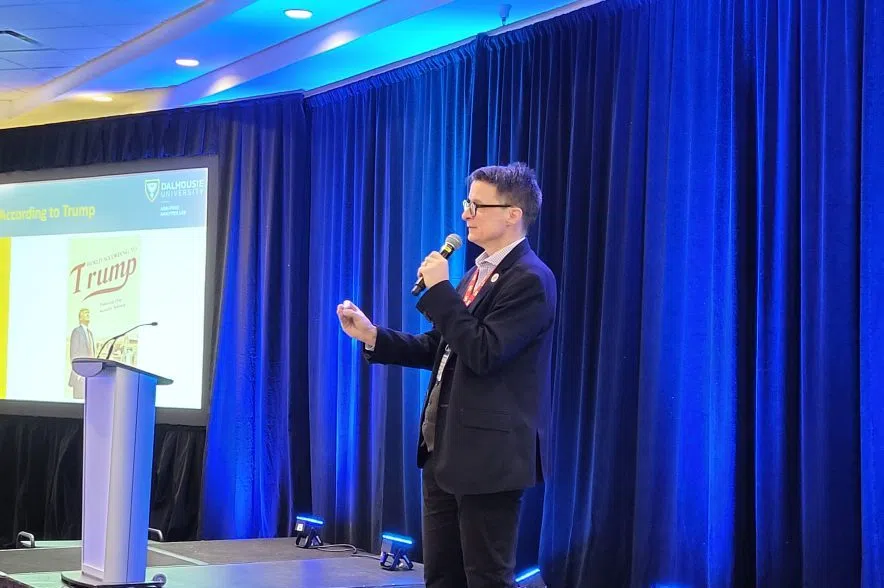
An expert on food distribution and policy says Ottawa made a mistake by cutting funding to agricultural research.
Regina is hosting the third annual Convergence Conference, an event featuring discussions about agronomy, farm business management, health and wellness and agri-food production. The conference is set to wrap up on Thursday.
Read more:
Dr. Sylvain Charlebois, director of the Agri-Food Analytics Lab at Dalhousie University, was one of the conference’s guest speakers. He spoke at length about issues like trade, economic growth, agriculture and food prices.
Speaking to 980 CJME after his address, Charlebois said it was a “bad decision” for the federal government to cut funding for agriculture research in the 2025 federal budget – a move made with the goal of saving up to 15 per cent of Agriculture and Agri-Food Canada’s budget.
Dr. Sylvain Charlebois said the cuts to agriculture research in order to find short-term savings will have a negative effect on farmers over the long term. (Daniel Reech/980 CJME)
“It’s hard to ramp up research. It takes five to seven years,” Charlebois said, bemoaning the closures of several research centres across the country.
During his speech, Charlebois pointed out that Canada is a world leader in food-safety protocols, but it’s possible that Canada’s reputation as a source of high-quality foods could be impacted by the cuts down the line.
He also said cuts to research will hurt farmers in the long term.
“Farmers need the help. They need the support. They need a helping hand in real time. So you’re not only killing science, you’re also killing relationships between these centers and farmers,” Charlebois said.
Meanwhile, rising grocery prices continue to be a top-of-mind issue for many Canadians. Charlebois said Canada has seen the highest recorded level of food inflation in the G7 at 6.2 per cent, doubling the 3.1 per cent seen at grocery stores in the United States.
While Charlebois said the Liberal government played a key role in worsening food inflation, he said its underlying cause dates back to the 2008 financial crisis when Stephen Harper was in office. Charlebois said the country was never able to properly recover and build capacity to keep inflation in check after the crisis.
He also levied some criticisms of the recently announced GST rebate, which is meant to help Canadians foot rising grocery bills.
Charlebois said Prime Minister Mark Carney has made few, if any, “stupid” mistakes since taking office, but the GST rebate was the worst error he’s seen.
“Why don’t we get rid of the GST on all food?” he asked.
Charlebois noted that Canadians pay as much as $10 billion in GST on food annually, and said it “would certainly help a lot of families” to drop the tax entirely instead of offering rebates.
“The problem with ‘shrinkflation’ is that it makes some food products become snacks, and snacks are taxable,” he explained.
“For example, a box of six granola bars, that’s not taxable. But if you go down to five, that is taxable, and that makes a big difference.”