


Sarah Mills: Ending door-to-door is the future for Canada Post
Rural Sask. has picked up mail from shared mailboxes for decades. Now, it will be the same in some parts of in Regina an...
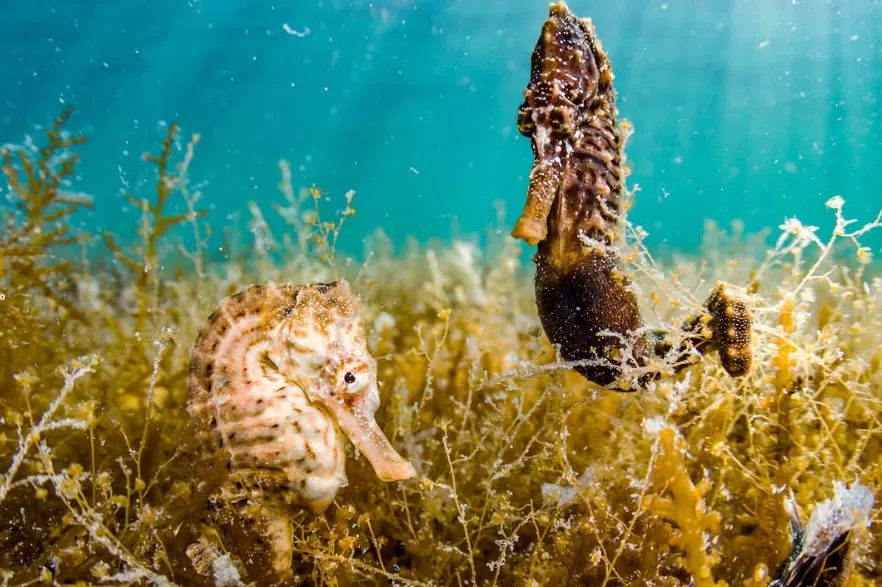
Shane Gross has been reaching for National Geographic magazines since he was a little kid at his grandparents’ house.
Now, the Regina-born photographer gets to look at the pictures he shot on the cover of the February edition of the publication.
Read more:
“It’s a huge personal achievement and honour to be a part of that amazing legacy,” he said.
The cover features a pregnant male lined seahorse on a bed of algae at an inland pond in the Bahamas.
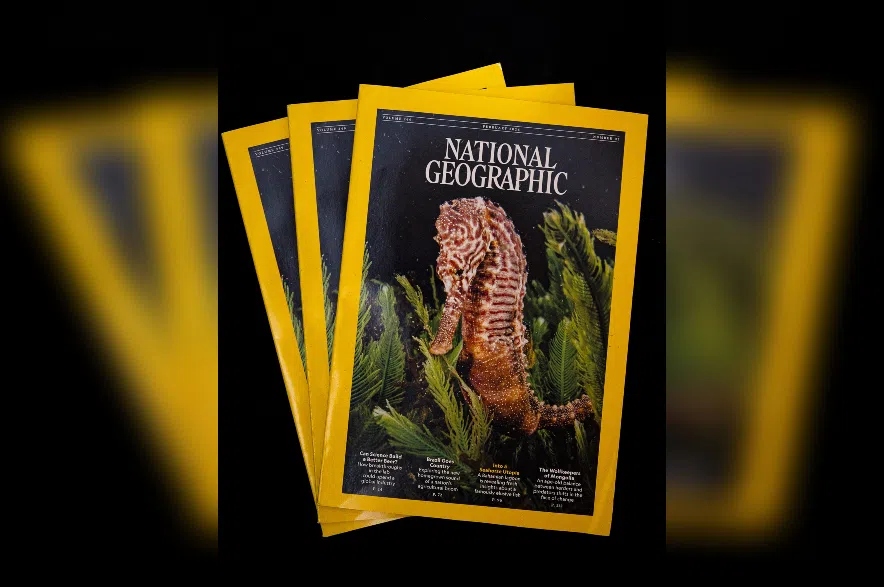
Gross’ photography on the cover of National Geographic’s February edition. (Shane Gross/Facebook)
Gross photographed the sea creatures at the island of Eleuthera for more than a decade, while he lived in the country.
The National Geographic article features how Dr. Heather Mason, a marine ecologist with the University of Tampa, discovered that Sweetings Pond had the highest density of seahorses in the world.
Two years ago, all the seahorses, octopuses and crabs were shielded when the pond was declared a marine protected area at the newly created Seahorse National Park.
The shift in priority from public access to conservation is something Gross has been advocating for years at the pond.
“Having the a cover story in National Geographic magazine is also very personally satisfying, but I know that it’s not hollow,” he said. “I know that it’s for the best possible reason that these animals can now live out their lives in peace.
“We don’t have to worry about the place being destroyed or people coming in and poaching animals out of it – that is the best feeling.”
Gross is no stranger to what lurks underneath the water’s waves with 4,000 dives and thousands of hours snorkelling experience.
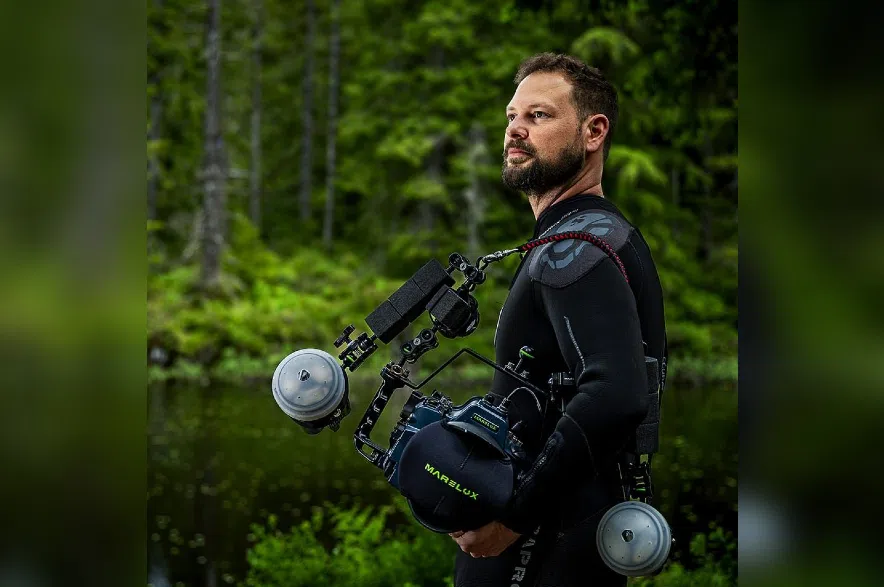
Gross, who is now based out of Vancouver, has been working as a professional wildlife photographer for the last five years. (Shane Gross/Facebook)
Growing up in a landlocked province, Gross was infatuated by the ocean.
“I was a shark nerd as a kid growing up,” he said. “My dad was – and still is – an avid scuba diver and free diver.
“I was surrounded by scuba diving magazines and documentaries, and that grew into finding a way to spend as much time as possible in the ocean.”
Gross has now photographed 39 different species of sharks in countries around the world.
Gross will scuba dive, snorkel and dunk his camera off the side of a boat to snap different shots of sea creatures.
“Whatever the best way is for that specific animal or habitat, I will happily do it,” he said.
Seahorses are one of the species that flash photography and its effects on the animals has been scientifically studied, he said.
That study found the flash had a lesser effect on the seahorses, according to Gross.
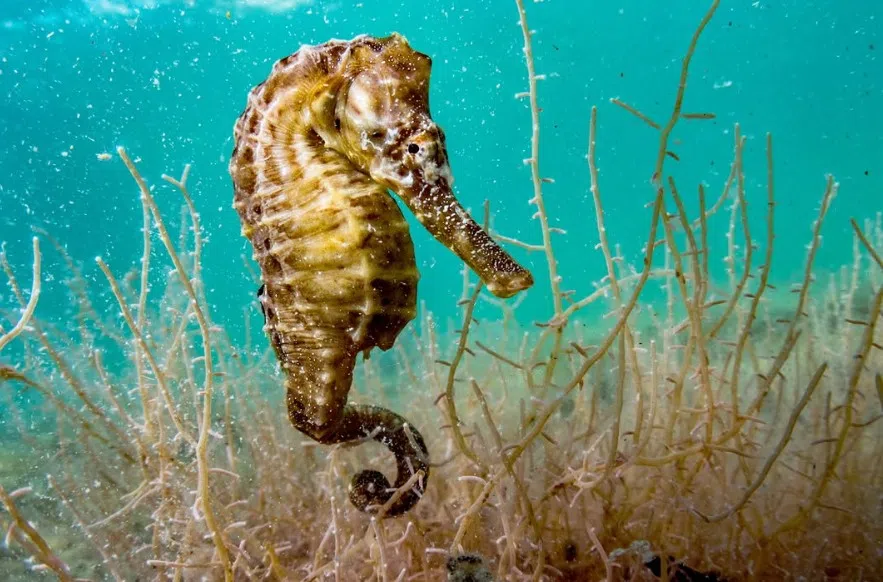
Gross said researchers found the seahorses at the pond were distinct to other Lined seahorses with shorter tails and longer snouts. (Shane Gross/Instagram)
“The underwater environment is different than above water,” he said. “Underwater, there are waves rippling over the surface, and the light penetrating down is constantly changing very quickly.
“Animals are quite used to different changing lighting conditions.”
Just like people, Gross said not all seahorses want to be in the spotlight.
“Part of the challenge of photographing the seahorses was finding the individuals that didn’t mind my presence,” he said. “Some of them did, and they would show that by turning away from the camera or burying their face in the algae.”
Gross said he would continue along to find seahorse that was less camera shy.
“The pond has so many seahorses in it that it was easy to move on and find another one very quickly,” he said. “Hopefully, that one was very tolerant of my presence and would let me get the pictures that I was hoping for.”
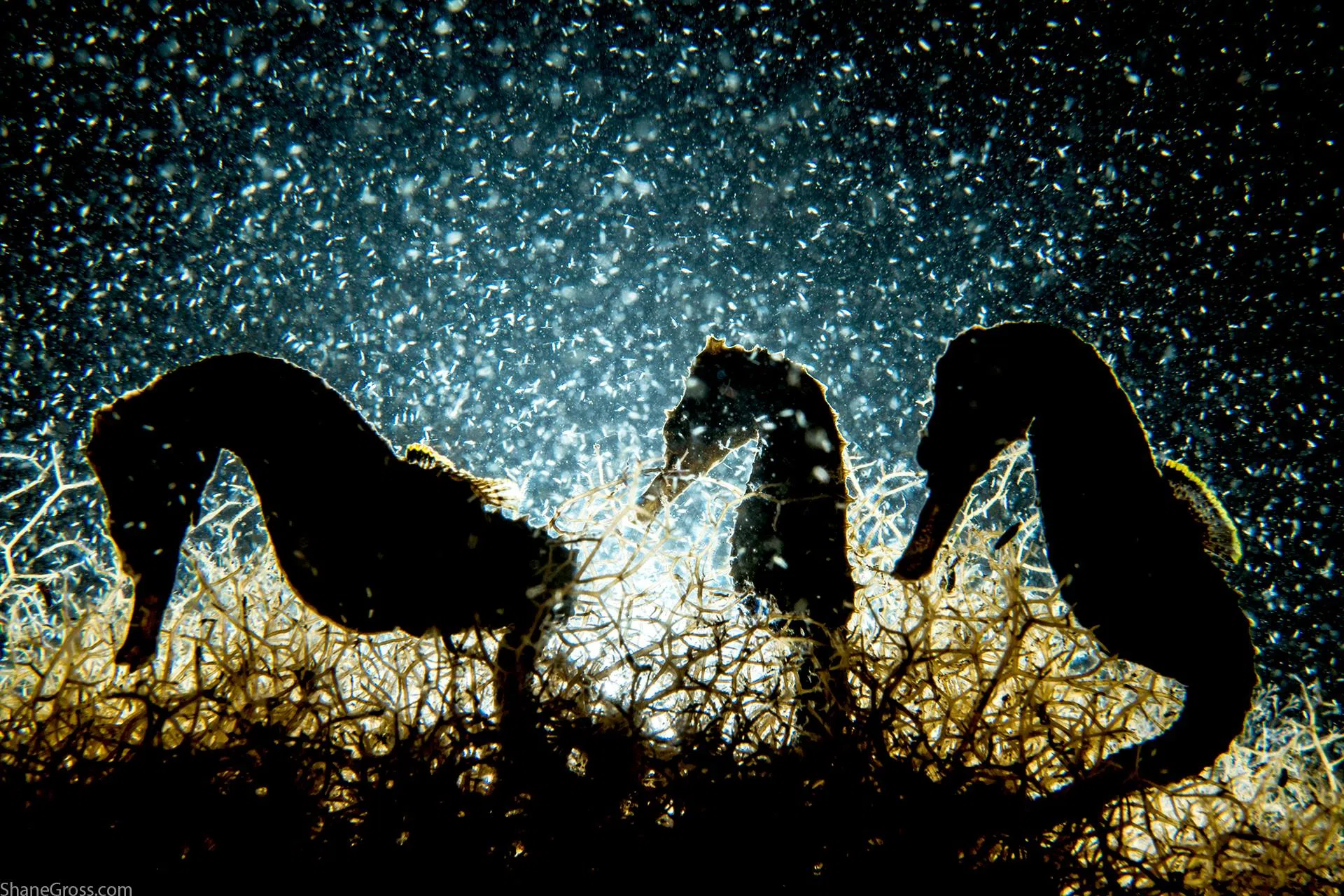
Gross said he would dive in the evening at the pond because the seahorses were more active at night. (Shane Gross/Facebook)
Dr. Mason’s research was supported by the Bahamas National Trust.
Her research found that the seahorses in the pond had evolved differently because it had been separated from the population for thousands of years.
Gross hopes to return to the pond for another shoot, as some visitors will return to conservation area.
“I’d like to follow up on that, see how the implementation of the park helps the seahorses, helps locals be able to get in the water and see the seahorses without disturbing the environment,” he said. “It’s going to be very interesting.”