Murray Wood: Is it fake, or just stolen?
People looking for news on Facebook need to watch out for fake content. And even if it's true, it may have been stolen. ...
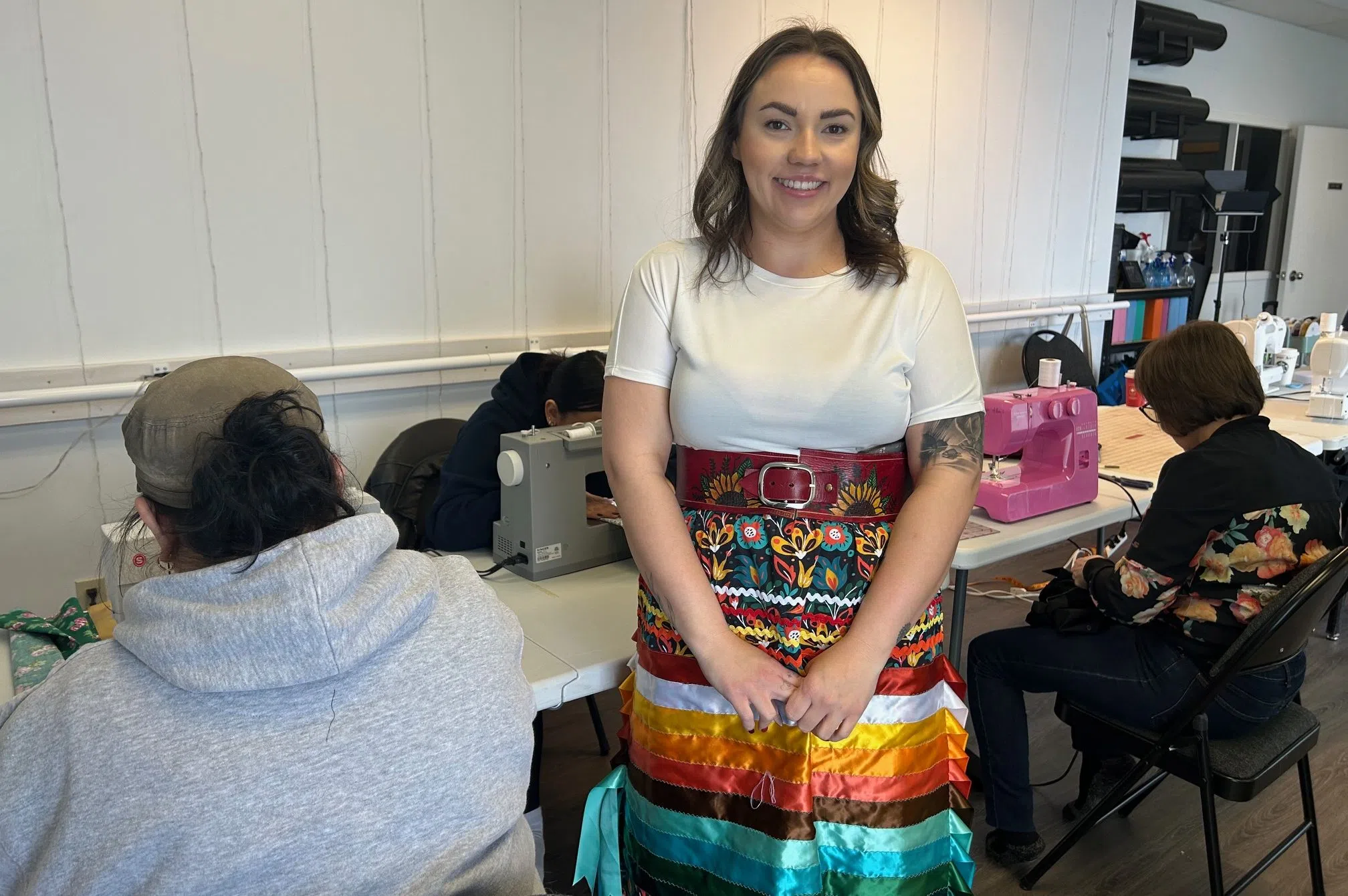
Sewing machines hum. Fabric and brightly coloured ribbons spill across folding tables. A young girl squints in concentration, slowly guiding cotton beneath a presser foot.
At the front of the room, Jasmyn Albert moves gently between tables, crouching down beside one participant, offering quiet encouragement to another.
Just as she was taught.

Albert patiently walks her workshop participants through each step of the process. Some are experienced sewers, others have never touched a sewing machine. All are welcome. (Brittany Caffet/650 CKOM)
When she was a little girl, Albert would sit on her kohkum’s lap, watching careful hands guide beads onto thread, needle through hide.
Sometimes they were in the kitchen, the scent of fresh buns rising in the oven, flour dusting the counter as stories drifted as easily as steam.
Other days, they were in the car, or picking medicine, or simply together. It was never a formal lesson.
“It was never ‘Sit down and listen,’” Albert explained. “You taught by doing things with your kids. You taught by doing things with your grandkids. You were hands on. You were involved in their life.”
That is how she learned. And now, it’s how she carries those teachings forward.

Workshop participants choose the fabric and ribbons that will adorn their skirt, choosing colours that speak to them. (Brittany Caffet/650 CKOM)
Albert is a Saskatoon-based Indigenous educator. She is Plains Cree, Métis and of settler ancestry, and has been teaching sewing and beading since she was 15 years old.
Her workshops are hands-on and story-filled. She teaches people how to make ribbon skirts, moss bags, medicine pouches and moccasins. She offers teepee teachings and traditional parenting teachings. Sometimes she is invited into schools. Other times, organizations hire her to speak so staff can gain a better understanding of Indigenous teachings and world views.
But Albert is clear: what she offers goes beyond instruction.
“If people want, they can go on TikTok or go on YouTube and type in ‘How to make ribbon skirt.’ You can get a tutorial, and you can follow along,” she said. “I want to offer more. Where they get teachings out of it. Because that’s how it’s supposed to be. This is cultural practice. This is ceremonial. Every time that we create something, it could be ceremony, if we look at it that way.”

Many of Albert’s workshops are offered out of a classroom space at Saskatoon Pole & Dance Studio. Owner Sarah Longpre donates use of the space. “So I’m able to make this an affordable class,” Albert explained. “It’s cheaper than even buying a ribbon skirt from somebody, and you get to learn the skill.” (Brittany Caffet/650 CKOM)
In her workshops, the sewing machines hum, but so do the conversations. Participants ask questions about the meaning behind the skirts — why they are important, how they connect to identity, womanhood, family and ceremony.
Stories surface depending on who is in the room; young people, mothers and daughters, fathers and sons, people connecting with culture for the first time.
“There’s always stories that come up,” Albert said. “Things that I feel like I should share.”
Sometimes the learning is joyful. Sometimes it is heavy. She has facilitated workshops with Indigenous people in their 70s, 80s and 90s who are learning about their culture for the first time — some after decades of disconnection from their culture and language.
For some, it is the first time anyone has ever explained these teachings to them.
“You might not always be happy with what you learn. Sometimes it can be triggering. Sometimes it can be hard,” she said. “You’ve got to kind of work through some feelings.”

Some of the workshop participants are Indigenous and hoping to connect or reconnect with their culture. Others are non-Indigenous, but eager to learn. (Brittany Caffet/650 CKOM)
At the beginning of each workshop, Albert smudges. Sage is burned and the smoke created is used in a cleansing practice meant to help participants clear their minds, ground themselves and enter the space in a good way before the teachings begin.
She shows people how to gently pull the smoke toward themselves — over their head, their heart, their body.
Some participants are Indigenous but were never taught to smudge. Others are non-Indigenous and experiencing it for the first time. Albert meets both with the same calm reassurance, sharing stories about the meaning behind the practice and why it is done.

Albert floats around the room, lending a hand and offering stories or teachings as the hours tick by. (Brittany Caffet/650 CKOM)
And while she is more than willing to share her teachings, Albert does not position herself as the authority on all things Indigenous.
“I’m not telling you this is how you’re supposed to think or how you’re supposed to feel or how you’re supposed to do things,” she noted. “I’m sharing what I was taught.”
And what she was taught came from one central figure: her kohkum, Mary Lee, a beloved Elder in Saskatoon whose presence still anchors her life.
“I was very fortunate to grow up so close to her,” Albert said. “She came and took care of us like every day. She’s a very, very important part of my life, my kids’ life.”
She describes Lee as embodying the strong matriarchs people speak of from long ago. Women who were not only pillars for their own families, but for entire communities.

Each ribbon skirt that leaves the workshop is completely unique. (Brittany Caffet/650 CKOM)
From her, Albert learned that culture is not something you inherit all at once.
“You really give your life to learning this way of life,” Albert explained. “You don’t just decide one day, ‘Okay, I want to learn my culture,’ and think that you’re going to learn it all in one sitting … You really do learn for the rest of your life.”
As the workshop nears its close, a finished ribbon skirt is lifted from a table. Across the room, Albert bends beside another student, guiding the final few inches of fabric forward with steady hands.
Just as she once watched careful fingers pull a needle through hide, others now watch hers.
Teaching by doing.
Living the lesson.
And passing it on.
Jasmyn Albert is a Saskatoon-based Indigenous educator. She shares her culture through craft, passing on teachings to anyone who is open to learning. (Brittany Caffet/650 CKOM)