Murray Wood: Trump's potash claim is more 'art' than deal
The U.S. president says a deal is in the works to buy cheap potash from Belarus, but Murray Wood says Donald Trump proba...
Crude prices jumped on Monday morning following the attacks on Iran by the United States and Israel, and it’s expected that the war will significantly affect the production and movement of oil, pushing prices even higher.
Heather Exner-Pirot, director of the energy, natural resources and environment program at the Macdonald-Laurier Institute, joined The Evan Bray Show with guest-host Brent Loucks on Monday to discuss how the conflict in the Middle East is affecting markets and prices around the world, especially when it comes to Canadian resources.
Read more:
This transcript has been edited for length and clarity.
BRENT LOUCKS: Any big surprise in what we’re seeing, the first day of markets since the attacks began on early Saturday?
HEATHER EXNER-PIROT: No, and you know, it is interesting. I’m sure there’s many reasons they attacked when they did, but they do tend to attack on weekends when the markets aren’t open. And I think hoping maybe that this shock won’t be quite as bad by the time markets open on Monday morning, but obviously we saw very significant shock. Everyone was expecting it. It looks like maybe this time will be a bit more sustained than the last few incursions into Iran, so people are hedging a bit more risk this time around.
Late Sunday, Iran had it they had closed the Strait of Hormuz, where I believe 20 per cent of the oil of the world passes through. Is that the biggest choke point there that is potentially going to impact our gasoline prices here?
EXNER-PIROT: Yeah, and that’s why this particular area is so important. As you say, 20 per cent of oil and gas moves through there. About three quarters of all oil in the world has to move through water, over water, and so you’re obviously going to see an impact on the physical market. Sometimes you just see geopolitical risk priced into prices. This time, you’re seeing actual disruption to supply. And so you will see a reaction to the price of oil, and yeah, that’s what we’re seeing. It’s just a question of how long is this going to go and how fast would it unwind, or is this a new kind of level that we’re just going to be around the 70-, 80-dollar mark going forward?
It’s an interesting position that governments find themselves in. And I speak here in Saskatchewan, where our legislature is resuming their spring sitting here today and a budget is coming out later this month. And in Alberta, with the $9 billion budget deficit they reported last week, they were talking about “well, oil revenues aren’t what we’d like to see them at.” So the bad side is we’ve got a war. The good side is we may get some more money into our provincial coffers off of this?
EXNER-PIROT: I think you absolutely will. For the people of Saskatchewan, for your listeners, the first thing is probably go gas up. Might only save you a couple bucks on tank of gas, but you do see it reflect in the price of gasoline pretty quickly after a shock like this. But number two is Alberta. I’m not sure what Saskatchewan was pricing in for oil, but Alberta was forecasting a $60 barrel of oil. Now, we’re obviously in the mid 70s, so this would pretty much take care of almost all of the deficit if you kept up price levels like this. Obviously we’re in the two days following a shock, but it is, long term, good for provincial revenues. Even if it kind of unwinds and you see more movements for the strait, people will be more likely to price in this risk and prices will be likely to be a little bit higher going forward, certainly for the next few months, a couple months. So good for Saskatchewan in their budget. Probably won’t see that huge deficit that we were forecasting in Alberta, either.
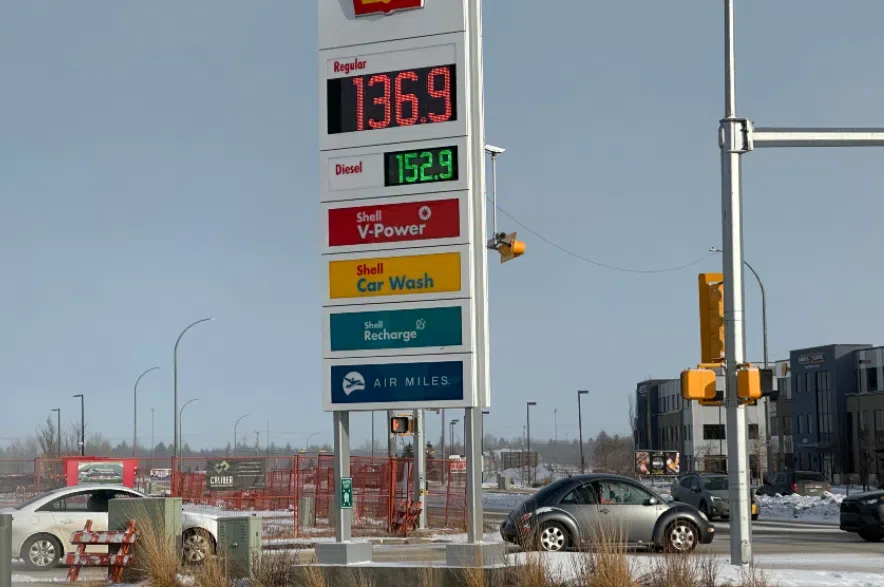
Volatility for gas prices has been off the charts lately, at least in our part of the world. Two weeks ago, I know you could get gas in Saskatoon for $1.19/litre. Then last week it was $1.26, and then – it was like the oil companies had a crystal ball – this past Thursday and Friday our gas prices were at $1.36/litre, and there’s talk of them going even higher, so that it’s really been moving around a lot lately.
EXNER-PIROT: Yeah, and this is the time of year where they move from a winter fuel to a summer fuel. They’re getting rid of old winter stocks. They want to bring in summer fuels, which are a bit more efficient, so you do tend to see that volatility this time of year. But obviously there’s more geopolitical risk than we’ve seen in many years. Venezuela was already one example of that. We’ve had a few incursions into Iran. This does feel like it’s a little bit different. This does feel like it’s a little bit more structural.
Speaking of crystal balls, how long this fighting is going to continue, and if it continues at this level – and especially where Iran is reaching out and attacking neighbouring countries, and a lot of those are oil producers as well – this could have an even greater impact, I’m guessing, on the oil supplies.
EXNER-PIROT: I will say, we don’t know what will happen in this particular conflict. But you certainly see a world where there is more conflict, there is more geopolitical risk. And people do care more about energy security, or think about it a lot more than they have, maybe five or eight years ago. And so regardless of how this particular conflict goes, I do think, overall, it is bullish for Canada. Canada is obviously a very reliable country. We have very good reserves. We don’t really have (roadblocks) other than our own, the way we hamper our own development. Once you get it to tidewater on the Pacific coast, I mean, it’s a straight shot over to Asia. There’s no congested bottlenecks or contentious war zones that you have to move a Canadian tanker through to get to China or Japan or Singapore, so overall, I think this increases the premium that you might pay for a Canadian barrel or a Canadian ton of potash or a Canadian bushel of grain, because you expect that this is going to be reliable, non-geopolitically impacted product at the end of the day.
I saw this morning one particular commodity that did see a significant bump up was the price of diesel. And again, that would be impacting all of those trucking companies that bring us our food each and every day.
EXNER-PIROT: Absolutely. That impacts farmers, impacts truckers, it impacts miners and it impacts air transportation as well. We’ve been taking for granted that we’ve had pretty cheap fuel for the last 10 years, since 2014 to 2015. The whole commodity cycle is starting to change, and you’re going to move into an era of higher material costs, higher fuel costs. This looks like the volatility is going to be part and parcel going forward.