Murray Wood: Who's hot... and who's not
Every Friday, Murray Wood takes a look back at the week's news and decides who's hot... and who's not. This week's list ...
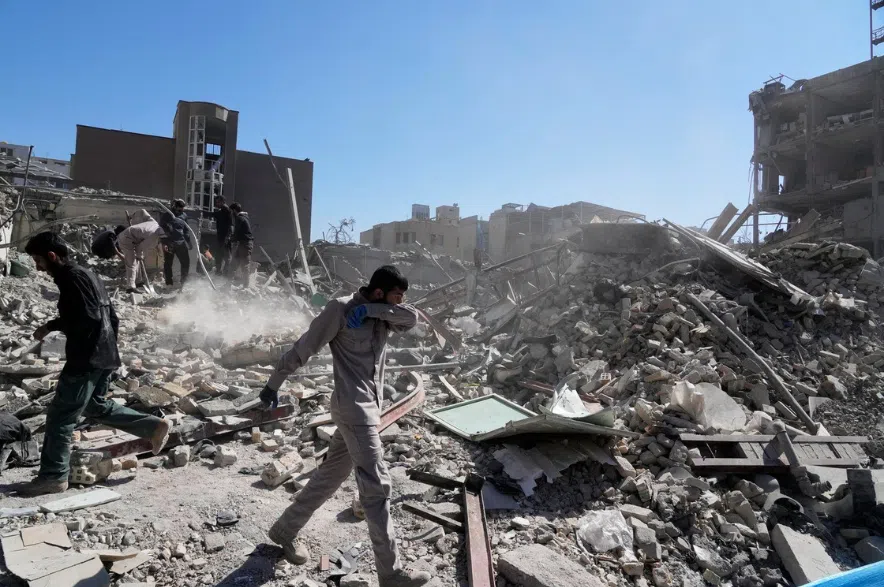
Canada’s former top soldier says the country should do everything in its power to support the United States and Israel in their military operations against Iran.
Rick Hillier, the retired general who served as chief of Canada’s defence staff from 2005 to 2008, made the comments on The Evan Bray Show on Tuesday after the situation between the United States, Israel and Iran shifted from tension to direct military action over the weekend.
Read more:
This transcript has been edited for length and clarity.
EVAN BRAY: Can you give us your initial thoughts on this mission?
RICK HILLIER: One thing I didn’t do was wake up surprised that the United States and Israel had attacked Iran. It’s not if. It’s when. You don’t put together an armada like this and publicize what you’re going to do if you don’t get agreement on the nuclear issue, or on the ballistic missile issue, or on looking after your own people, and then leave without having accomplished any of what you said you wanted to do.
I was surprised at some of the tactical events that did occur and surprised a little bit at the Iranian response, as they tried to attrit the Western air defenses and therefore be able to attack targets that they want across many, many countries, which is not necessarily a smart thing. I was surprised, tactically, of what occurred, but not surprised that the Americans and the Israelis had attacked. It was high time. I think they did the right thing.
We heard yesterday from the president of the United States that they’re just getting started. He threw out a timeline of four to five weeks. Does that seem plausible or doable?
HILLIER: Certainly anything is doable. However, once you let loose the dogs of war, you’ve got to be prepared for strategic surprise, and that can occur. I find it extremely hard to predict the length of a conflict or a fight. Everything is conditional. Did we meet our objectives? Have we removed that threat? Are we going to come out of this better at a better position in the world, in the region, for the United States of America, for Israel, than we were before? I would say four to five weeks is the minimum time frame here. If it went longer I would not be at all surprised, because conflicts like this tend to drag on.
You think what we did after the first Gulf War and the air campaign to keep Saddam Hussein from doing a variety of things. That went on for several years, where air patrols from England and France and the United States and other nations, perhaps over Iraq, were continuing to attack targets that they viewed outside of what was a temporary ceasefire. And so four to five weeks? Yeah, that’d be a minimum. And would it go longer? Certainly a high potential that it would.
Yesterday we also heard from Pete Hegseth, the U.S. Defense Secretary, who laid out the objectives of the mission. I’m just going to play this short clip:
HEGSETH: The mission of Operation Epic Fury is laser focused. Destroy Iranian offensive missiles. Destroy Iranian missile production. Destroy their navy and other security infrastructure, and they will never have nuclear weapons. We’re hitting them surgically, overwhelmingly and unapologetically.
From what we heard from both the president and the U.S., defense secretary, many people are clear on what the mission is about. Can you speak to the justification for the mission?
HILLIER: The United States and Israel have been criticized because, according to international law, they attack Iran and that’s illegal. I think international law has morphed into this beast that the only thing that’s illegal is any actions by Western democracies, and I would say this: Iran has been the world’s leading sponsor of terrorism, perhaps forever. Over the past two decades they have been responsible for hundreds of thousands of deaths, whether that’s in Syria, in Lebanon in Israel, in Gaza, in Iraq. They did so much there to kill Iraqis, to kill American soldiers. I did read a statistic that 607 American soldiers had been killed by Iranian actions during the war in Iraq itself.
They continue to sponsor terrorism around the world. That’s why Hamas and Hezbollah, the Houthis and ISIS still exist and have all these weapon systems. We didn’t have justification for closing our eyes the last 20 to 30, years to what Iran was doing, and now we have justification aplenty for taking the actions we did to remove at least the capabilities from a terrorist and a terrorist-supporting regime, and perhaps remove the regime itself, although I do believe that a lot of that regime change talk actually is misplaced. That’s going to come from inside of Iran if it happens, and I do think it will, not from outside. But I do think there is ample justification, and maybe we should be held responsible for not having taken action in the last 20 years as Iran did so much evil around the region and around the world.
A lot of people against this action are pointing at Article 51, saying that use of force in self defense is justified. Is the U.N. charter long overdue for an overhaul or reform, given how things have morphed and changed, from a technology standpoint, in warfare today?
HILLIER: You’re talking an organization who was driven really into being by Franklin Roosevelt, before he died an untimely death, and did not actually see it come to fruition. That was 80 years ago. Things have changed dramatically. That charter needs to be dramatically rewritten, because I do think it has morphed against Western democracies in a very real way.
I think the United Nations itself is an organization that is without credibility almost completely now. Every single facet of it – whether it’s the Secretary General António Guterres. who puts out a comment mourning the death of (Iranian Supreme Leader Ruhollah) Khomeini, who is a leading sponsor of terrorism, and then UNRWA (United Nations Relief and Works Agency for Palestine Refugees in the Near East) in Gaza, who was really a leading supporter of Hamas and masquerading as a supporter and allowing Hamas to do all the things that they did, including the 7 October massacres several years ago.
I think it’s high need of overhaul, and right now it lacks credibility. You see that because it has no impact on anything that happens around the world anymore. Despite spending huge amounts of money and despite long speeches, nothing seems to occur with the U.N. being able to actually shape the events in a positive manner. It always seems divisive. It always seems outrageous. They have outrage from the UN and fail to accomplish much.
Could you talk about the importance of confidentiality when it comes to a mission like this? The war powers notification was just done to Congress yesterday. Five hundred people having free information and knowledge about this is potentially dangerous to a mission like this. Can you speak to that?
HILLIER: First of all, security is a huge responsibility on the senior leaders of any country, every organization, because what you’re talking about are the lives of the men and women are going to execute the policies of that nation, the military policies. If your security is not good, you endanger them. You could cause them not to come home alive. That is unforgivable.
A year ago, we had the national security advisory inadvertently include somebody on Signal about an operation, and a journalist. Security was breached back in 2003 prior to the invasion of Iraq. A British colonel had the entire war plan for the invasion on his laptop, left it in his car in downtown London, and it was stolen. The security breaches are very real. People die when these things occur, so you play it very close to the chest.
You have been making plans for attacking Iran for years, including details of how you would do it, an air campaign, a missile campaign, a combination campaign, and doing it in conjunction with another nation. You bring those plans to about 75-80 per cent completion. At the last part of it, as a detail floods in and the intelligence comes in, then you complete that plan. You make sure as few people as possible do it. You put in place protocols for the people that are engaged so that things don’t get put on laptops and things don’t get transmitted outside of the confines.
It is always a challenge. You can lose a lot of sleep as a senior commander or senior leader at night, worried about whether or not you’ve kept that confidential, kept it secure, and you have not risked the lives of the men and women are going to execute the mission and risk the success of the mission through carelessness.
With the cyber world being what it is, it’s even more prevalent right now that you want to make sure that you put something on a computer, for example, and lay out a plan that’s not going to be seen somewhere in China, somewhere in Russia, somewhere in Iran or North Korea. Really frightening for leaders. They’ve got to pay attention to it, because it is real for lives of the men and women that look to them for that leadership.
You commented earlier that will be up to the people in Iran to build a democracy. Is there a need for foreign involvement in some form to ensure that that can happen?
HILLIER: Well, first of all, yes. But just thinking for a second about what kind of form it would take, I think personally that form is already taking place. I would be absolutely astounded if there are not conversations ongoing between Americans and between Israelis and between leaders at various levels and people in Iran who could lead such a fundamental regime change. I’m talking about soldiers and commanders and police officers. During the protests last year, there were some cases in town where the police were on the side of the protests for a change in the regime. Those kind of leaders are out there.
But I think what we have seen is an overwhelming demand inside of Iran and in a population of 90 million people an overwhelming demand from people who want a change or want a better life, and whether that turns into a full democracy, we don’t know, but I think there is a is a need for support from the West. Do what we’re doing now. Decapitate the horrible, murderous leaders that have been running the country. Promise those leaders inside of Iran that as soon as you can throw over that regime and establish some kind of coherent, stable, maybe a democratic government, the sanctions are going to start to come off. We’re going to help you live a better life as a people. Oh, by the way, we’re going to help you get rid of that big bogeyman called nuclear weapons and nuclear materials, because you don’t need nuclear weapons. Let’s put the resources together towards the Iranian people to have a better life.
I think all those things are going to be required to support Iran. I do believe that the people there, in a variety of forms, will actually rise up in the next days and weeks here and possibly throw over that regime. I hope it does occur. I think the actions taking place over the days now are going to facilitate that.
What role does Canada play?
HILLIER: I think Canada has to be supportive of this, and don’t come out and say, “Oh, now is not the time to say, ‘Ready, high ready.'” It is the time to say, “Ready, high ready.” We have been, here, responsible I believe, in allowing Iran over the last 20 years plus to be that purveyor of terrorism around the world, to have agents inside of Canada working.
I think we should ensure that the sanctions against Iran are complete. As long as that regime stays in place, I think we should freeze any assets from Iran in Canada. I think we should ensure that any agents inside of Canada from Iran, from that regime, from that government, are neutralized, deported or arrested, or whatever it is that we should be doing. We should be prepared to support the United States and Israel in any way that we possibly can, because this truly is taking down the leading purveyor, supporter, organizer of terrorism and death in the world. We don’t have military capabilities that are going to help them, but we possibly have other capabilities, and we also could support in many ways, economically and financially, as that regime hopefully gets overthrown.