


Evan Bray: Harvest time brings back memories of home
Evan Bray recently spent some time on his family's farm, helping with harvest. He says it's a special time of year that ...
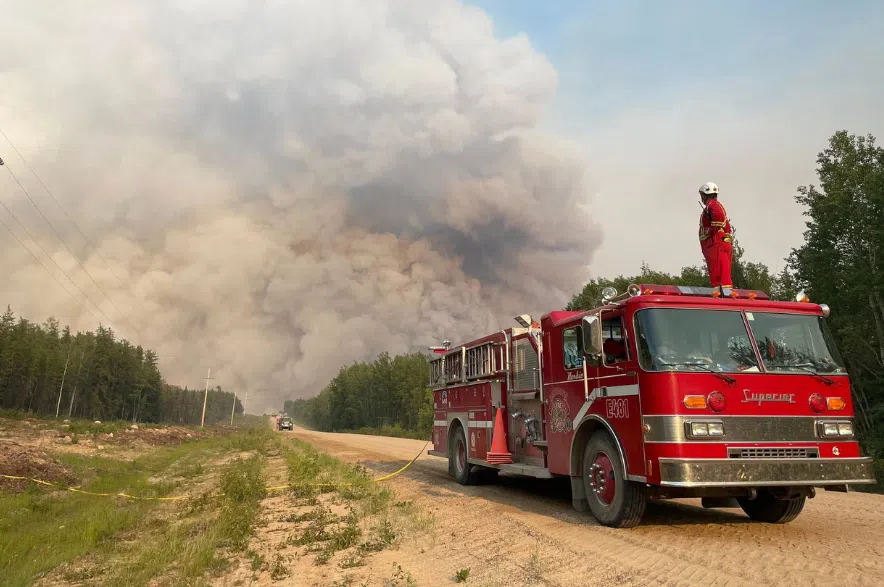
Saskatchewan’s premier says the province is committed to doing better after an independent review criticized the government’s response to the destructive 2025 wildfire season.
The review, conducted by accounting firm MNP, found that the Saskatchewan Public Safety Agency (SPSA) “was not fully prepared for a wildfire season of the scale and complexity seen in 2025.” The review included a number of recommendations which the province says it is working to implement, including a full review of the agency’s structure.
Speaking from the Eurosatory Exhibition in Paris, France, Premier Scott Moe said the report, which was released publicly on Friday, was impacted, in his mind, by the recent forest fire near his home community of Shellbrook.
Read more:
“There’s a process the government went through to ensure that we had an adequate response to that review, and a response that, I think, would provide some level of confidence in people that live in communities across this province.” Moe said.
“Largely, those communities throughout northern Saskatchewan do have the confidence that the government is taking action to ensure that our SPSA is always delivering a higher level of service and a more competent service… than we were able to last year.”
Moe said Saskatchewan faced “the most significant fire season that we have seen… in the history of the province” in 2025, which resulted in “some devastating loss of homes.”
He said the review was necessary in order the province to do everything it can to offer services at the highest level possible.
Moe pointed to a new provincial funding mechanism, the FireSmart Grant Program, which provides up to $40,000 to communities that obtain a FireSmart designation – listed under the report’s “immediate actions” to undertake – as a way to help communities take steps to prevent and control wildfires.
Wadin Bay, the northern Saskatchewan community where 22 people elected to stay behind and protect homes rather than evacuate during last year’s wildfires, was the first recipient of the grant.
“We want more communities to be prepared at that level,” Moe stated, adding that he hopes to see more communities working to receive that funding over the coming years, along with bolstered support between the province and local communities when responding to wildfires.
The premier said he would not comment as to whether there should be any resignations in response to the findings of the MNP report, but said there “needs to be an improvement in the level of service” within the public safety agency.
Any potential changes to the agency’s staffing, Moe said, wouldn’t necessarily be made by elected members of government.
In the coming weeks and months, Moe said the government will start to build on its initial answers and responses, as suggested in the report and by the province’s minister of community safety, Michael Weger.
“We can agree with individuals that faced those fires last year, in particular in places like Denare Beach, East Trout Lake, Creighton, that we need to do better, and this is a government that is committed to doing so,” Moe said.
“We wanted to ensure that we had some initiatives that came out of that initial response, but I think there’s more work to do.”
As examples, Moe listed actions like restructuring and expanding the public safety agency and working with northern and First Nations communities on firefighter and FireSmart training for years going forward.
Carl Neggers, CEO of Forest Saskatchewan, said the recent independent review into the Saskatchewan Public Safety Agency raises familiar concerns about how the province manages wildfire risk, particularly when it comes to protecting the broader forest resource alongside communities.
Neggers spoke on The Evan Bray Show on Tuesday.
He said one of the most significant issues identified is that wildfire management continues to operate in silos, with the SPSA too focused on community safety. Although this is important, Neggers argues there should be focus on preventing wildfires early before they get out of control.
“Its complete focus is on community safety, which is important, but it’s not the satisfying condition to address the impacts and damages that occur in wildfire,” Neggers said.
He pointed to a key recommendation that the SPSA review its mandate and structure, saying greater collaboration across ministries is needed, which could potentially include board representation beyond cabinet ministers to include industry and other forest users.
Nekers added that programs like FireSmart remain largely focused on protecting communities and that prevention needs to extend further into early wildfire suppression and landscape-level management. He warns that once fires grow large, community preparedness measures alone are often not enough.
“Currently, it is focused on community protection and preparedness against wildfire,” Neggers said.
He added that earlier, more proactive intervention, along with better coordination on forest health, could reduce wildfire severity over time. Neggers said the key is urgency in acting on recommendations before the next fire season.
“We just can’t afford not to address these things in an urgent way,” he said.
–with files from 980 CJME’s Abby Zieverink and Joshua Potter