Sarah Mills: Ending door-to-door is the future for Canada Post
Rural Sask. has picked up mail from shared mailboxes for decades. Now, it will be the same in some parts of in Regina an...
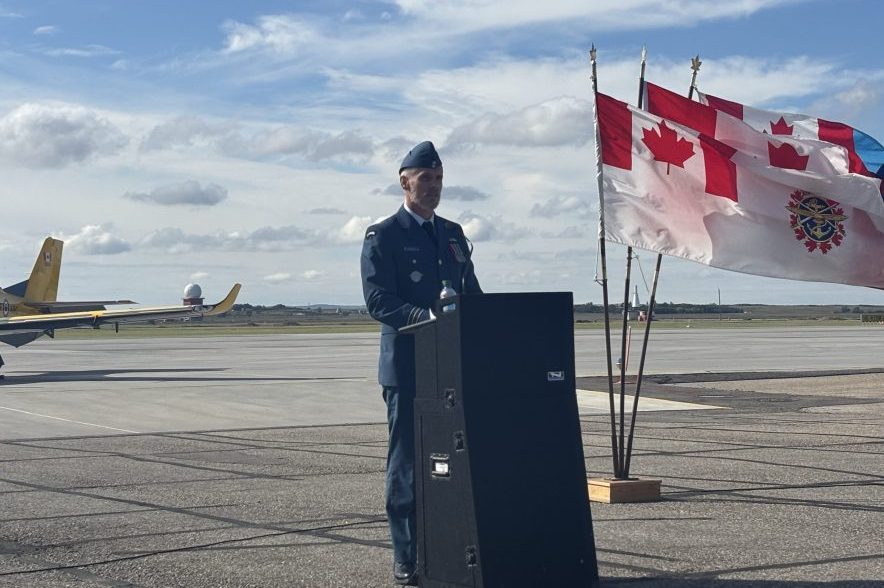
One by one, the names of 23 Canadians who never came home from the Battle of Britain were read aloud Sunday morning at 15 Wing Moose Jaw.
Uniformed members of the Royal Canadian Air Force, veterans, cadets, families and guests stood for two minutes of silence before aircraft passed overhead as part of a ceremony marking the battle’s 86th anniversary.
For the young pilots training at the Saskatchewan base, the ceremony connected the aviators who fought over Britain in 1940 with those learning to fly more than eight decades later.
Read more:
“It’s essential that we recognize them,” said Lt.-Col. Craig Cloete, acting wing commander at 15 Wing Moose Jaw and commandant of 2 Canadian Forces Flying Training School.
“Their sacrifice is important for our younger generation to remember, to keep their memory alive.”
The Battle of Britain was fought from July 10 to Oct. 31, 1940, as British and Allied air forces defended the United Kingdom against Germany’s Luftwaffe. It became the first major military campaign fought primarily in the air and a pivotal point in the Second World War.
Canadians flew with both the Royal Canadian Air Force and the Royal Air Force. The RCAF says it’s difficult to determine the exact number of Canadians who participated because historical sources use different definitions and arrive at different totals. All sources agree 23 Canadians were killed.
Cloete told those gathered Sunday that 117 Canadian pilots answered the call.
Saskatchewan also has ties to that history.
Squadron Leader Ernest “Ernie” McNab, from Rosthern, commanded No. 1 RCAF Squadron during the battle and was later awarded the Distinguished Flying Cross. Pilot Officer Camille R. Bonseigneur, from Gull Lake, was killed in action on Sept. 3, 1940, while serving with the RAF’s No. 257 Squadron.
WATCH: A look at today’s Battle of Britain commemoration at 15 Wing Moose Jaw, as the Royal Canadian Air Force marks 86 years since the historic Second World War battle. #RCAF #BattleOfBritain #Saskatchewan pic.twitter.com/zOPl8aqM2O
— Jacob Bamhour (@Jbamhour96) September 20, 2026
Those connections give the ceremony additional meaning at 15 Wing, Cloete said.
“We had Squadron Leader Ernest McNabb, who returned from the war, decorated a hero,” he said during an interview after the ceremony.
He also pointed to Bonseigneur, who was killed at just 22.
That age stood out to student pilot Rhea Panashtia.
“It’s almost unimaginable that someone so young could commit to something so much bigger than themselves.”
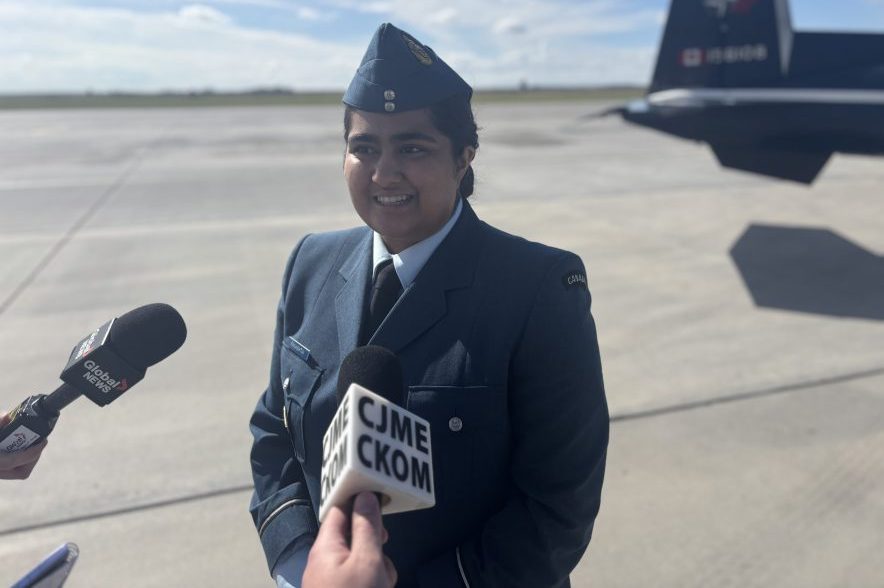
Second Lieutenant Rhea Panashtia, a student pilot at 15 Wing Moose Jaw, speaks with reporters following a ceremony marking the 86th anniversary of the Battle of Britain on Sept. 20, 2026. (Jacob Bamhour/980 CJME)
For Panashtia, the ceremony also offered a break from the day-to-day demands of learning to become a military pilot.
“When you’re in training, you really just think about the program,” she said. “You think about, like, ‘Oh, what’s my next flight? What do I have to do? The next mission.’”
That ceremony, she said, brought the reason behind the training back into focus.
“It’s nice to have ceremonies like this where you see the bigger picture. You remember why you’re here, why you’re in uniform, and to me, that’s a very special reminder.”
Panashtia said she has wanted to become a pilot for much of her life and joined Air Cadets at 13.
“I am working for Canadians. They have entrusted a huge responsibility on myself,” she said. “I am here for the greater good. I am here for Canada.”
Second Lieutenant Maxime Blouin, another student pilot at 15 Wing, served as master of ceremonies Sunday.
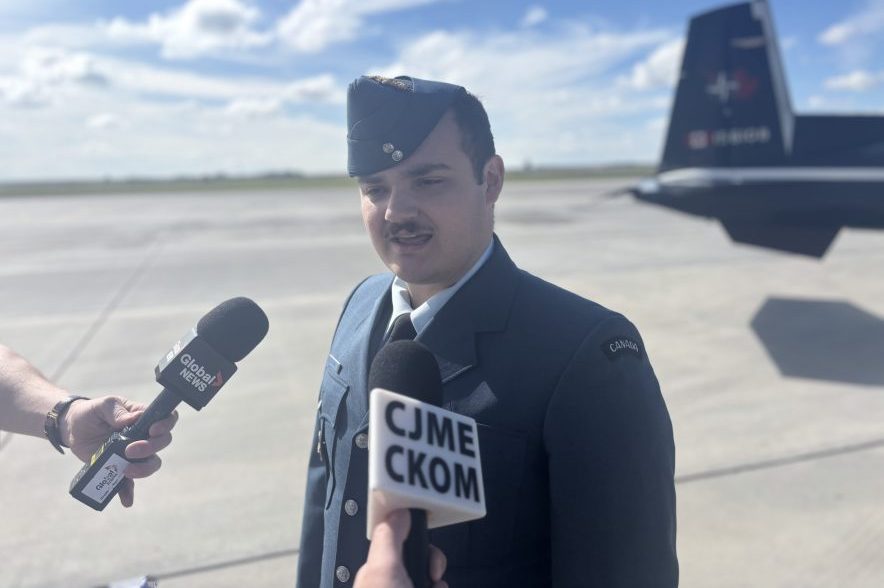
Second Lieutenant Maxime Blouin, a student pilot at 15 Wing Moose Jaw, speaks with reporters following the Battle of Britain commemoration on Sept. 20, 2026. (Jacob Bamhour/980 CJME)
Blouin said looking back at the pilots who went through their own training before being sent to war gives today’s students something tangible to draw from.
“This training on this aircraft — it can be really hard. It’s very demanding,” he said.
Knowing others went through similar challenges before serving their country gives that work a purpose, Blouin said.
“To know that at the end of it, there’s a country that needs us, and to have the opportunity to reflect on people that did the same thing,” he said. “They put in the effort, and then they got to serve their country and do something good. It’s really motivating.”
The biggest lesson he takes from those aviators is courage.
“We take danger in this job. We take a lot of risk, and it can be paralyzing at times,” Blouin said.
“It’s important to remember that it’s normal to be afraid. However, that still means we have to push forward. We have to do what the mission requires of us because there’s a lot of people that count on us.”
Sunday’s ceremony carried its own connection to Canada’s wartime aviation history.
The site that became 15 Wing was built as part of the British Commonwealth Air Training Plan during the Second World War and graduated more than 1,200 pilots for the air forces of Canada, Great Britain and New Zealand. Today, 15 Wing remains the RCAF’s centre for initial pilot training.
Cloete said the aircraft and technology have changed dramatically since the Battle of Britain, but some parts of being a military aviator have not.
“Obviously technology changes, but the physics of flying generally doesn’t,” he said.
“We have a lot more technology that aviators have to be aware of in the aircraft. But the core of that is the determination and the spirit of the aviators, and that’s what we work towards every single day here at 15 Wing Moose Jaw.”
That connection between generations wove through Sunday’s ceremony.
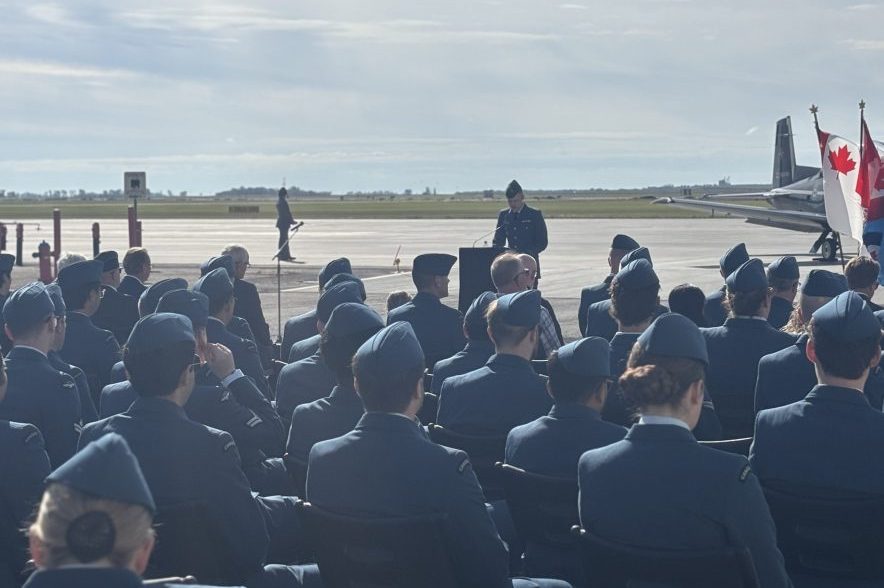
Members of the Royal Canadian Air Force and guests gather on the tarmac at 15 Wing Moose Jaw to commemorate the 86th anniversary of the Battle of Britain on Sept. 20, 2026. (Jacob Bamhour/980 CJME)
For Cloete, remembering that history is also personal.
“I come from a long history of military serving members, so it’s important on a personal note for me to remember them, all those that have passed,” he said.
He said he also wants the students training at the base to understand they are joining something that stretches far beyond their own time at 15 Wing.
“They’re not alone,” Cloete said. “There’s a long history and a proud history behind them.”
Read more: