


Murray Wood: It's getting better all the time
Even if it seems - as the rejoinder in the Beatles' song observed - 'it couldn't get much worse,' Murray Wood suggests w...
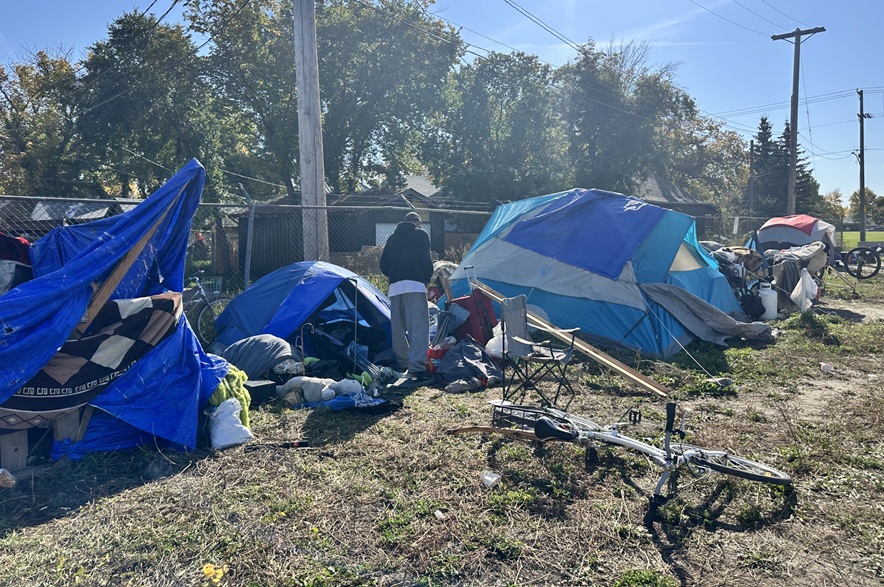
A judge has denied an injunction that would have prevented the City of Saskatoon from clearing an encampment at Avenue K and 20th Street in Saskatoon.
On Tuesday, Justice Richard Danyliuk decided to not grant the injunction requested by lawyer Crystal Fafard.
Read more:
Danyliuk’s decision outlined issues with standing, procedure and evidence. Fafard said she had tried to file two more affidavits related to the injunction on Tuesday morning, but those were both rejected.
The judge also noted that it isn’t the court’s position to intervene on a matter such as this one, instead indicating a desire to see other government authorities like the city and the province address the issue.
Fafard said she spent Tuesday at the encampment, and after the decision came down, she explained the decision to David Fineday, who is considered the leader of the encampment by some of those living there.
She shared that Fineday is now hoping to sit down with the city to discuss how to dismantle the camp in a safe way.
At a hearing at Saskatoon’s Court of Kings Bench on Monday, Fafard said she was requesting an interlocutory injunction rather than a permanent one.
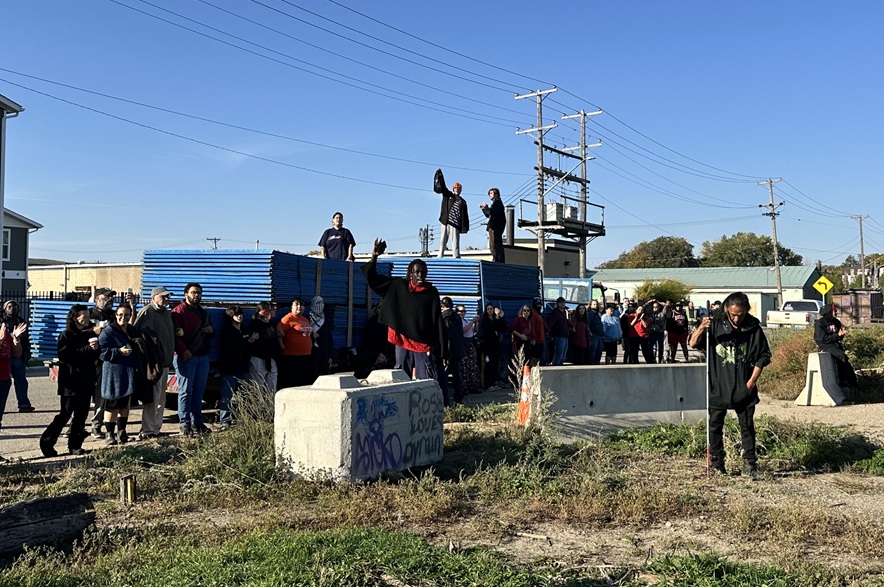
Protestors and people living in the encampment tried to stop fencing from being put up at the encampment located at Avenue K South and 20th Street West on Sept. 24, 2026. (Libby Gray/650 CKOM)
Fafard argued that the injunction should not be removed until housing was found for every resident living in the tent city in order to prevent irreparable harm. She said the injunction she was requesting was narrow, temporary and proportionate, and she was willing to allow for the city to take action to address its concerns about sanitation and safety at the site without dismantling the encampment.
The City of Saskatoon said that whatever the court’s decision, the city will decide on the appropriate next steps while working with community partners.
“The ultimate goal is to offer people supports so they can move along the housing continuum,” the City of Saskatoon said in an emailed statement on Monday morning.
Danyliuk, along with Alan Rankine, counsel for the City of Saskatoon and Noah Wernikowski with the Constitutional Law Branch of the Saskatchewan Ministry of Justice, raised concerns during the proceedings about insufficient evidence provided in Fafard’s application. Danyliuk noted Fafard was legally bound by the confines of the information that had been provided in her affidavit.
Fafard said the urgency of her application required her to complete it within hours instead of days, leaving her without sufficient time to include all the information she was hoping to. Fafard said she had also been trying to get an affidavit from one of the residents at the encampment, but that hadn’t happened.
“We had a very short time to pull this application together,” she told reporters after the proceedings on Monday.
“We brought public policy issues forward, and we’re hoping that the judge will look at those instead of, like, the four square corners of, you know, the rules of court,” Fafard said.
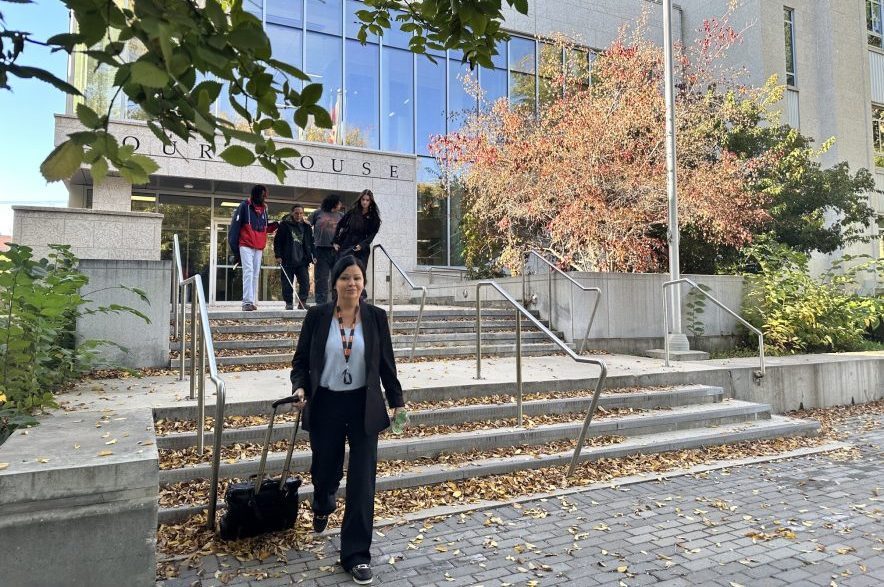
Lawyer Crystal Fafard leaves Saskatoon’s Court of Kings Bench on Sept. 28, 2026, after a hearing over an injunction to stop the removal of an encampment on Avenue K. Supporters, including David Fineday (second from left) walk behind her. (Libby Gray/650 CKOM)
She acknowledged that the hearing on Monday had effectively allowed for an unofficial one-week injunction already, as the encampment has remained in place pending the outcome of the court’s decision.
“We might get another 24 hours, but my point is, regardless of what the decision says, the city can do what they wish to do,” Fafard said.
Fafard said her suggestion is that the encampment’s residents and the city work together to find a reasonable solution to transition people into various forms of housing.
“It’s very reasonable. It’s very balanced, and it meets everybody’s needs,” she said.
During Monday’s hearing, Rankine noted in his submissions that the city owns the private property where the encampment is located, and has future plans for it. He said this, and the evidence of risk to the land due to the encampment, favours the city on a balance of convenience. He also noted that the community surrounding the encampment has raised concerns.
About a dozen people attended the proceedings on Monday, along with various members of the media. Fineday was in attendance and spoke after the proceedings.
“Sat in there for two hours, listened to a lot of stuff. I had to start crying halfway through,” Fineday told reporters outside the court as he commended the work of Fafard.
“She did a real good presentation, and then the city stood up, and none of them have a heart. None of them. Those lawyers, city council, the mayor – where’s their heart? How many people are they going to let die this year?”
Fineday told reporters that the encampment is on Treaty Six territory.
“I didn’t see no receipt that the city bought this off of us. If they can show me a receipt, then I’ll gladly move. But as of my position right now, I’m not moving. I don’t care if I have to go to jail,” Fineday said.
“I’m 70 years old. Why are they doing this to me?”
The homeless advocate said he didn’t have much hope for the injunction being granted after Monday’s hearing, though he expressed some gratitude for some of Danyliuk’s comments.
“When the judge was talking there, he did have a piece of heart there,” Fineday shared. “I could feel that when he was talking, but like I said, it’s his decision.”
An emailed statement from the City of Saskatoon on Tuesday afternoon acknowledged the decision from Danyliuk and said it appreciated the court’s consideration of the matter.
“The City’s approach to the encampment has consistently focused on connecting individuals with available supports and services while addressing significant health and safety concerns for people staying at the site, the nearby school, neighbouring residents, businesses and the broader community,” the statement said.
According to the city, it remains “committed to working with community partners to support vulnerable individuals to uphold its responsibility to maintain safe public spaces.
“We will continue to follow established encampment response processes and work closely with partner agencies to ensure supports remain available for those who need them,” the city said.