Sarah Mills: There is no interference in the U.S. midterm elections
The U.S. ambassador to Canada is telling Canadian politicians to stay out of American politics. Sarah Mills says that's ...
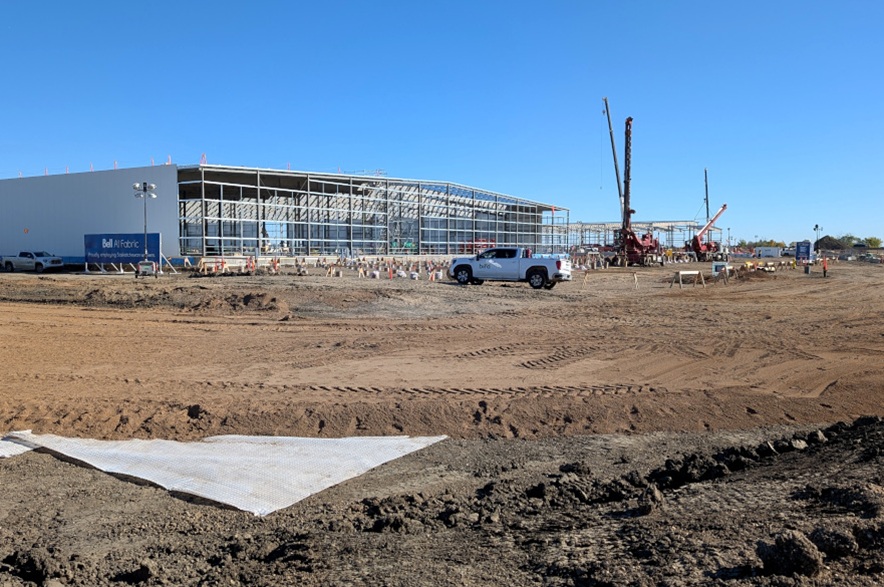
Regina city councillors narrowly approved a motion requesting reports from city administration on the potential impacts of Bell’s AI data centre.
The motion, jointly introduced by councillors Sarah Turnbull, Victoria Flores, Shobna Radons and Shanon Zachidniak, requests a report defining the city’s role, assessing the project’s impact on the city’s infrastructure and outlining options to protect the environment.
Read more:
It also requests ongoing consultation with the provincial government and the results of all environmental assessments related to the data centre.
Turnbull said the purpose of the motion wasn’t to provide reports for council’s benefit, but for the public’s.
“People have a lot of hopes and a lot of fears,” she said, “and they’re all justified and they’re all validated. When the community cares this much, there’s going to be a lot of interest, and that’s not a bad thing.”
The decision followed hours of debate and presentations from delegations. It also came after acting city manager Jim Nicol cautioned that regular reporting could mislead residents into believing Regina city council has a formal role in the project.
“When a report comes to council, there will be many people out there in the community who will conclude that council has a direct say in decision-making,” Nicol told council. “And I respectfully say, in this regard, you do not. This is a decision that is within the parameters of the R.M. of Sherwood.”
He also said future reports could open the door to additional delegations and a repeat of Wednesday’s discussion.
“That is your prerogative, to have as many meetings as you want,” he explained. “But we are getting into a very busy time of year, as you know. We have the budget coming forward, and at the end of the day, the decision is ultimately not yours to make.”
Despite his concerns, Nicol said Regina’s administration was prepared to address all the questions raised in the motion at Wednesday’s meeting.
“Whether your concern is ‘Are there going to be emissions in my air? Am I going to be OK?’ Or whether your concern is how many jobs is this going to build, the common denominator is that people just want to know what’s going on, and they want accountability and transparency, and that is what we did today,” Turnbull said afterward.
Administration said it could answer questions at the meeting, prompting concerns from some councillors about the time and expense involved in preparing a report. Turnbull said the goal was to provide official information to residents.
“I need administration to write it down on paper so that the citizens who are asking for it can see it and not get the information secondhand,” she said.
During their presentation to council, Dan Rink, president of Bell AI Fabric, and chief operating officer Jaethan Reichel announced that an information centre will open on Thursday at 2505 11th Ave. in downtown Regina.
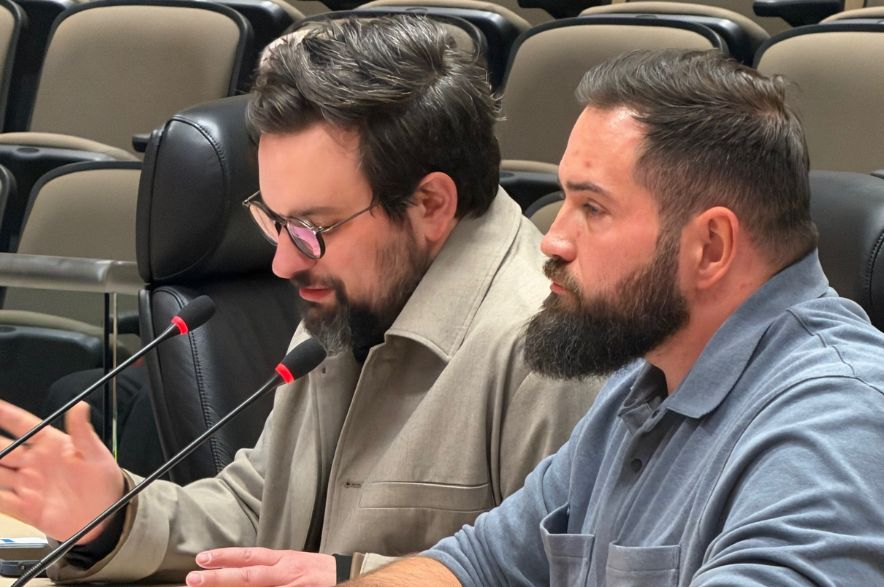
Jaethan Reichel and Dan Rink, of Bell AI Fabric, speak to Regina City Council on Oct. 14, 2026. (Geoff Smith/980 CJME)
The Bell representatives addressed a variety of concerns about the data centre project, and noted that the project has the support of neighbouring landowners.
“We consulted with all of the neighbours. We followed all of the regulations,” Rink said. “At this point, you could go to the 14 most proximal neighbours, and I think they would tell you they all like us. They’re engaged. They all personally have my cell phone number.”
Rink and Reichel described the facility as a “marquee campus,” and said the 100 head-office jobs that the data centre is expected to create would be based in Regina, ideally downtown.
Regarding the data centre’s cooling system, which has been a source for concerns from the public, Rink said it would use a mixture of ethylene glycol and purified water. The water would be obtained from a third-party supplier that had not yet been selected.
Responding to concerns about noise, Rink said millions of dollars are being spent on sound attenuation, with each generator housed in an enclosure designed to meet a standard higher than required by local bylaws.
Turnbull drew attention to the on-site power generation that two buildings at the centre will require. Rink explained that the amount of generation falls below the threshold requiring a separate application. However, he said, a final permit will be required before the generators could be turned on, and air-quality modelling is underway.
One component of the data centre plans that fell within the city’s control was a requirement for a concept or secondary plan for development within the zone known as the Collaborative Planning Area.
In January, the city informed the R.M. that it had agreed to waive that requirement for the rezoning. The city also said it intended to update the Official Community Plan to allow such a waiver in unique circumstances, or for developments with “broader economic benefits.”
Administration told council on Wednesday that it had determined a secondary plan was unnecessary because the rezoning involved a single user on a single site, with no subdivision of the land required.
Turnbull said council did not learn about the waiver until the R.M. of Sherwood made the zoning application public. She announced plans to introduce a motion at the next council meeting to amend the policy and require council approval for such waivers, citing the possibility of “unknown effects,” including the need for on-site power generation.
“That was part of the waived approval, which we weren’t part of, and that waived approval did have a future power station are on it, and all this information, but it wasn’t clear to many people, including many city councillors and myself, that there was on-site power happening so close to our borders until this motion came out,” she said.
The discussion began with Mayor Chad Bachynski recusing himself “out of an abundance of caution.”
“I sought some independent legal advice after receiving feedback that there were concerns that I may have a perceived conflict,” Bachynski said during the meeting.
In a statement, the mayor’s office said the recusal was related to Bachynski being on a leave of absence from SaskEnergy, which may have a role in supplying natural gas for the data centre’s power generation. The mayor’s office explained that a leave of absence is considered an employment benefit.
“Upon becoming aware of the potential perception of a conflict, the Mayor proactively sought advice from the Integrity Commissioner and independent legal counsel,” Bachynski’s office said. “Given the timing between receiving the concern and obtaining comprehensive guidance, he determined that recusal from today’s discussion was the most prudent course of action.”
Bachynski’s office also said he would take some time to better understand the potential conflict.
Speaking to reporters after the meeting, they mayor said he did not expect his recusal from Wednesday’s meeting to have an ongoing impact.
“This is a pretty remote connection, obviously, but I just want to make sure that I’m doing my due diligence and making sure I get proper guidance, so that way, for future discussions, I have the right approach,” Bachynski said.
Ward 4 Coun. Mark Burton also recused himself. He explained that he works for one of Bell’s competitors and data centres are his field of expertise, creating the potential for a perceived conflict.
In response to concerns about the waiver of a secondary plan, Bachynski said he felt the process had worked as intended, with authority delegated to Regina’s administration.