


Sarah Mills: There is no interference in the U.S. midterm elections
The U.S. ambassador to Canada is telling Canadian politicians to stay out of American politics. Sarah Mills says that's ...
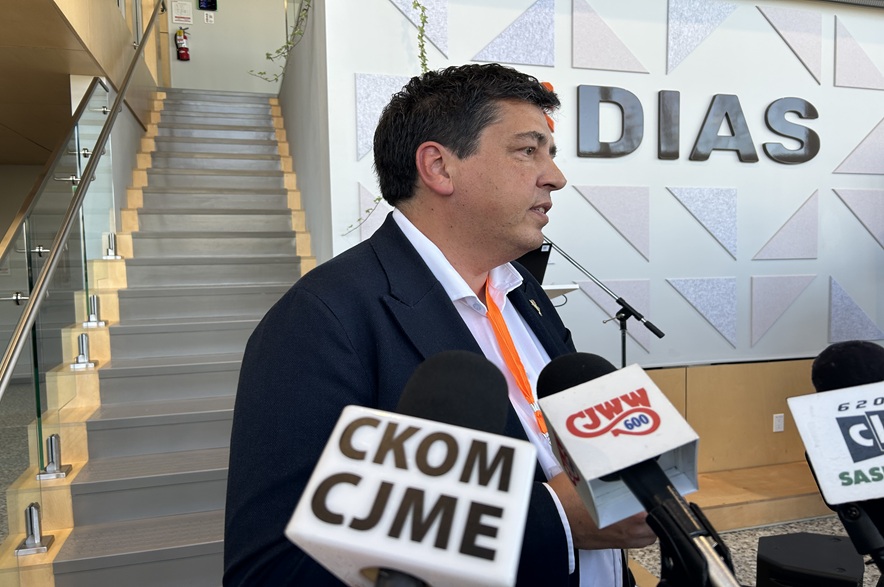
A Saskatchewan-based company is making big changes in mineral exploration.
DIAS Geophysical, based in Saskatoon, has unveiled two new technologies: the DSTX (Deep Search Transmitter) and QAMT (Quantum Airborne Magnetotellurics), adding to its lineup of mineral exploration equipment.
Read more:
The DSTX is a deep mineral exploration transmitter. It aims to deliver 2.5 times the power of other transmitters, enabling deeper, more efficient surveys and more accurate models while reducing emissions.
Designed for larger-scale operations, the DSTX’s increased power allows for deeper target investigation, faster identification of prospective mineral systems and better-informed exploration decisions.
Glenn Chubak, president of DIAS, said the technology represents a significant advancement in the field.
“The DSTX expands an existing technology with much more power, allowing us to image deeper and more rapidly. Essentially, this is a system that can detect things like copper, not directly, but find copper deposits. It can find lithium and all sorts of mineral deposits. We have the measurement side of this, but we haven’t had the power to really push into the ground to create the response. The DSTX allows us to extend what we’re doing with greater depth and better resolution,” he said.
The first commercial deployment of the DSTX is expected to take place Oct. 16.
The QAMT uses naturally occurring electromagnetic signals generated by solar and atmospheric activity to create images at depths exceeding one kilometre.
Developed in partnership with German technology company Supracon AG, the device is carried over terrain by helicopter and uses Supracon’s SQUID (superconducting quantum interference device) sensor to survey large areas.
“The QAMT system is entirely new. We have nothing in this space already, but it allows us to rapidly detect mineral deposits from an aircraft. It’s really great for things like iron ore and nickel, these highly conductive, high-value targets, and allows us to do that from the air because of the really cool quantum technology that Supracon has developed for us,” Chubak said.
The first commercial deployment of the QAMT is expected within the next 30 days as the team awaits additional parts from Germany.
Chubak said both technologies are expected to have a significant impact on mineral exploration.
“Finding drill targets faster, but also not drilling all of the targets. If you do a better job with imaging to start, you don’t have to drill all the holes. Drill holes are very expensive. They have an environmental impact and take time to complete. If you can skip that process because your imaging is better, you’ve shortened that exploration cycle and created value throughout the process,” he said.
Chubak said growing demand for critical minerals has helped propel the company forward.
“The demand for critical minerals is absolutely driving our success at the moment. Companies are seeing commodity prices increase significantly. Copper, uranium and many others are sitting at record levels, and that is absolutely driving demand. Those materials are primarily going into things like the electrical grid, EVs and power generation,” he said.
“It’s fuelled our growth. It’s been the tailwind. Even before the recent increase, DIAS was an expanding company based on our technology advantages. But DIAS’s growth right now has been supercharged by the demand for critical minerals,” Chubak said.
He expects the company to experience significant growth over the next five years, with both its workforce and revenue doubling.