


Murray Wood: No means no, unless you're a separatist
Murray Wood says the Alberta referendum results were pretty clear, but for many of those who think Alberta would be bett...
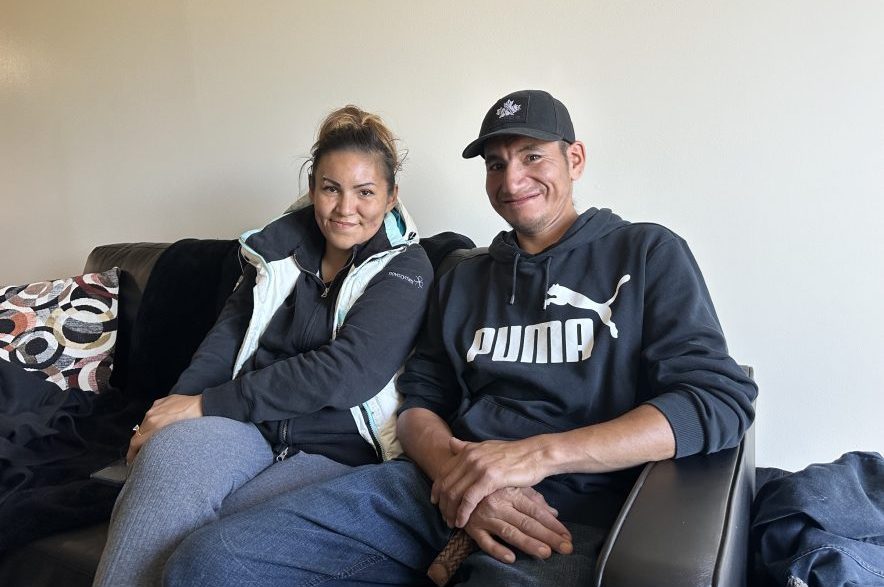
It’s been two weeks of better sleep, warmer nights and a new routine for a couple who recently moved from a tent in Saskatoon’s Avenue K encampment into an apartment of their own.
Genine Okanee and Tyler Rabbitskin have been together for the past seven years. They met on Okanee’s birthday. Both had moved to Saskatoon from their home communities – Thunderchild First Nation for Okanee and Big River First Nation for Rabbitskin.
Read more:
While shopping for a new apartment might come with a wish list of features for a typical couple, Okanee and Rabbitskin are grateful for some much more basic perks of their new place.
“We can actually leave stuff without getting stolen,” Rabbitskin shared.
“If it’s raining, we’d have to go back home and … our stuff would get all wet.”
Okanee described having a place of their own as “still kind of unreal” and something she’s still getting used to, after spending the past two years on the street. The two have found shelter around the city, including at the Gordie Howe Campground, the Central Urban Métis Federation Inc. (CUMFI) and the Avenue K encampment.
Okanee said they were constantly worrying about whether the things they owned would still be in their tent whenever they left.
“We couldn’t lock our tent because the zipper was broken,” she explained.
Moving from a tent to a two-bedroom apartment all for themselves is an adjustment, but a positive one for the couple. Okanee shared that she used to get angry and frustrated a lot when they were on the streets.
“It was, like, ruining our relationship, too,” she said. “It was hard.”
“Being in a place now that we have for ourselves is like way better, and we don’t have roommates,” she said. In the past, the couple has shared living space with friends they thought they could trust, which Okanee said ended up not being the case.
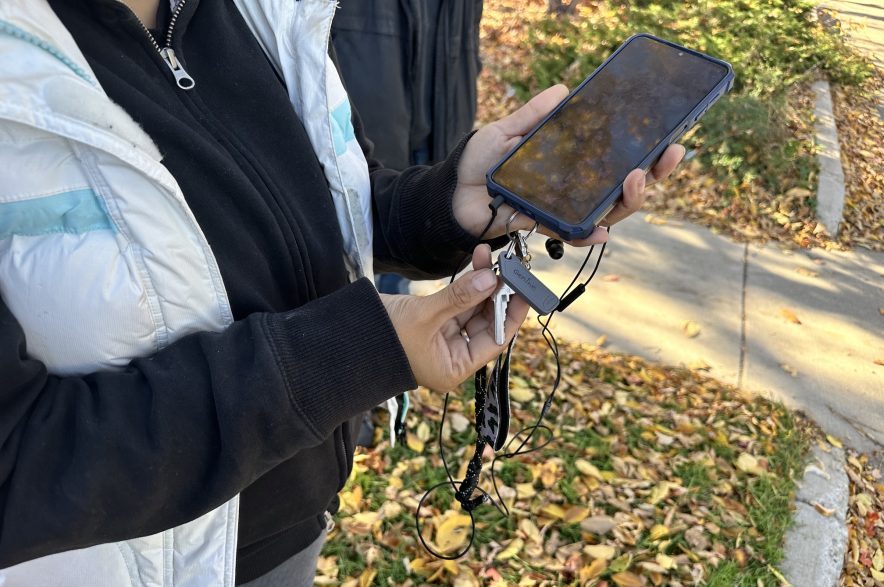
Genine Okanee proudly shows off the fob to her new apartment after spending the past two years living on the streets of Saskatoon with her partner. (Libby Gray/650 CKOM)
To stay in their apartment, Okanee and Rabbitskin both need to complete programming twice a week – classes, of sorts, about things like budgeting, housing, Alcoholics Anonymous and Narcotics Anonymous. As long as they can keep up with that, the couple can call their suite home for as long as they want.
Okanee said the programming has been one of the more difficult aspects of their move.
“There’s been so much happening for these past few weeks, like with the encampment and then here, and you know we’re still adjusting,” Okanee said. “But hopefully soon we’ll get everything in line, and it’ll be easier by then.”
Despite leaving the encampment about a week before it was cleared, Okanee said it’s been hard on them, watching their friends and fellow homeless community deal with the closing of the encampment. They were visiting the site even after they’d moved into their new home, and helped many of their friends pack up their belongings as the property was cleared on Oct. 8.
“I helped build that encampment with Dave (Fineday) and Tyler, and so it had a really big effect on me. Because I made a lot of new friends, and you know, and I was happy just keeping everybody together and in one place, and knowing that they were safe. So then seeing it being cleared out, it just was like a lot,” Okanee shared.
“We always gotta be out there,” she said. “I can’t stay home, even though we have, like, our place of our own now, but I still gotta be out there and be checking on people.”
Rabbitskin said they always knew they were ready for their own place, though.
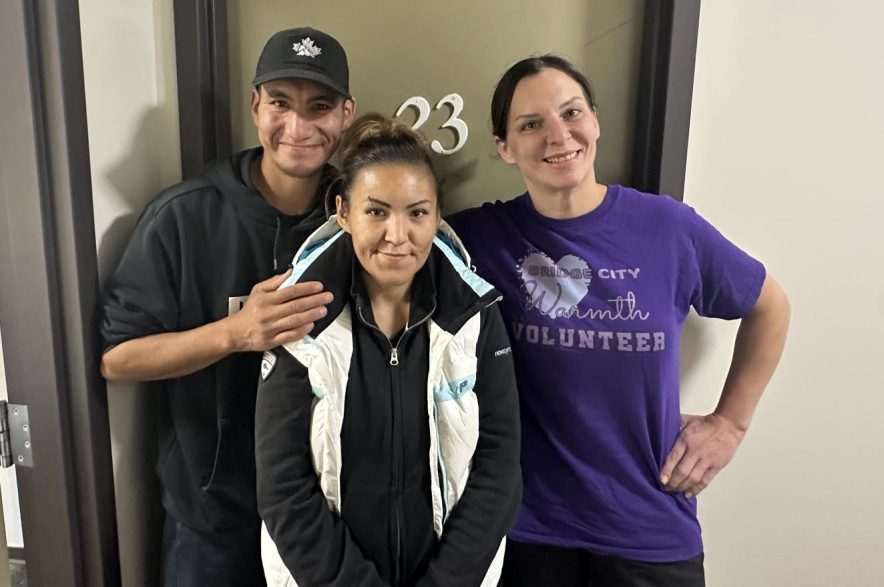
Tyler Rabbitskin (left) and Genine Okanee (middle) stand in front of their new apartment suite alongside Melissa Zimmer (right), founder of Bridge City Warmth, who helped the couple secure the housing. (Libby Gray/650 CKOM)
The two had lived in a home previously in Saskatoon for four years, until they said their landlord was deported. After that happened, they said they were evicted and the person who bought the property tore down the house.
Rabbitskin said they lost many sentimental possessions and many cats they kept as pets when they were evicted. For a time, the couple paid to store some belongings, but the price for that kept climbing until it was unaffordable.
“So we lived outside,” Rabbitskin said.
“It was hard trying to get a place by ourselves. Like applying for places,” Okanee explained, “there’s always something that there’s always a roadblock with that, and like sky-high rent or the three times you got to be making three times the rent.”
Rabbitskin had spent about two decades renting from his landlord before he was sent away, and had worked for him doing things like framing houses and painting. Okanee joked that Rabbitskin could have built them a house.
He’s hoping to find work in that area again, while Okanee wants to work to help others who are still homeless.
“That’s like, a passion of mine is trying to help the homeless, and I really care about that and (it’s) something I want to do,” she shared.
Now that the couple has a home, Okanee is also excited for her four children – who are currently in the care of social services, she said – to come and visit. She’s hoping to regain custody one day.




