


Evan Bray: Diversifying trade doesn't mean abandoning U.S. relationship
Evan Bray says there's nothing wrong with Canada looking for new trade partnerships, but the idea of joining the Europea...

The Sask. NDP stood to call for the Bell AI data centre expansion outside Regina, and other projects, to be stopped a day after Premier Scott Moe stood with the prime minister and head of Bell to announce it would quadruple in scope.
NDP Leader Carla Beck said a moratorium should be put in place for the data centre expansion, as well as any new AI data centre projects, until the provincial government answers several questions she said remain outstanding.
“Without these questions answered, I don’t think we can answer the very basic question: is there value for the people of this province?” said Beck.
Monday’s announcement outlined how the Bell AI data centre would go from the originally announced 300 MW project to 1.2 gigawatts. With the expansion, permanent full-time jobs at the facility would rise from 80 to 500, and Bell plans to build its AI infrastructure hub on the same campus.
A couple of hours after the announcement, the NDP’s technology, innovation and AI critic Brittney Senger released a statement with a list of questions she said still needed answering; however, some of them already had answers.
Bell said the project won’t use any local water except for fire suppression systems and normal building use, like washrooms. It will use a closed-loop water system for cooling, along with air-cooled heat rejection, which doesn’t require refilling or changing out.
The 900 MW of power over and above the original project will be built and provided by Bell. Its website said it’s working with SaskPower, SaskEnergy and TransGas on the natural gas energy system, and an experienced partner will manage it.
However, on Tuesday, Beck said questions remain about those things. She said a 900 MW privately produced power system is unlike anything we’ve seen, and it’s unclear how that would work. SaskPower’s current largest natural gas power facility is 528 MW; its largest power plant of any kind has a capacity of 582 MW.
She also said it’s unclear where that natural gas will come from, and whether demand for a 900 MW power station will increase natural gas prices and, therefore, prices for SaskEnergy customers.
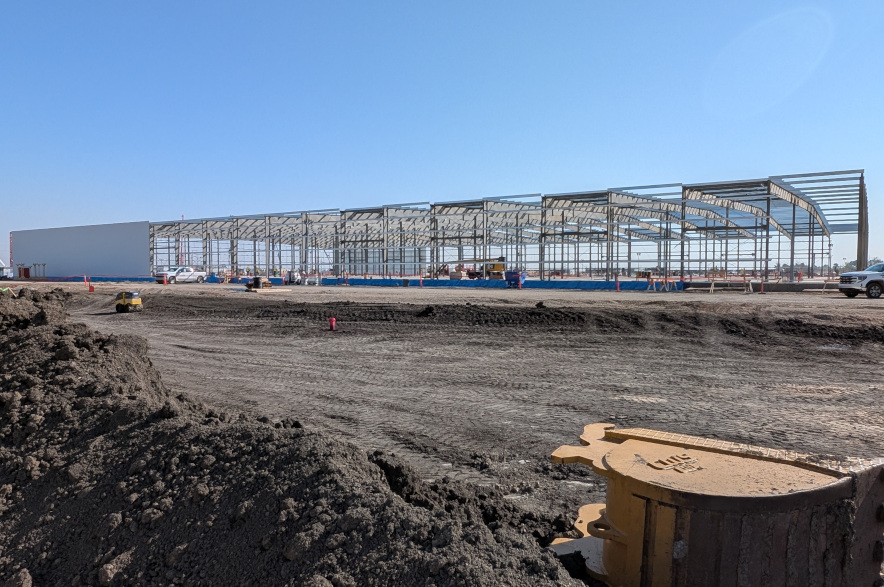
Construction continues on the Bell AI data centre outside Regina. Aug. 27, 2026 (Lisa Schick/980 CJME)
Beck said there are questions about the project’s environmental impact; no environmental impact assessment was done on the original project, and it’s unclear whether anything has been done or will be done for the expansion.
She said it’s also unclear what the criteria are for approving or rejecting a project. The provincial government released its six-point framework last month, but Beck said that framework isn’t good enough.
“There’s more regulations to set up a lemonade stand in this province right now than it seems to be to build an AI data centre. I don’t think that passes the smell test for most people,” said Beck.
The NDP leader wants the government to sit down, answer questions, and listen to people’s concerns. She said the NDP has done town halls about the data centre, while the government has not.
“This government was not given a mandate to govern without question, without providing answers to the people of this province, and I think that the thousands and thousands of people who have already voiced concerns about this project, already put forward questions, deserve to have those questions answered,” said Beck.
When the provincial government was asked to respond to the NDP’s allegations, it declined to respond, instead pointing to a video the premier posted on social media that repeated the same points raised in Monday’s announcement.
The government also declined to provide the premier or a minister to answer questions about the expansion, saying it had “no further comment at this time.”
Home ice matters.
— Scott Moe (@PremierScottMoe) September 15, 2026
The new Bell data centre near Regina is the largest capital project ever in Canada and will create thousands of good paying jobs.
But it's much more than that.
It's about building to protect Canada's data sovereignty, our destiny and our future.… pic.twitter.com/5j7IkOC1Bv
While some have concerns about the expansion, others fully support it.
Michael Kram, the Member of Parliament for Regina—Wascana, said the project is exciting, especially given the jobs and career opportunities it will bring.
“I was very excited to see that Bell Canada will be making Regina its head office for its national AI initiative. As a graduate of the University of Regina’s computer science department, I’m very excited to see these IT jobs coming to Regina and coming to Saskatchewan because I remember back when I was going to school that was a very rare occurrence. It used to be that people had to move away from Saskatchewan to find these high-tech jobs, and so it’s great to see it going the other way now,” he said.
“It’s the knowledge economy that future generations are going to be living in and working in. So, if those career opportunities are available here in Saskatchewan, that’s just excellent news. So, we don’t have to move to Alberta. We don’t have to move to Ontario. We can have our careers and have a high quality of life right here in Saskatchewan and have exciting career opportunities at the same time,” Kram added.
When it comes to why Bell Canada chose Saskatchewan, Kram believes it’s simple.
“I think Scott Moe and the provincial government deserve a lot of credit for doing a lot of things right in this province. We have developed our natural resource sector, and I understand that Bell will be required to build a natural gas plant to power this facility. We have a skilled and highly educated workforce, thanks to our universities and Sask Polytech, and we’ve been investing in infrastructure over the years. So I think all of the stars have aligned to make Regina and Saskatchewan the best place for this AI data centre, and I’m excited about future opportunities in this field that will be coming down the road,” he said.
As for some of the complaints surrounding the facility, Kram said he has heard it all before.
“I have heard similar concerns over the years about literally every major infrastructure project and every new technology that has ever come online. New technologies are the future. We can’t be stuck in the past, and so we do have regulations in place to make sure that the environmental impacts are mitigated, and we do have a tremendous opportunity here, whether it’s medical research or other new areas that have not been explored yet. There are all kinds of opportunities, and the benefits by far outweigh the costs,” he said.
“If we do not build our economy here, then our skilled workforce will only move elsewhere to pursue these opportunities. So I would caution against slamming on the brakes of a major project like this,” Kram said.
-with files from 650 CKOM’s Roman Hayter