

Sarah Mills: Birthdays bring a sense of wistfulness and nostalgia
Sarah Mills says getting older isn't for the faint of heart, and turning a year older can make a person think about youn...
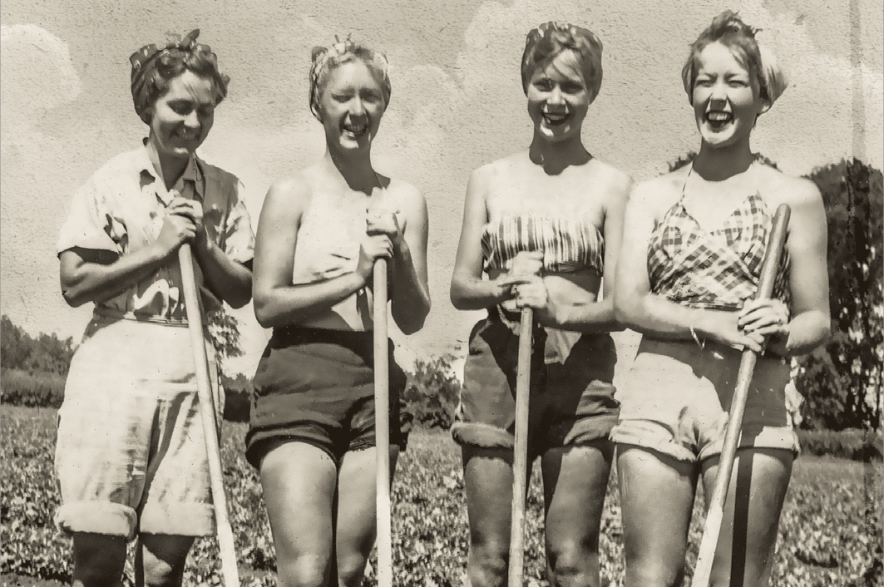
With Remembrance Day coming up, we want to remember those who served overseas. But what about the people who kept things going here at home?
Historian Kelsey Loney studies Saskatchewan women, agriculture, and animals during the Second World War. She has written a book, A Vacation for Victory, and talked to Jenn Dean about how home front history is military history.
Read more:
A Better Life with Jenn Dean can be heard every Sunday at 3 p.m. on 980 CJME and 650 CKOM.
This transcript has been edited for length and clarity.
JENN DEAN: Can you tell us about the Women’s Land Army?
KELSEY LONEY: I grew up on the stories of my grandma. She would tell me stories about the Great Depression in Saskatchewan, the Second World War, and one of my favourite stories was to hear her talk about her time being transported by train to British Columbia to pick fruit for the war effort.
I didn’t know much about this programme until after her death. I heard about the Farmerettes of Ontario — women who worked on farms when men were away — and I thought that sounds pretty similar to what my grandmother did.
It turned into an entire master’s thesis on the topic. I found that there was a whole mobilisation of female farm labour during the Second World War under the Dominion Provincial Farm Labour Service Programme that moved women into areas where labour was needed most to work on farms in those communities for short periods of time, almost like almost like a blitz of female farm labour.
JENN DEAN: Was the Women’s Land Army a national or provincial programme?
KELSEY LONEY: It was shared financially, but it was left up to each province to administer as they saw fit, so only British Columbia and Ontario really took advantage of the programme, pulling women from all across Canada to take part.
There would be an advertisement in the newspaper that said, “Come take a vacation on a farm somewhere and work for victory.” That’s where the title of my book comes from.
A lot of these women did see it as a vacation. I look at how Prairie women, who were so exhausted from the Great Depression and drought and hadn’t seen fresh fruit in a really long time, suddenly had a free train ticket somewhere where fruit grew and there was lush greenery.
It almost sounded like the Garden of Eden, and often they were being paid for labour that they were doing for free at home.
I don’t think it was much of a vacation. They worked about 12 hours a day with a short lunch break. They were transported to the fields each day, but there was a sense of unified purpose in it.
Most women did know somebody who was serving overseas, and they saw it as an opportunity to do their part. We forget about how Canada contributed to this notion of total war where everybody had a part to play, everybody was mobilized in some way, shape, or form.
And with 400,000 men off the farms by 1943, women really needed to step up. They had no choice. They’re were now doing roles that previously were considered too hard for women.
We always talk about women in factories or working jobs that were totally new to them, and it was seen as this liberating time for women. But farm work was not that liberating. Women have been working on farms forever, but now they were doing it with less help, longer hours, and after the war they were expected to just continue. And nobody really said thank you for this service.
Once the men came back, the women were kicked out of the factories and told to go back home. But on the farm, it was ‘Oh, now we know how hard you can work. We’re going to keep this going.’
They may have returned to where they were before the war, but not to who they were. They were changed.
JENN DEAN: All of a sudden there were moms out there looking after the land, feeding the animals. What were all the kids doing?
KELSEY LONEY: Children were working alongside their parents, especially on farms, and that was not new.
In British Columbia, where there was a significant labour shortage for female farm labour, they were relying on children more than they had been.
There were no men around, and there was some pretty distinct racism towards others who might be able to do the work.
With the removal of Japanese Canadians from British Columbia, they used a large number of children in 1943 on farms. This was a warning flag to reach out of province and say maybe we should pull some women from the Prairies because we’re not finding the women we need within British Columbia.
JENN DEAN: What were the Prairie women doing?
KELSEY LONEY: All manner of farm labour but specifically picking peaches, apples and cherries, planting, harvesting, selling things at stands, and working in canneries.
JENN DEAN: If these women grew up in Saskatchewan on a farm, they would already know how to do a lot of this? There wasn’t a lot of training needed?
KELSEY LONEY: A lot of women enjoy working outdoors under the big blue sky. Not every woman wants to work in a factory, so this was an opportunity for women who wanted to serve on the home front, get away from home for a little bit, but do something that they already enjoyed doing or knew how to do.
JENN DEAN: What was it like for these Prairie families? Mostly men, but some women were serving overseas. Not just as a nurse; they were serving?
KELSEY LONEY: There were women in the Army, Navy, and Air Force for Canada at home and overseas. Not in combat roles, but support roles.
JENN DEAN: What was life like for them when they came home?
KELSEY LONEY: I think we would like to hear that everything was great and that folks came home and hugged their loved ones and had a happy life, but we know that that’s not true.
War is complex, and just because there is a day of victory doesn’t mean that there isn’t a lot of rebuilding that happens. A lot of men and women came home and met children that maybe they hadn’t seen since they were one, and now they’re five.
Or they came home unrecognisable after being in a prisoner of war camp, or unrecognisable mentally. Maybe they were a different person after returning home. Coming home comes with arange of emotions. I think everybody came home changed.
I think a lot of people would agree that their relatives didn’t share any stories, and they were lucky if they heard little tidbits.
Or maybe they were the person that they did share with, and and feel very honoured that those stories were shared. Those are are special stories that don’t come easy, and a lot of men and women didn’t necessarily want to talk about it.
JENN DEAN: What do you think it means for people now to go to Remembrance Day ceremonies. Do you think it is still as important to veterans as it was that the whole community shows up?
KELSEY LONEY: Some choose to celebrate at home quietly. My grandpa never wanted to wear his medals from the Second World War. Everybody reflects on Remembrance Day differently, so I don’t think there’s a wrong way. But to wear a poppy or to attend a service, it shows that those stories matter. That you are taking time off on a day that you don’t have to work to show up for something bigger than yourself.
I have a website wlacanada.org where people can check out what the Women’s Land Army is all about.
Read more: